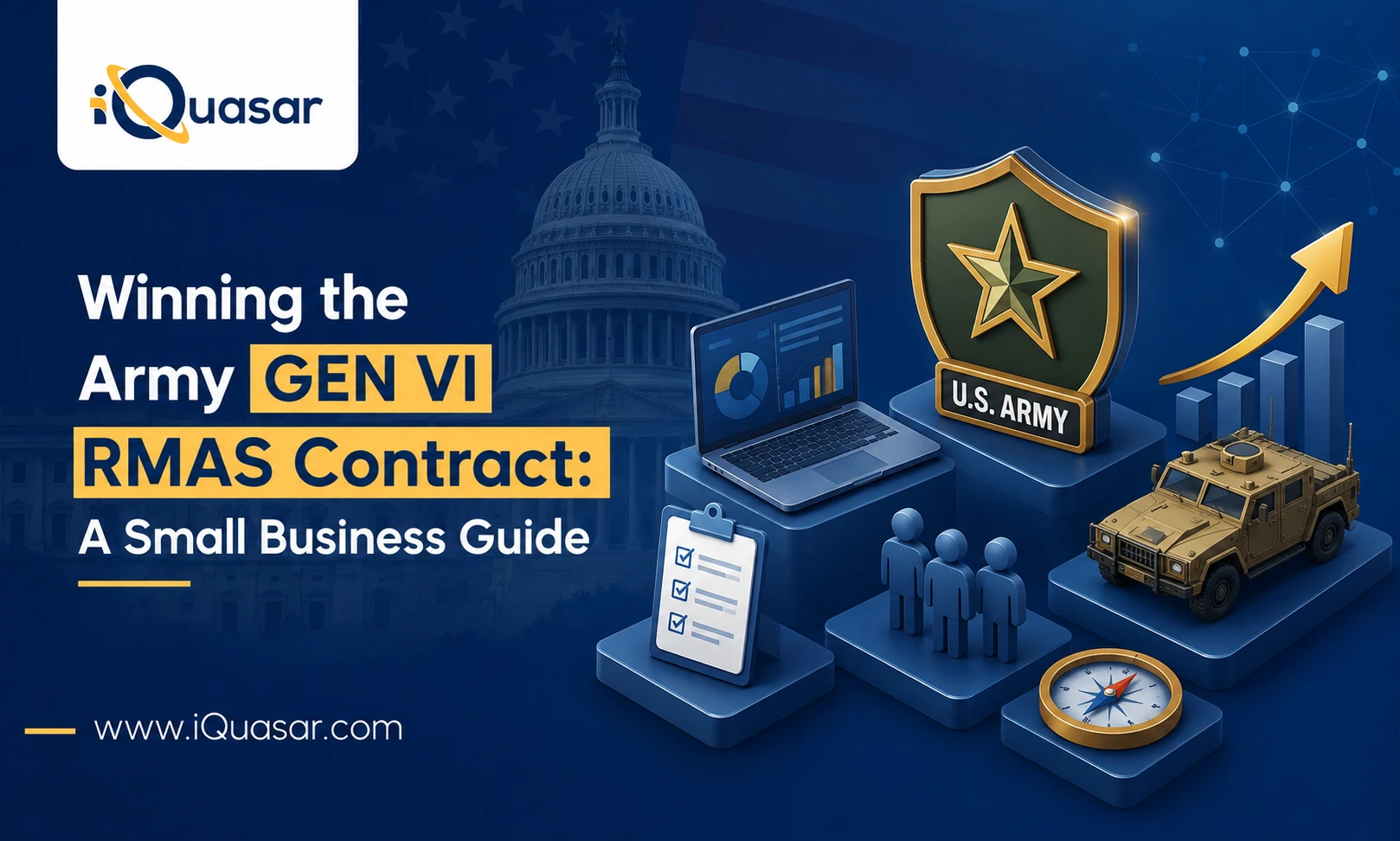
A $1.52 billion, 100% small business set-aside contract supporting Army recruiting, personnel management, and administrative operations across the United States and OCONUS locations represents one of the most significant opportunities in the current federal government contracting landscape for small businesses in the human resources and program support space. The Army’s GEN VI Recruiting, Management, and Administrative Support contract, commonly referred to as RMAS, is the successor vehicle to an established contract family that has sustained Army recruiting and HR support operations for years. For small business contractors in NAICS 541612, Human Resources Consulting Services, and adjacent professional services domains, understanding how to position for this vehicle before the solicitation is released is the difference between a competitive proposal and a reactive one. In this blog, we explore the contract’s structure, core service requirements, capability alignment strategies, and the long-term positioning work that separates firms that win a seat on GEN VI RMAS from those that submit and lose.
Understanding the GEN VI RMAS Opportunity
The GEN VI RMAS contract is the Army’s primary vehicle for acquiring recruiting support, retention program management, human resources administration, data analysis, and related professional services across the Army enterprise and select DoD components. The contract’s $1.52 billion ceiling reflects the scale and duration of the requirement this is a long-term, ten-year vehicle designed to sustain mission-critical personnel operations that the Army cannot interrupt or allow to degrade.
The 100% small business set-aside designation makes GEN VI RMAS one of the most consequential small business contract opportunities in the DoD space. It eliminates large business competition entirely from the base contract award, creating a competitive environment where small businesses with genuine capability compete against each other rather than against large defense contractors with substantially greater resources and proposal infrastructure. That designation also reflects a deliberate Army policy decision: the service has determined that the market for RMAS services is sufficiently developed within the small business community to support full set-aside competition. Firms that understand this context approach the pursuit differently than they would approach a partial set-aside or an unrestricted competition. According to SAM.gov, the solicitation and all associated documents will be published on the federal procurement portal, and firms should actively monitor the opportunity before the RFP is released.
Aligning Your Capabilities with RMAS Requirements
The GEN VI RMAS scope encompasses a deliberately broad range of professional and administrative service categories, which means capability alignment is not a simple exercise in matching your firm’s existing service lines to a single requirement type. Recruiting and retention support is the anchor capability; contractors must demonstrate experience supporting military or large-scale civilian recruiting programs, managing retention initiatives, and conducting data-driven analysis that informs recruiting strategy and resource allocation. Program management capability across complex, geographically distributed service delivery environments is equally central to the requirement.
Beyond those anchor capabilities, the contract scope includes data analysis and reporting, administrative services, technical writing and documentation support, event planning and coordination, and public relations support for recruiting mission activities. Firms that have historically focused on one or two of these service areas need to honestly assess whether they can credibly deliver across the full range, either through existing internal capabilities, key personnel with relevant backgrounds, or teaming arrangements that fill documented gaps.
The NAICS 541612 designation establishes the primary competitive framework, but firms should also review their registration under adjacent codes that may be relevant to specific task order categories within the vehicle. SAM.gov entity registrations should reflect the full range of applicable NAICS codes before the solicitation is released, as corrections made after RFP publication carry less credibility than registrations that were already current.
Building a Strong Past Performance Foundation
Past performance evaluation on a vehicle like GEN VI RMAS will be rigorous and directly correlated to the scope categories the Army has defined. Relevant past performance means contracts that demonstrate experience in recruiting support, HR program management, workforce administration, or related professional services at a scale and complexity that reasonably anticipates the RMAS task order environment. Federal contracts in these categories carry the highest evaluative weight; experience supporting DoD, Army, or other military service recruiting operations is particularly relevant and should be featured prominently.
Commercial past performance in large-scale HR services, workforce management, or recruiting support operations is also credible under the evaluation framework if presented with sufficient detail in scope comparison. The key is not simply asserting that commercial experience is relevant; it is demonstrating specifically how the scope, scale, geographic complexity, and performance standards of a commercial engagement parallel the demands of the RMAS environment. Evaluators are experienced enough to recognize genuine relevance and to dismiss claims of relevance that are not supported by specific contract data.
Firms whose past performance portfolio has gaps relative to the RMAS scope should use the time before solicitation release to close those gaps deliberately, pursuing subcontracting opportunities on related contracts, establishing teaming relationships with firms that have complementary experience, and documenting internal capability development in ways that support a credible proposal narrative.
Addressing Staffing and Operational Readiness
GEN VI RMAS is not a contract that can be performed from a central office with a small team. The requirement spans Army recruiting commands, retention program offices, and administrative operations across the continental United States and OCONUS locations, a geographic footprint that demands genuine nationwide workforce capability, not just a headquarters presence with a notional ability to staff remotely.
Workforce planning for RMAS must account for surge requirements associated with Army recruiting cycles, seasonal variations in program intensity, and the possibility of rapid expansion or contraction in response to shifts in Army personnel goals driven by policy, budget, and operational tempo. Firms that have managed staffing surges on prior contracts particularly in environments where qualified personnel had to be onboarded quickly and deployed to distributed locations have a significant advantage in demonstrating this capability credibly in a proposal.
Telework and remote support capabilities have become standard expectations in professional services contracts, and RMAS will be no exception. However, certain task categories — particularly those involving direct recruiting station support, administrative operations at Army installations, and event coordination require on-site presence that cannot be substituted with remote delivery. Firms should be explicit in their proposals about which service elements will be delivered on-site, which will be delivered remotely, and how the transition between these modes will be managed to maintain service continuity.
Also Read: How to Win Federal Contracts Without Past Performance
Key Takeaways
GEN VI RMAS is a $1.52 billion, 100% small business set-aside contract representing one of the most significant DoD professional services opportunities in the current government contracting cycle. Capability alignment across the full RMAS scope—recruiting support, retention management, program administration, data analysis, and related services—is a prerequisite for a competitive proposal. Past performance in federal HR and recruiting support carries the highest evaluative weight, but commercial experience, when presented with specific scope comparisons, is credible. Nationwide workforce capability and demonstrated surge-management experience are operational differentiators that evaluators will scrutinize closely. Teaming strategy, proposal readiness, and staffing pipeline depth will determine which firms convert a contract seat into sustained task-order revenue over the vehicle’s ten-year lifecycle.
Positioning for Long-Term Success Beyond Contract Award
Winning a seat on GEN VI RMAS is the beginning of a ten-year competitive engagement, not the end of it. Task orders under the vehicle will be completed among awardees throughout the contract period, and firms that treat the base award as the destination rather than the entry point will consistently underperform against those that approach it as a platform for sustained revenue growth.
Long-term positioning requires teaming relationships that extend beyond the base proposal. Firms that build teaming arrangements specifically calibrated to anticipated task order categories, bringing in specialized recruiting technology experience for data-heavy task orders, for example, or partnering with firms that have strong OCONUS operational experience for geographically complex requirements, will be better positioned to win task order competitions than those that submitted a broad teaming structure at the base award level and never refined it.
Talent pipeline depth is equally critical. A firm that wins a GEN VI RMAS task order but cannot staff it within the required timeline delivers a performance failure that damages its standing for future competitions under the vehicle. Building and maintaining a cleared, qualified, pre-vetted talent pipeline in the functional areas RMAS covers—HR specialists, program managers, data analysts, technical writers, and recruiting support personnel—before task orders are released is the operational foundation that converts contract access into contract revenue.
Preparing for Award and Future Task Order Success
Capture planning for GEN VI RMAS must begin before the RFP is released. Firms that initiate capture activities at solicitation publication are already operating at a structural disadvantage relative to those that have been developing customer intelligence, refining their capability narrative, building teaming relationships, and preparing proposal infrastructure for months prior. The Army’s procurement history for predecessor RMAS vehicles is publicly available through USASpending.gov and SAM.Gov, analyzing that history gives firms insight into task order volume patterns, geographic distribution of work, and the service categories that have historically generated the most contract activity.
Proposal readiness means having a compliance matrix built, a current past-performance repository, a key-personnel roster identified and committed, and a technical approach narrative drafted before the RFP drops. Firms that invest in those assets during the pre-solicitation period submit substantively stronger proposals than those that build them under deadline pressure. The difference in proposal quality between a firm with six months of preparation and one with six weeks is visible to evaluators and directly affects source selection outcomes for a vehicle at this scale.
Process infrastructure for task order competition is the final readiness dimension. Firms that win a seat on GEN VI RMAS and then discover they have no established process for monitoring task order releases, assembling rapid-response proposal teams, and delivering compliant task order proposals within compressed timelines will consistently lose task order competitions to firms that built that infrastructure before they needed it.
The Army GEN VI RMAS contract is one of the most significant small business opportunities in the federal professional services market. Firms that approach it with disciplined preparation, honest capability assessment, strategic teaming, and a long-term execution mindset will find it a vehicle capable of sustaining substantial revenue for a decade. Firms that approach it reactively will find it a competition they entered too late and a vehicle they are not equipped to maximize.
For small business contractors preparing to pursue GEN VI RMAS whether through capture strategy development, proposal writing support, teaming facilitation, or staffing pipeline preparation iQuasar’s proposal development and GovCon360 teams provide end-to-end support across every stage of the pursuit and execution lifecycle. Contact us today to build the competitive foundation your GEN VI RMAS pursuit requires.