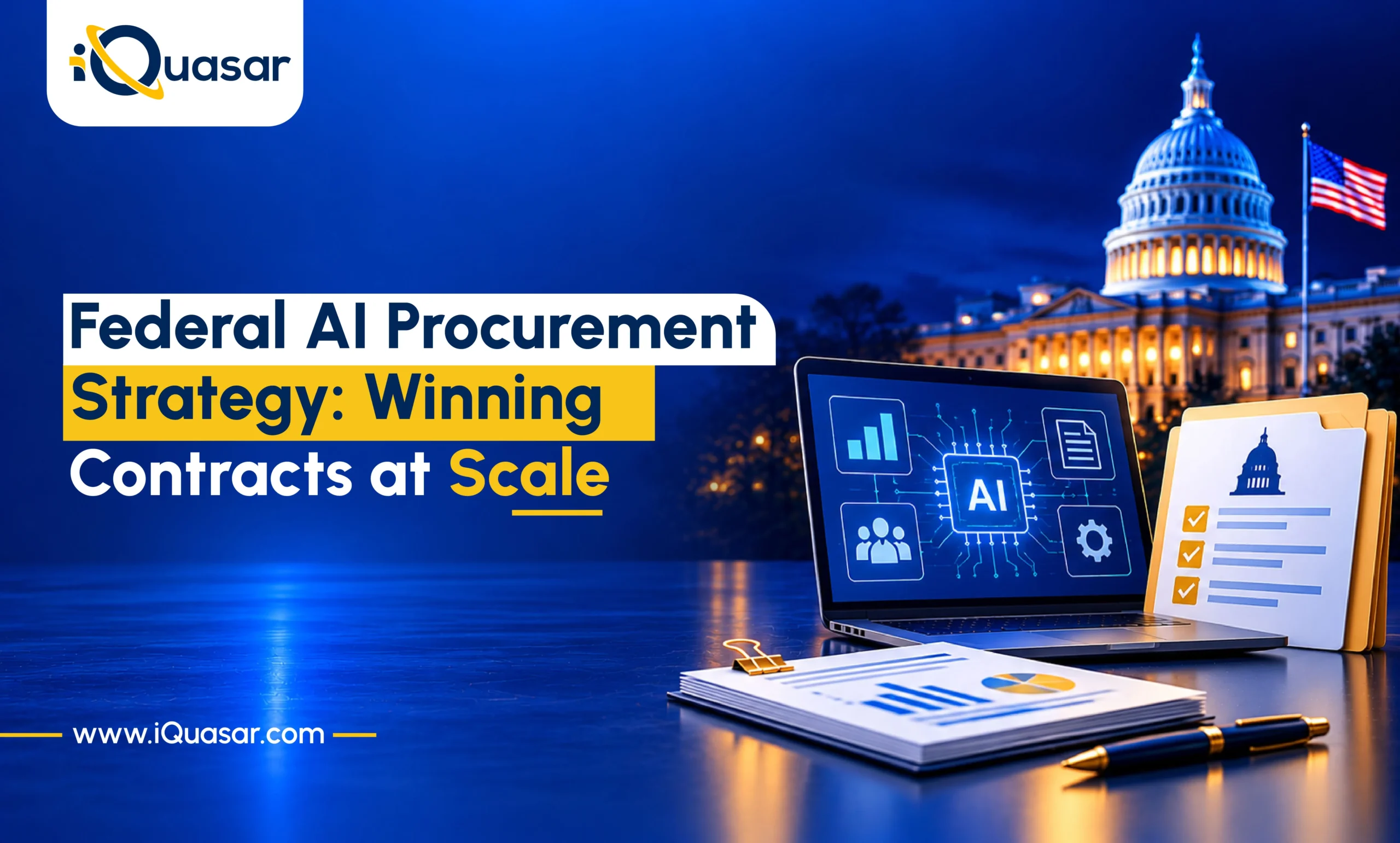
The federal AI market is undergoing a structural shift as civil and defense agencies transition artificial intelligence initiatives from isolated pilot projects to enterprise-wide contract vehicles. On September 10, 2026, the General Services Administration announced a significant OneGov agreement with OpenAI, with the offer taking effect on October 1, 2026. This announcement signals a growing shift in federal AI procurement toward governmentwide purchasing frameworks. Consequently, government contractors must recalibrate their capture and proposal strategies to align with centralized buying models.
In this blog, we explore how federal artificial intelligence acquisition is evolving and what contractors must do to win enterprise-scale opportunities.
How Is Centralized Federal AI Procurement Transforming Enterprise IT Acquisition?
Centralized enterprise purchasing under the OneGov AI strategy consolidates fragmented agency demand into unified, governmentwide contract mechanisms that lower unit costs and standardize compliance baselines. On September 10, 2026, the General Services Administration (GSA) expanded its OneGov AI offerings by securing enterprise access to commercial large language models under negotiated discount structures. Managed through the GSA and supported by the IT Vendor Management Office (ITVMO), this initiative shifts agency buying from fragmented, ad hoc acquisition to a centralized government-wide enterprise framework.
For commercial artificial intelligence software vendors and system integrators, centralized purchasing changes market entry dynamics. Instead of pitching individual agency program offices, commercial firms must secure positions on primary contract vehicles such as the GSA Multiple Award Schedule (MAS) which incorporates the former GSA IT Schedule 70. Agencies use MAS Special Item Numbers (SINs) to acquire technology solutions, while Transactional Data Reporting (TDR) supports greater pricing transparency and data-driven acquisition decisions. Therefore, contractors seeking long-term growth must adapt their capture plans to target enterprise vehicles rather than isolated agency prototypes.
What Security and Governance Mandates Define Federal AI Procurement?
Federal buyers increasingly evaluate AI solutions against FedRAMP authorization requirements, Zero Trust principles, and AI risk-management practices aligned with the NIST AI RMF.
Under the Office of Management and Budget (OMB) Memorandum M-24-10, issued on March 28, 2024, federal agencies must implement specified risk-management practices for AI systems that could affect public safety or rights. Consequently, procurement evaluators are likely to scrutinize proposals that do not adequately address security, governance, monitoring, or AI risk-management requirements. Mandatory AI safeguards require rigorous testing for hallucinations, robust data-rights protections, and full alignment with NIST AI RMF standards prior to agency deployment.
Commercial software vendors entering federal markets must address data sovereignty and model governance immediately. Contractors should clearly explain how agency data is protected, governed, stored, and prevented from unauthorized reuse. Therefore, contractors should be prepared to explain how their architectures meet applicable FedRAMP or DoD cloud security requirements based on agency mission needs. Furthermore, proposals must detail explicit operational protocols for tracking model drift, managing hallucinations, and delivering transparent explainability to agency evaluators.
How Can Emerging Contractors Demonstrate AI Capability Without Overclaiming?
Contractors must validate technical capability through verified performance metrics, structured data governance models, and transparent proof-of-concept benchmarks rather than unsubstantiated marketing assertions. Emerging AI firms often face challenges when competing for federal opportunities because agencies frequently assess both technical capability and the contractor’s ability to meet security, compliance, and performance requirements in operational environments. Therefore, to strengthen credibility, contractors should focus on measurable outcomes, clearly defined governance processes, and realistic descriptions of AI functionality. By doing so, they can demonstrate technical maturity while avoiding claims that may raise concerns during the evaluation process.
To overcome past performance hurdles, commercial technology firms should consider strategic subcontracting relationships with experienced prime contractors on established federal contract vehicles. Enterprise vehicles such as Alliant 3 and OASIS+ provide access to complex IT, systems integration, and professional services opportunities, while small-business vehicles such as Polaris and 8(a) STARS III can help emerging firms compete for federal IT requirements. In addition, small businesses can strengthen their positioning by translating commercial implementation results into measurable outcomes that align with federal evaluation criteria. By presenting performance data in terms familiar to government evaluators, contractors can demonstrate capability without overstating maturity or experience. Similarly, pricing tools such as CALC+ can help capture teams benchmark labor rates and support data-informed pricing strategies during proposal development. As a result, contractors can develop more credible and market-aligned cost proposals while reducing pricing risk during evaluations.
Key Elements For a Winning Proposal for Federal AI Procurement
A winning federal proposal must present a complete operational framework that pairs advanced model architecture with rigid security, transparent governance, and measurable performance outcomes. Technical evaluators increasingly examine AI solutions through the lens of security, governance, transparency, and risk management, reflecting federal priorities established by Executive Order 14110 issued on October 30, 2023 and subsequent agency guidance. Therefore, proposals must demonstrate full compliance with federal acquisition standards while proving long-term operational reliability.
A high-scoring technical proposal must incorporate the following core components:
- NIST AI RMF Compliance Matrix: A crosswalk demonstrating alignment with the Govern, Map, Measure, and Manage functions of the NIST AI Risk Management Framework can help evaluators assess risk-management maturity.
- FedRAMP Authorization Baseline: Documentation demonstrating compliance with applicable FedRAMP or agency-specific cloud security requirements, including encryption protections for data in transit and at rest.
- Data Rights and Sovereignty Plan: Explicit contractual terms confirming that agency operational data and fine-tuned weightings remain exclusive government property, and defining ownership, access, use rights, and protection of agency data and AI-generated outputs.
- Model Governance Protocols: Actionable procedures for continuous monitoring of algorithmic drift, hallucination tracking, explainability, and human-in-the-loop oversight.
- Cost Realism and TDR Strategy: Transparent pricing models aligned with GSA MAS or acquisition vehicle requirements and supported by relevant market benchmarks.
Practical Steps to Align Capture Operations
Executing an enterprise-scale AI capture strategy requires replacing fragmented pilot-stage practices with rigorous operational protocols that satisfy federal compliance standards. The following guidance outlines the technical and strategic framework that capture leaders must implement across their proposal pipeline.
1. Audit Technical Architectures Against OMB M-24-10 Safeguards
Prior to pursuit, technical capture teams must conduct a thorough gap analysis of their software solution against the mandatory risk management controls established under OMB Memorandum M-24-10. For systems categorized as rights-impacting or safety-impacting, agencies require verification that audit logging, algorithmic drift detection, and data privacy safeguards are natively engineered into the solution architecture rather than offered as ad hoc modifications. As a result, demonstrating that your baseline product inherently satisfies federal safety mandates eliminates compliance risk early in the source selection process.
2. Establish Prime Vehicle Access or Strategic Subcontracting Alliances
Winning enterprise task orders requires securing direct contract access through central acquisition vehicles. Capture leaders must evaluate whether to pursue prime positioning on relevant GSA Multiple Award Schedule Special Item Numbers (SINs) or negotiate formal teaming arrangements with prime holders on major unrestricted vehicles like Alliant 3 and OASIS+. Furthermore, small businesses can leverage set-aside vehicles like Polaris or 8(a) STARS III to deliver commercial AI capabilities through reserved federal channels.
3. Construct a Modular NIST AI RMF Governance Crosswalk
Proposal teams must build a standardized, reusable technical library that maps every software feature and operational control directly to the four core functions of the NIST AI Risk Management Framework: Govern, Map, Measure, and Manage. How do evaluators verify that a commercial model operates safely within sensitive agency environments? They review the vendor’s documented crosswalk to verify that continuous risk assessment, bias mitigation, and human oversight are systematically enforced across the system lifecycle.
3. Integrate Bias Testing and AI Risk-Management Controls
Federal agencies are placing greater emphasis on identifying and managing risks associated with AI systems, particularly those that may affect public rights, safety, or mission outcomes. As a result, capture teams should be prepared to describe how their solutions address bias mitigation, performance monitoring, human oversight, and broader AI governance considerations. When applicable, documenting testing methodologies, validation procedures, and risk-management practices can help demonstrate responsible deployment readiness and strengthen evaluator confidence in the proposed solution.
5. Engineer FedRAMP-Compliant Enterprise Data Boundaries
Data sovereignty is a paramount requirement for federal buyers evaluating commercial large language models and analytical frameworks. Accordingly, systems integrators and software vendors must design deployment options that operate strictly within isolated FedRAMP High cloud environments for civilian agencies or Department of Defense Impact Level 5 (IL5) environments for defense components. Capture plans must explicitly guarantee that agency prompts, proprietary datasets, and fine-tuned model weightings remain completely segmented from public commercial model retraining cycles.
6. Structure Cost-Realistic Pricing Models Using CALC+ Analytics
Pricing strategy must reflect federal market standards while accommodating complex commercial software licensing structures. To achieve this, capture teams should use GSA’s CALC+ analytics tool to benchmark proposed labor categories and specialized technical roles against verified federal contract rates. Aligning your cost volume with established market benchmarks ensures that enterprise licenses, cloud infrastructure support, and specialized engineering labor pass rigorous agency cost-realism evaluations.
7. Form Complementary Teaming Structures to Bridge Past Performance Gaps
Commercial technology firms frequently lack extensive federal past performance, while traditional government contractors often lack proprietary, state-of-the-art AI intellectual property. Establishing complementary prime-subcontractor alliances solves both operational limitations simultaneously. By pairing advanced commercial technology with an established prime contractor’s proven contract administration, security clearing infrastructure, and agency past performance, capture teams construct a highly competitive, low-risk offer.
Federal artificial intelligence acquisition is moving from experimentation to enterprise-scale procurement. As the General Services Administration expands OneGov purchasing frameworks, federal agencies are seeking secure, fully compliant, and cost-effective artificial intelligence solutions. Navigating complex compliance frameworks, contract vehicle requirements, and rigorous source selection standards requires experienced expertise in capture and proposal management.
iQuasar LLC’s Proposal Development Services can help strengthen your capture strategy, refine your technical messaging, and execute compliant, winning proposals. Contact us today to discover how our services can elevate your competitive positioning.