Federal procurement tribunals issued warnings in at least 20 public decisions in 2025, flagging AI-generated content containing fabricated citations, invented case numbers, and arguments applied to facts that never existed. On September 25, 2025, the Government Accountability Office dismissed three consolidated protests filed by Oready, LLC, citing repeated reliance on non-existent authorities as an abuse of the bid protest process. Similarly, in October 2025, the Armed Services Board of Contract Appeals struck a contractor’s reply brief in its entirety after finding over 70 percent of its citations inaccurate due to unverified AI output.
While these cases involve legal filings rather than proposal volumes, they stem from the exact failure that threatens proposal teams using AI without structured oversight: confident, well-formatted text that cannot be verified. For federal contractors, this is an active compliance problem rather than a theoretical risk. Every capture and proposal leader must now address two core questions: where does proposal-writing AI introduce hallucination risk in a live submission, and what does a practical human-in-the-loop review model look like?
Why Generative AI for RFP Responses Creates Accuracy Risk
Generative AI for RFP responses produces errors that look nothing like typos or formatting mistakes. Instead, the output is polished, structured, and confident, which is precisely what makes it dangerous in the context of a federal proposal.
Large language models predict the most statistically likely continuation of text. They do not retrieve facts from a database of verified records. As a result, they can and do produce specific-sounding metrics, regulatory citations, and past performance figures that are plausible in structure but inaccurate in content. A model asked to describe a contractor’s program management approach may include staffing ratios, cost-saving figures, or delivery timelines that the contractor has never actually achieved. The model is not misrepresenting facts on purpose. It simply has no mechanism to distinguish between what is true for this contractor and what is generically common in proposals it was trained on.
The consequence is significant. Federal contracts require that representations made in proposals be accurate and verifiable. Contractors remain responsible for maintaining adequate internal controls and ensuring that AI-assisted work satisfies contract specifications, regardless of which tools were used to generate a draft. When an evaluator questions a technical claim or a contracting officer requests supporting documentation for a past performance metric, an AI-generated figure that was never grounded in real organizational data creates immediate legal and compliance exposure.
Growing Agency Scrutiny
Federal agencies are aware of the problem and are responding to it. ICE noted in a request to industry that the proliferation of generative AI tools has made it easier to produce highly polished, technically accurate-looking proposals, and that it is not difficult to imagine the potential for generative AI tools to hallucinate or otherwise mischaracterize proposal details that are material to an agency’s award decision. Some agencies have begun including AI-related disclosure language directly in solicitations. Federal agencies are increasing scrutiny around AI-assisted proposal development through policy updates, evaluator guidance, disclosure language, and proposal quality expectations.
For small and mid-sized contractors operating with lean proposal teams, this shift carries a specific warning. The speed that AI tools offer is real. However, that speed does not reduce your obligation to verify every technical claim, every regulatory citation, and every past performance figure before submission.
What Proposal Writing AI Gets Wrong Most Often
Understanding where AI-generated errors cluster helps proposal managers design smarter review checkpoints. The risks are not randomly distributed across a proposal volume; they tend to concentrate in predictable areas.
1. Technical Claims and Performance Metrics
When AI tools draft technical narratives, they draw on patterns from similar proposals. The result is that staffing counts, cost avoidance figures, delivery timelines, and capability claims are frequently inconsistent within the same proposal and often unsupported by any actual organizational record. When AI generates content section by section, staffing counts, timelines, pricing assumptions, and performance commitments frequently contradict each other across volumes.
2. Regulatory and FAR citations
A model that confidently cites FAR 52.212-4 or DFARS 252.204-7012 may be applying the right clause number to the wrong requirement or citing a clause that does not apply to the procurement vehicle at hand. FAR 3.104 prohibits the disclosure of source selection and proprietary information, and contractors must vet AI tools for compliance with internal non-disclosure obligations and cybersecurity policies, but FAR compliance errors in draft text are a separate and equally serious problem.
3. Past Performance Narratives
AI tools asked to draft past performance sections frequently invent contract numbers, agency names, award values, and delivery outcomes. These fields are among the most closely verified elements in a federal evaluation. A fabricated contract vehicle number or an inflated award value can disqualify a submission entirely.
What a Human-in-the-Loop Review Model Looks Like
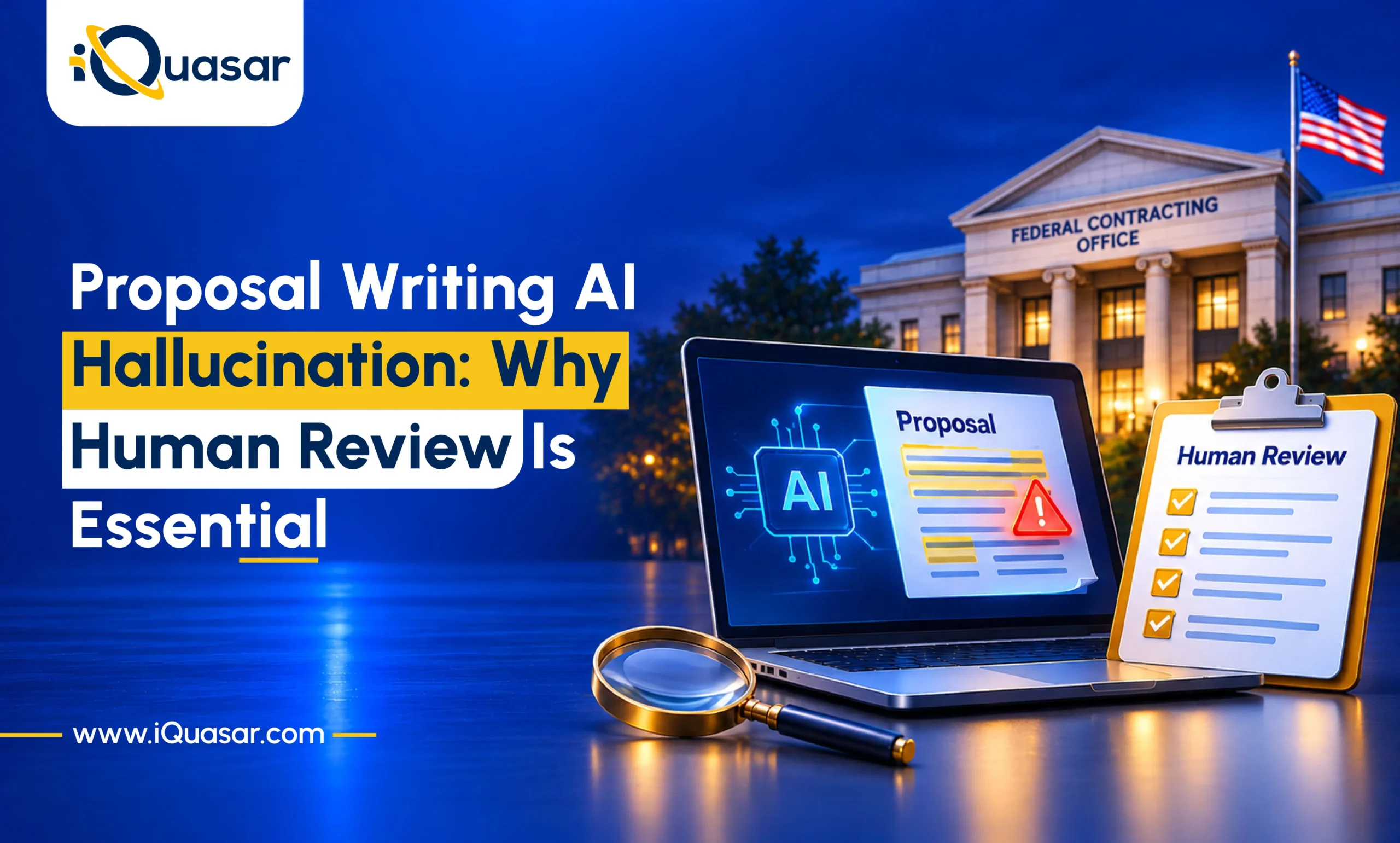
A human-in-the-loop review model is not simply a final proofread before submission. It is a structured sequence of verification checkpoints that run in parallel with the AI drafting process, ensuring that every claim produced by a generative model is validated against an actual organizational record before it enters the final document.
The model works because it separates two tasks that most teams conflate: generating text and verifying facts. AI is well-suited to the first. But unsuited for the second. The review structure assigns each task to the appropriate resource, so the team benefits from AI’s speed without absorbing its accuracy risks.
Before deciding which opportunities to pursue, teams can benefit from using AI tools responsibly at the pre-proposal stage. Tools like GovFind help contractors search for federal opportunities and make informed bid/no-bid decisions using verified public procurement data, which means your team enters the proposal phase with a clear, grounded picture of the opportunity before any AI drafting begins.
Also Read: Government Proposal Writing That Reduces Evaluator Uncertainty and Wins Contracts
Building Your AI Review Framework
1. Classify your proposal content by verification risk before drafting begins.
Separate sections into three tiers: high risk (past performance, technical metrics, regulatory citations), medium risk (management narratives, staffing plans, organizational charts), and lower risk (boilerplate, transition language, executive summaries). Assign your SME review time proportionally. This classification step informs every downstream checkpoint.
2. Use AI only on content that can be grounded in source material you control.
Feed AI tools verified internal documents: actual contract records, real past performance write-ups, incumbent deliverables, and your own technical documentation. AI output without source material to reference is most likely to contain fabricated details. Grounding the model in real organizational data directly reduces the risk of hallucinations in the sections that matter most.
3. Require subject matter experts to validate every technical claim before it enters the final volume.
SME review is not optional for high-risk sections. It must be a named, documented step in your proposal schedule with a specific sign-off requirement. Each technical claim needs to be traceable to a real data point, an actual contract, or a verifiable organizational capability. This traceability standard is what separates a defensible proposal from one that creates post-award liability.
4. Cross-reference every regulatory citation against live federal sources.
Do not assume that an FAR or DFARS clause cited by an AI tool is accurate, applicable, or current. Verify each citation against the official FAR at acquisition.gov before it enters the submission. This step takes minutes per citation and eliminates one of the most common and consequential AI errors in federal proposal documents.
5. Build a structured AI-output checklist into your review gate.
The checklist should require a named reviewer to confirm the following for every AI-generated section: all metrics are sourced from verified organizational records; all regulatory citations have been checked against live federal documents; all past performance references match actual contract records; and no claims have been imported from generic AI training patterns without verification. Document the review by section, not just by volume.
6. Maintain an audit trail that connects proposal claims to source records.
Contractors should maintain audit trails for AI-assisted proposal work as a best practice, including prompts, sources, and human revisions, especially when solicitation language requires disclosure or certification. This documentation serves two purposes: it provides a defensible compliance record if the award is protested, and it creates a reusable content library that improves the accuracy of future AI-assisted drafts.
The Risk Window for Unverified AI Drafts Is Closing
Federal procurement tribunals no longer treat AI-generated errors as oversights. A Defense Department request for proposals in 2026 included disclosure of potential AI use in the review process, signaling that agencies are applying AI-based scrutiny to incoming submissions at the same time contractors are using AI to draft them. The proposal teams that build structured human review into their process now are the ones that will avoid compliance exposure and produce submissions that hold up under that scrutiny.
Developing compliant, accurate, and competitive federal proposals requires both process discipline and subject-matter expertise that generative AI tools cannot provide on their own. iQuasar LLC provides comprehensive Proposal Development Services to help government contractors responsibly manage AI-assisted drafting, validate technical claims against real organizational data, and produce compliant, high-scoring submissions. Connect with our team to learn how iQuasar can strengthen your proposal review process and prepare you for your next federal opportunity.