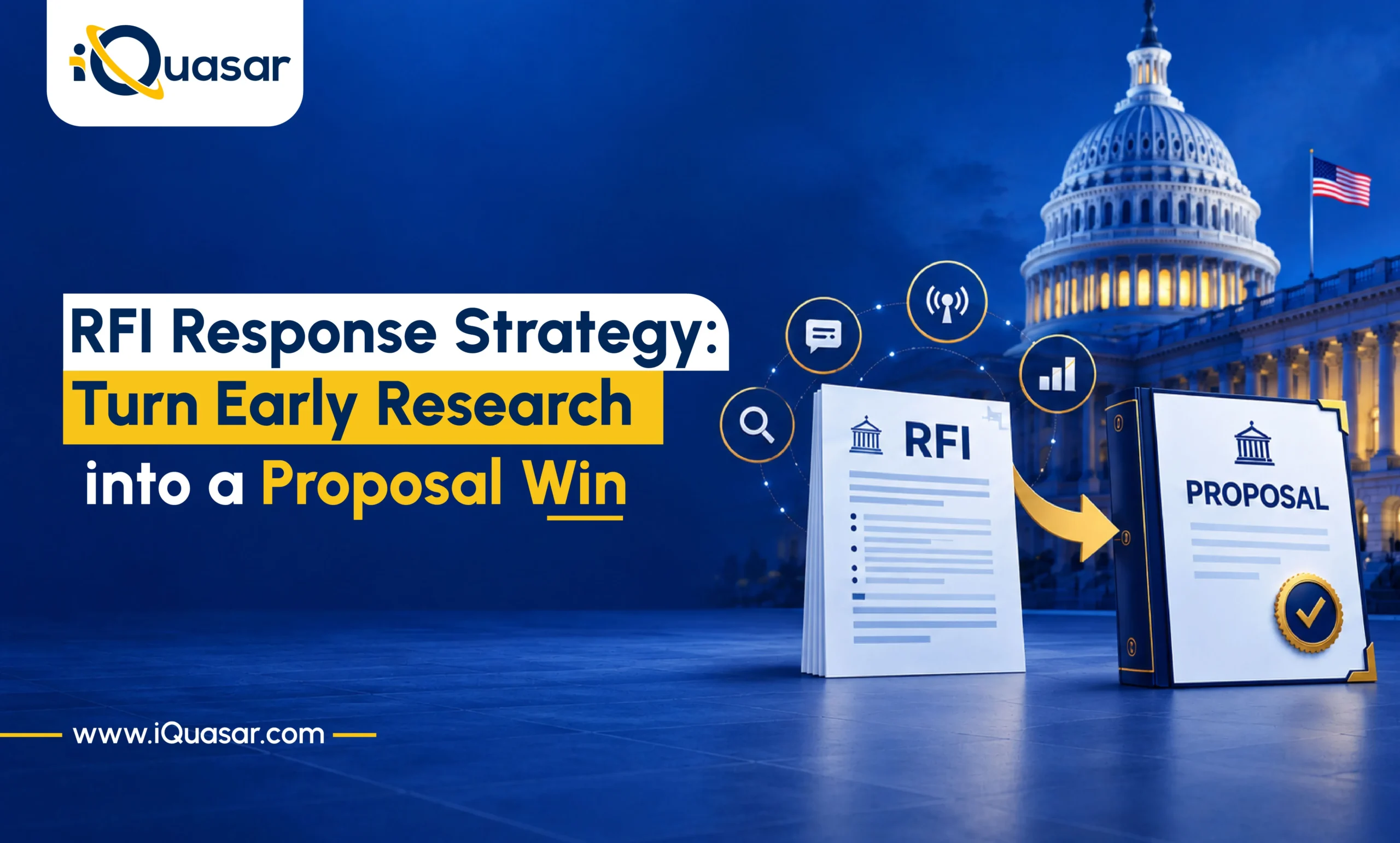
Responding to a Request for Information (RFI) is no longer a passive marketing task for federal government contractors; it is an important “first move” in the proposal lifecycle. Much of the acquisition strategy development process occurs before a formal Request for Proposals (RFP) is released, making the pre-solicitation phase a critical period for industry engagement and market research. Under FAR Part 10-Market Research agencies conduct market research to understand available solutions and inform acquisition planning. Contractors should use this pre-solicitation phase to better understand agency needs and prepare for potential opportunities.
RFIs increasingly provide agencies with information that may influence acquisition planning, commerciality assessments, contract structure, and small business participation decisions. An effective RFI response allows contractors to provide market intelligence that may inform technical requirements, acquisition strategies, and set-aside considerations long before a formal solicitation is released.
In this blog, we explore how federal government contractors can use government contracting market research to gather early acquisition intelligence, refine capture strategies, and develop more competitive proposals.
Why Early Market Research Matters in Federal Acquisition Planning
Federal agencies use Requests for Information and market research to shape acquisition strategies, define technical scope, and establish contract vehicles long before issuing a final solicitation. Under Federal Acquisition Regulation (FAR) Part 10, contracting officers must conduct market research to determine whether commercial services exist and whether small business set-asides are viable. Market research helps acquisition teams evaluate available contract vehicles, small business participation, and potential acquisition approaches, including vehicles such as GSA MAS, Polaris, 8(a) STARS III, and Alliant 3.
Contractors therefore have meaningful opportunities to provide feedback through RFIs, industry days, and other market research activities before solicitations are posted on SAM.gov. Agencies may use RFIs, structured questionnaires, industry days, and other engagement methods to gather information about vendor capabilities and available solutions. Responses can inform market research and acquisition planning, including consideration of potential contract structures and small business participation.
Acquisition strategies frequently change between early agency forecast disclosures and the final RFP release. Agencies adjust contract types, performance-based evaluation criteria, and technical requirements based on the depth of market intelligence gathered during pre-solicitation. Contractors that treat market research as a passive exercise may miss opportunities to align with evolving requirements and acquisition strategies.
Why Early RFI Analysis Is Essential for Government Contractor Success
Early market research gives federal contractors an opportunity to provide relevant industry feedback before a formal solicitation is released. While agency decisions may change as acquisition planning progresses, this engagement can help contractors understand potential requirements and prepare their capture strategies. An RFI response must be managed as a capture opportunity. Contractors must use the acquisition planning phase to analyze agency priorities, map technical pain points, predict likely evaluation factors and source-selection considerations that may appear in the published requirement.
Effective capture teams use RFI activity, incumbent knowledge, and market intelligence to assess the competitive landscape and develop targeted teaming strategies. Identifying capability gaps early allows prime contractors to recruit complementary partners, secure key personnel, and build tailored solution concepts well ahead of the final RFP.
Pre-RFP preparation enables proposal teams to draft core technical narratives, past performance write-ups, and win themes early. Writing proposal content during the market research phase provides additional time for solution refinement, reviews, and compliance validation.
Also Read: Government Proposal Writing That Reduces Evaluator Uncertainty And Wins Contracts
5 Strategic Steps to Turn RFI Intelligence Into Proposal Readiness
To convert pre-solicitation market research into proposal wins, capture and proposal teams need to follow a structured, execution-focused workflow that feeds intelligence into proposal development.
1. Analyze agency pain points and strategic priorities.
Evaluate agency budget justifications, strategic plans, and prior award history to identify underlying operational challenges before drafting your response. Reviewing historical procurement trends and agency-specific capital planning documents allows capture teams to map technical risks and align responses with the agency’s primary mission objectives. Beyond published acquisition documents, capture teams should review recent agency strategic initiatives, technology modernization efforts, Inspector General reports, GAO findings, and public statements from agency leadership. These sources often provide valuable context on mission priorities, operational challenges, and areas where agencies seek improved outcomes. Ultimately, understanding this broader environment can help contractors frame their RFI responses to align with agency objectives rather than focus solely on solution features.
2. Shape requirements with targeted technical feedback.
Recommend acquisition approaches, labor strategies, performance measures, and technical architectures that align with commercial practices and mission requirements. Well-structured feedback can help agencies evaluate alternative implementation models while demonstrating a contractor’s understanding of delivery considerations, program risks, and operational constraints. Under the revised FAR Part 10 framework, agencies may use RFIs, structured questionnaires, industry engagement, and other market research techniques to assess commercial capabilities and gather information that supports acquisition planning. Feedback received during market research may inform decisions related to requirements, contract structure, and procurement strategy. Effective RFI responses provide more than a description of existing capabilities. Specifically, contractors can offer constructive feedback on proposed requirements, performance measures, implementation approaches, or acquisition structures based on relevant project experience. When presented objectively and supported by industry practices, this feedback may help agencies evaluate alternative approaches while giving contractors an opportunity to demonstrate subject-matter expertise and an understanding of potential implementation considerations.
3. Establish baseline win themes and discriminators.
Translate identified agency challenges into clear win themes that demonstrate your team’s technical approach, mission alignment, and risk-mitigation capabilities. Early identification of discriminators enables capture teams to align solution positioning with anticipated evaluation considerations, customer priorities, and program outcomes throughout the procurement lifecycle. During the pre-solicitation phase, capture teams can begin documenting potential discriminators, customer benefits, and proof points that may support future proposal narratives. Consequently, early development of these themes allows teams to validate messaging against agency priorities, identify supporting evidence from past performance, and establish a foundation for a consistent value proposition throughout the procurement lifecycle.
4. Formulate teaming and capability alignment.
Identify technical gaps revealed by the preliminary work statement and execute non-disclosure agreements or teaming agreements with niche subcontractors early. Establishing small business partnerships or specialized subcontractor relationships during the pre-solicitation phase can improve readiness for anticipated set-aside requirements and reduce the risk of losing key partners to competing teams. The market research stage also provides an opportunity to assess whether additional capabilities, certifications, contract vehicles, or past performance references may strengthen the overall solution strategy. Furthermore, early engagement with potential partners allows teams to align responsibilities, explore complementary expertise, and determine how each organization can contribute to anticipated requirements while reducing proposal-development complexity later in the process. Capture teams should also evaluate contract vehicle positioning, socioeconomic participation strategies, and capability coverage across the anticipated scope. In turn, early assessment of these factors can help inform teaming structures, identify potential execution gaps, and support the development of a more comprehensive pursuit strategy.
5. Draft core technical and management content pre-RFP
During the pre-solicitation phase, organizations can begin developing solution narratives, management concepts, staffing approaches, transition frameworks, and past-performance mappings aligned with anticipated requirements. Establishing these assets early allows proposal teams to focus on solicitation-specific customization, compliance validation, and competitive differentiation once procurement documents are released. Developing foundational proposal content during the pre-solicitation phase can reduce proposal development bottlenecks, create additional time for compliance reviews, and strengthen overall proposal readiness once the solicitation is released. Organizations that begin developing reusable proposal assets during the pre-solicitation phase are often better positioned to respond efficiently once solicitation requirements become available. As a result, drafting preliminary solution concepts, management approaches, staffing strategies, and past performance summaries early enables proposal teams to focus more attention on compliance, responsiveness, and solicitation-specific tailoring during the formal proposal period.
Key Takeaways
- RFIs are Strategic Capture Opportunities: Responding to an RFI is an essential capture vehicle that provides an opportunity to contribute market intelligence that may inform acquisition strategies, work statements, and evaluation criteria. Use these to communicate capabilities and gather insight without assuming the agency will adopt your recommendations.
- Research before Committing: Combine agency priorities, procurement history, and market intelligence to assess opportunity fit and identify potential risks. Develop preliminary win themes, assess teaming needs, and organize reusable proposal content, then validate your strategy against the final solicitation.
- Early Preparation Improves Readiness: Analyzing agency priorities, organizing teaming partners, and drafting core technical content during the market research phase help improve proposal readiness, compliance, and alignment when the solicitation is released.
Turn Pre-solicitation Intelligence into Proposal Wins
Responding to an RFI is only one part of a successful capture strategy. The real value comes from using early market intelligence to assess opportunity fit, identify capability gaps, develop a credible solution, and prepare for the requirements that ultimately appear in the solicitation. Waiting for the final RFP to be released leaves contractors with limited time to build teaming relationships, formulate win themes, and draft compliant technical solutions. Contractors that begin this work early can make more informed pursuit decisions and prepare more effectively when an RFP is released.
Organizing capture intelligence and developing compliant, high-scoring proposals requires dedicated resources and deep industry expertise. iQuasar LLC provides comprehensive Proposal Development Services to help government contractors analyze market research, craft strategic RFI responses, and develop compliant, competitive proposal content. Contact us today to learn how iQuasar can support your pursuit strategy, help you strengthen your pre-solicitation strategy and prepare for your next federal opportunity.