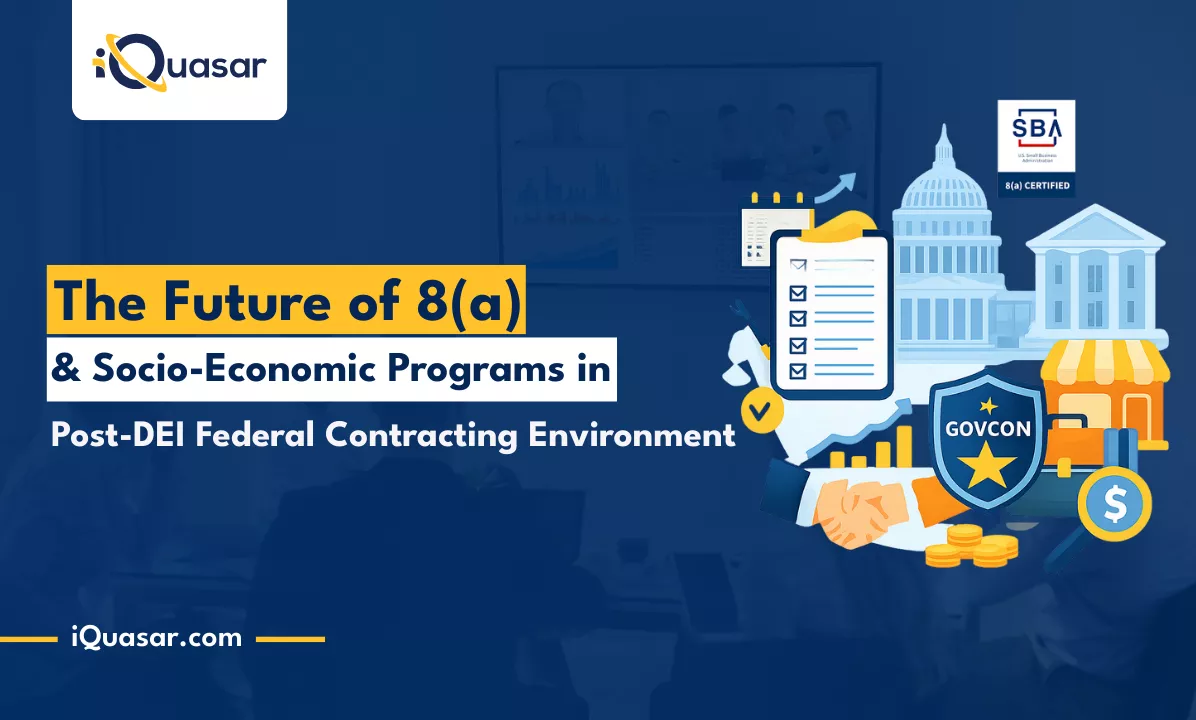
More than eight million federal contracts are awarded every year, representing billions of dollars in small business opportunities. But the contracting landscape entered a new era with the release of Executive Order 14173, a directive that removes Diversity, Equity, Inclusion, and Accessibility programs from federal policy. The announcement has left many wondering how this shift will influence cornerstone socio-economic programs such as 8(a), WOSB, HUBZone, and SDVOSB.
The big question now is whether these statutory programs will be weakened, restructured, or even strengthened as DEI is phased out of federal operations. This post takes a closer look at the ripple effects of Executive Order 14173, the crucial difference between Congressional mandates and administrative policies, and the practical steps small businesses can take to remain competitive in a changing environment.
Understanding EO 14173’s Impact on Agency Behavior
The release of President Trump’s Executive Order 14173 in January 2025 marked a direct and sweeping reversal of all federal DEI and DEIA programs. The order shifts the government’s focus toward “merit-based competition” and removes identity-driven considerations from federal workforce and contracting policies. For contractors, this signals a major cultural and operational pivot inside federal agencies.
What does EO 14173 actually do?
- Ends every federal DEI initiative and withdraws associated funding.
- Bars agencies from carrying out discretionary diversity-focused outreach or any preference that could be interpreted as identity-based.
- Directs agencies to review existing programs and revise language and processes to align with merit-only standards.
Socio-Economic Programs vs. DEI Initiatives
DEI initiatives have always been discretionary efforts designed to broaden representation. They are regulatory in nature and do not guarantee spending commitments. Socio-economic programs like 8(a), WOSB, HUBZone, and SDVOSB are much different. These programs are grounded in federal statute, including the Small Business Act and Public Law 95-507, and require agencies to meet specific small business award goals. They are not optional and cannot be removed by an executive order.
Agency Behavioral Shifts
Despite the legal protections around socio-economic programs, agency behavior may still shift. Contracting officials and program leaders are likely to take a more cautious stance to avoid any perception of identity-based preference, even for programs that are required by law. Discretionary networking events, DEI-driven advocacy, and outreach efforts may decline sharply. Although set-aside goals remain in place, outreach and training that once supported these communities could be scaled back.
The Future of Socio-Economic Set-Asides: Shrink or Shift?
With EO 14173 reshaping the federal equity landscape, many are asking whether core small business programs like 8(a), WOSB, HUBZone, and SDVOSB could be weakened. The reality is that these programs are grounded in Congressional authority, not executive preference. While DEI efforts can be removed through administrative action, socio-economic set-asides are written into federal statute and supported by established regulatory frameworks, which gives them significant legal protection.
Statutory Foundations and Protections
- 8(a) Program: Established under the Small Business Act, this program requires agencies to reserve certain opportunities for socially and economically disadvantaged businesses.
- WOSB and SDVOSB Programs: These preferences are explicitly mandated by Congress. The SDVOSB program, in particular, benefits from strong bipartisan support that makes its position even more secure.
- HUBZone: Focuses on geographically based eligibility, supporting firms located in historically underutilized business areas.
Possible Scenarios
- Status Quo: Agencies comply with the law and continue using set-asides, although proactive engagement may subtly decline as internal DEI infrastructure fades.
- Restructuring: Officials may explore strategies like bundling requirements, shifting attention to race-neutral programs, or tightening interpretations of eligibility criteria.
- Reduction: Outreach efforts may drop and agencies could fall short of meeting utilization goals, even if the programs themselves remain intact.
- Elimination: This remains highly unlikely unless Congress passes new legislation.
Risk Analysis for Certified Small Businesses
How vulnerable are certified small businesses to potential cuts, restructuring, or shrinking opportunities? Each certification category faces a different level of exposure as legal, political, and administrative dynamics evolve.
8(a) Firms: Specific Vulnerabilities
- Race-Based Criteria: The program continues to face legal pressure, including recent lawsuits challenging how social disadvantage is evaluated and applied.
- Risk Level: Moderate to high, particularly for firms with borderline eligibility or incomplete supporting documentation.
WOSB Firms: Gender-Based Distinctions
- Legal Protections: These programs remain relatively secure, although they may face increased scrutiny in the post-EO 14173 environment. Gender-based programs historically encounter fewer legal attacks than race-based ones.
- Risk Level: Moderate, with the possibility of reduced agency outreach or discretionary support.
HUBZone Firms: Geographic Versus Identity
- Criteria: Because eligibility is based on location rather than personal identity, HUBZone is viewed as less controversial.
- Risk Level: Low, though the reduction of local events or tailored initiatives could have indirect effects.
SDVOSB Firms: Veteran Status
- Strong Bipartisan Support: Congress and the public consistently back veteran-focused contracting preferences, and legal challenges remain rare.
- Risk Level: Lowest among all major set-aside programs, with minimal expected change in agency messaging or support.
Political and Legal Dynamics
Ongoing lawsuits and recent executive actions have increased scrutiny of race-based and some gender-based programs. While none of these efforts have altered the statutes that authorize the programs, they signal a shifting environment. States are also taking action; for example, Texas recently revoked all HUB program certifications for women and minority-owned businesses, where firms will have to explain their ownership based on their SDV ownership and control.
The Return to “Merit-Based” Full & Open Competition?
Merit-based competition, as defined by EO 14173, centers on awarding contracts strictly by performance, price, and technical capability, excluding identity criteria. Agency leaders may interpret this as a mandate to reduce set-asides and expand full and open competition.
Will Merit-Only Rules Dominate?
- Some agencies may attempt to meet small business goals by shifting to “race-neutral” methods, such as general small business eligibility without further distinctions.
- Full and open competitions could increase for requirements historically reserved for set-asides, but Congressional goals (e.g., 23% small business threshold) remain binding unless amended.
- Practical Challenges:
- Small businesses may struggle in full and open competition, lacking scale, resources, or past performance.
- Agencies must balance statutory requirements with executive directives—a legal and operational tightrope.
Is this a fundamental shift or only rhetoric?
Current trends suggest more aggressive compliance auditing, less discretionary outreach, but no outright elimination of the statutory programs. The focus is on recalibrating how agencies achieve their small business goals.
Also Read: Key Preparation for a Successful SBA 8(a) Audit Response
Actionable Strategies for Remaining Competitive
As the policy environment evolves, small businesses need to strengthen their position in the federal marketplace by building resilience that goes beyond socio-economic program eligibility.
Diversify Beyond Set-Asides
- Build the skills and capacity needed to compete for full and open opportunities, not just reserved competitions.
- Invest in the systems, certifications, and technical depth required for complex, high-value procurements.
Strengthen Technical Capabilities
- Refine your core differentiators, whether through advanced technology, management frameworks, or standout past performance.
- Pursue industry training and certifications to demonstrate expertise and operational maturity.
Develop Strategic Partnerships
- Use joint ventures, teaming agreements, and mentor-protégé partnerships to access new capabilities or scale.
- Engage with agencies and prime contractors to widen your reach beyond set-aside ecosystems.
Enhance Past Performance
- Focus on delivering exceptional contract performance to build a strong narrative of reliability.
- Capture testimonials, references, and case studies that reinforce your track record.
Expand Business Development
- Target a broader range of agencies and diversify your federal customer base.
- Avoid relying too heavily on any single certification or contract vehicle.
Monitor Policy Developments
- Follow updates from resources such as FNN, Federal Register, and SBA to stay ahead of shifting guidance.
- Keep an eye on evolving FAR revisions and ongoing legal challenges that could influence program requirements.
Invest in Proposal Excellence
- Strengthen capture management and proposal development to deliver higher-quality, more competitive submissions.
- Use AI-driven tools to support research, compliance reviews, and competitive insights.
Build Relationships Proactively
- Network with procurement, technical, and program offices, not just small business specialists.
- Attend industry days, roundtables, and advocacy events to remain visible.
Consider Geographic Expansion
- Explore opportunities across different regions and federal buying centers to broaden your footprint.
Financial Positioning
- Ensure your working capital, bonding capacity, and compliance infrastructure can support larger or more competitive pursuits.
- Maintain clean accounting systems and audit readiness to meet agency expectations.
Conclusion: Resilience in an Uncertain Landscape
Socio-economic programs continue to be protected by law, yet shifts in policy tone and agency behavior are already reshaping how federal contracting operates. In this evolving environment, success will depend on technical strength, performance excellence, and the ability to navigate a landscape that is placing more emphasis on “merit-based” competition.
Small businesses that adjust early by strengthening partnerships, expanding capabilities, and diversifying their pipelines will stay competitive no matter how federal policies trend. The contribution of diverse and capable suppliers remains essential, and resilience has become a defining advantage.
Ready to assess your organization’s federal contracting strategy for the post-DEI era? Our expert GovCon team at iQuasar can help you evaluate your options and design a practical roadmap. Explore our Certification Support Services to enhance resilience and growth, or Contact Us to discuss your specific needs.