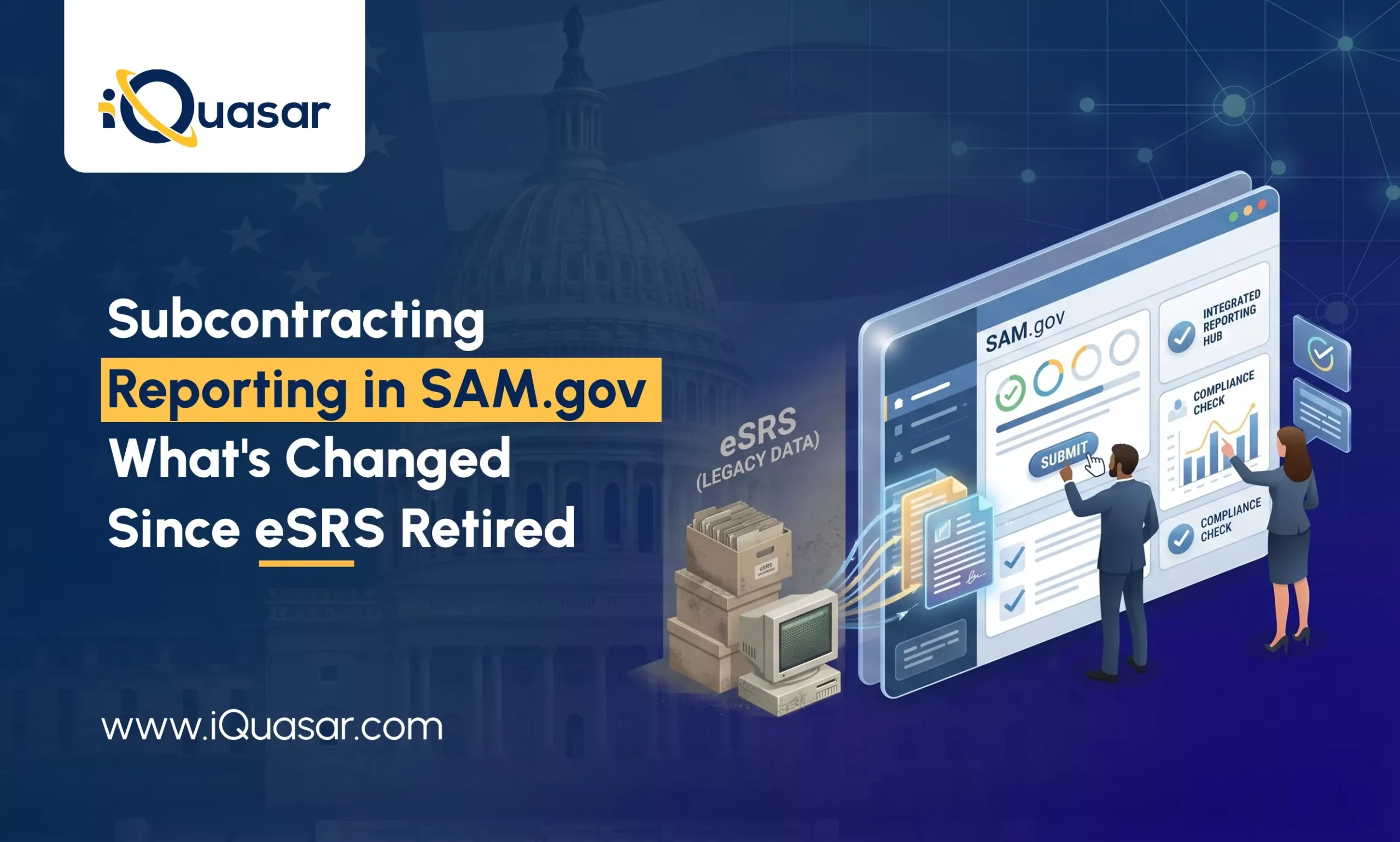
eSRS.gov officially shut down on February 20, 2026, and the FPDS public site followed four days later on February 24, 2026. Three months into life on SAM.gov, the shape of federal subcontracting reporting is now visible, including a few changes most contractors did not see coming until they tried to file their first report inside the new environment.
Earlier this year, we covered the migration mechanics and the pre-transition action plan in eSRS Reporting Moving to SAM.gov: What Contractors Must Do Now. This piece picks up where that one left off. With the system now live, the questions are different. How does the reporting authority actually work under UEIs and PIIDs? What does the new AI-driven “Validate Remarks” feature do to your submissions? And what should contractors be doing this month, given the SBA’s recent ISR deadline extension?
The Mid-Year ISR Deadline Has Moved to June 14, 2026
The most time-sensitive item on the table is also the most easily overlooked. Following the transition, the Small Business Administration issued a 30-day extension for FY2026 mid-year Individual Subcontract Reports. ISRs are now due June 14, 2026.
The extension was granted to allow further adjustments to the Subcontracting Plan Reporting capabilities inside SAM.gov following the initial release. Contractors should treat the extra time as a buffer, not a vacation. Many organizations are still finalizing user roles, reconciling legacy data, and getting comfortable with the new reporting workflow.
If your team has not yet completed a practice run inside the SAM.gov reporting module, the next few weeks are the window. The Validate Remarks feature, in particular, can surface issues with how goals and actuals are described, and you do not want to be discovering that two days before the deadline.
Key Takeaway: FY2026 mid-year ISRs are now due June 14, 2026. Use the extension to validate roles, run a dry submission, and check that legacy data reconciles cleanly.
Reporting Access Now Runs on UEIs and PIIDs
In eSRS, reporting access was largely managed at the user level. In SAM.gov, reporting access is controlled by Unique Entity Identifiers (UEI) and Procurement Instrument Identification (PIID). That single change has reshaped how reporting responsibility is delegated inside contractor organizations.
In eSRS, reporting access was largely managed at the user level. In SAM.gov, reporting access is controlled by Unique Entity Identifiers (UEI) and Procurement Instrument Identification (PIID). That single change has reshaped how reporting responsibility is delegated inside contractor organizations.
The regulatory framework has moved in step. The FAR Council has amended the FAR Part 19 model deviation text to align with the eSRS decommissioning, and GSA has issued an implementing deviation supplement for its acquisition workforce, with other agencies expected to follow. The takeaway: the SAM.gov transition is being reflected in acquisition policy, not just system infrastructure.
A few practical consequences are now clear:
- Only one report is permitted per PIID. Duplicate submissions are no longer possible, and any internal coordination problems, multiple teams trying to submit, unclear ownership across divisions, now show up immediately at the platform layer.
- Prime contractors must have a Contract Action Report (CAR) in place before a subcontracting plan report can be filed. If the CAR is missing or stale, reporting is blocked at the front door.
- First-tier subcontractors now report against a reported subcontract ID. This creates a structured chain between prime and sub, but it also means subs are dependent on the prime’s data being right.
For Small Business Liaison Officers (SBLOs) and contract administrators, the takeaway is that the reporting workflow is no longer purely an SBLO responsibility. Contracting, contract administration, and finance now share dependencies through the CAR and PIID linkages. If those handoffs are informal today, the new system will expose it.
The “Validate Remarks” AI Reviewer Is Now Reading Your Submissions
One of the more significant new features inside SAM.gov is the Validate Remarks capability on ISR and SSR data entry forms. It uses an AI mechanism to review contractor-submitted Goals, Actuals, and Remarks and returns feedback covering Strengths, Weaknesses, Potential Improvements, and Suggestions. SAM.gov.
This effectively replaces the older Contracting Officer acknowledgment workflow with an upstream automated review. Two implications matter:
- Narrative quality now affects compliance signaling. Boilerplate language that previously passed without comment is more likely to trigger weakness or improvement flags. Remarks that explain why a goal was missed, what corrective action is underway, and how it ties to specific subcontracting categories will fare better than generic statements.
- Documentation discipline matters before you reach the form. AI review only helps if there is a real story to validate. Organizations that have tracked subcontracting actuals month over month, by NAICS, by socioeconomic category, will write stronger remarks. Those who reconstruct numbers at submission time will not.
A few other validation changes are worth noting alongside this. Personal email addresses and direct phone numbers are no longer collected; generic emails or URLs are the new standard. NAICS and PSC codes are no longer required on ISR/SSR reports, although contractors now have the option to use a NAICS code for the subcontract that differs from the one on the prime contract, useful for representing the actual industry of subcontract work more accurately. SAM.gov.
Key Takeaway: Treat the Validate Remarks output as an internal quality check before final submission. If the AI flags weaknesses, your reviewing agency likely will too.
Also Read: FAS Catalog Platform First Steps: When GSA Contractors Need a T&C File Update
What’s Coming Next in the SAM.gov Consolidation
The February 2026 transitions were the visible piece of a longer consolidation. A few items on the near horizon are worth tracking:
- FPDS public site retirement (complete). The public-facing FPDS site was decommissioned on February 24, 2026. Award searches now run inside SAM.gov Contracting. Teams that depend on FPDS for capture research, agency buying analysis, or competitor work should update their internal SOPs if they have not already.
- ATOM feed sunset. The legacy ATOM data feed is scheduled to sunset later in fiscal year 2026, replaced by the new SAM.gov Contract Awards API. Any internal reporting, BI dashboards, or partner integrations built against ATOM will need a migration plan.
- CPARS migration. GSA has signaled CPARS as part of the broader consolidation roadmap, though no FY 2026 migration date has been formally announced.
The Direction is Clear: SAM.gov is becoming the single authoritative environment for entity, contract, reporting, and — eventually — performance data. Contractors who adapt internal workflows and data definitions to that reality will have an easier time than those who treat each migration as an isolated event.
What GSA Contractors Should Do This Quarter
For organizations that handle subcontracting plans, a focused checklist for the next 60 days:
- Confirm the mid-year ISR plan. Identify the owner, run a test submission against a non-critical PIID, and review the Validate Remarks feedback before final filing.
- Audit CAR status across active contracts. A missing or stale CAR will block reporting. Address gaps with contracting officers before deadlines.
- Verify UEI- and PIID-level role assignments. Confirm that the right people have reporting authority on the right contracts inside SAM.gov.
- Update narrative practices. Move away from boilerplate Remarks toward specific, evidence-backed explanations of goals and actuals.
- Plan for ATOM and CPARS migrations. Identify internal systems and processes that touch either, and start the transition conversation now rather than at sunset.
A More Connected Reporting Environment — With Less Forgiveness
The consolidation into SAM.gov is producing a more connected reporting environment, but it is also a less forgiving one. Validation runs earlier. Duplicate paths have been eliminated. Reporting authority is tied to specific identifiers rather than informal team conventions. An AI-driven review is now embedded directly in the submission flow.
For most GSA contractors, the practical answer is not a heavier process; it is sharper ownership. The teams that come through this quarter cleanly will be the ones who have explicitly decided who owns reporting at the UEI level, who is responsible for the CAR at the PIID level, and who reviews narrative quality before Validate Remarks does.
If you are mapping your subcontracting reporting workflow into the new SAM.gov environment and want a pragmatic review of where the gaps sit, iQuasar’s GSA MAS advisory team works with contractors on exactly this kind of post-transition tightening. Learn more about our GSA MAS Schedule Services or connect with our team to discuss your scenario.