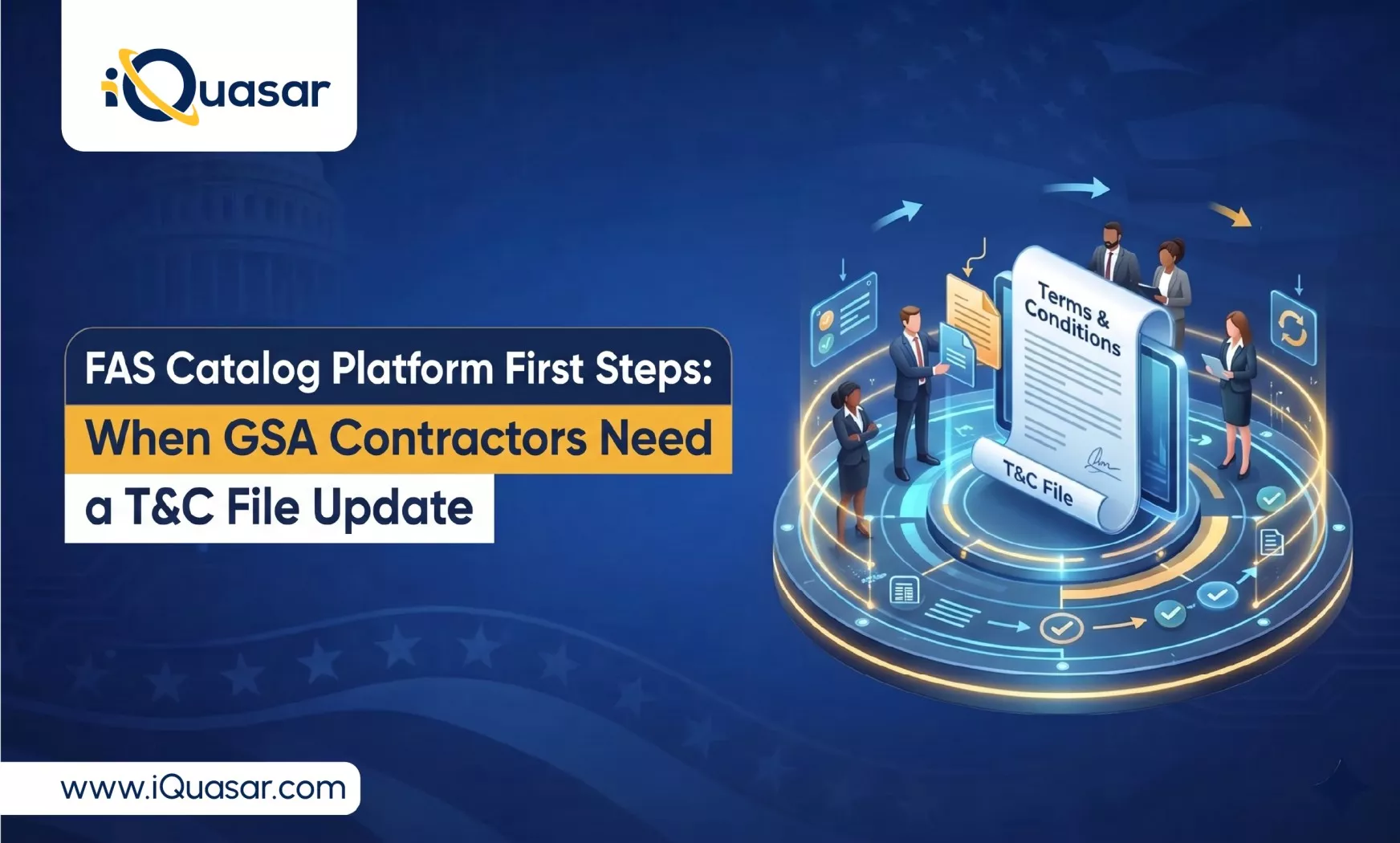
Starting April 6, 2026, GSA MAS contractors moving through the FAS Catalog Platform (FCP) First Steps onboarding process will be required to update their Terms & Conditions (T&C) File. While maintaining a current T&C File has always been part of MAS contract administration, FCP now makes it a visible and required step within the onboarding workflow.
This update is especially important for new contractors awarded after August 28, 2025, brand-new FCP users, and existing FCP users adding catalog offerings that require a new Baseline action, such as introducing services after previously offering only products on GSA Advantage. For these contractors, the T&C File serves as a verifiable baseline for current contract terms before catalog management begins in FCP.
The change also reinforces a broader shift in GSA catalog management: contract data, catalog content, and awarded terms must remain aligned throughout the contract lifecycle. Rather than treating the T&C File as a one-time upload, contractors should view it as an ongoing governance document that may need to be updated when approved modifications affect contract terms.
In this blog, we explain when GSA MAS contractors need to update their T&C File in FCP, how the First Steps process identifies the requirement, what should be included or removed from the file, and how contractors can prepare for smoother onboarding and ongoing catalog compliance.
When Do You Need to Update Your T&C File in FCP?
When you access your catalog in catalog.gsa.gov, the “Update T&C” action appears in the First Steps banner at the top of your Catalog Overview page when required.
1. How should I prepare my new file?
Existing contractors: download your current file from GSA eLibrary and update it as needed to remove all pricing and catalog details from your Product File or Services Plus File. New awards: refer to the I-FSS-600 for T&C requirements. Do not include pricing for any offerings listed on the Product File or Services Plus File. Only vendors with SINs that require specific PPTs should include catalog details in the T&C.
Who is not impacted?
You will not see this requirement if your contract was awarded after August 28, 2025, and you have already loaded a T&C File. Likewise, if your contract was awarded prior to August 28, 2025, and you have already transitioned to FCP prior to this requirement, you may not face the update in the same onboarding cycle.
Resources to support this update include the Terms & Conditions FAQ and the Getting Started Guide. See the Terms & Conditions FAQ at catalog.gsa.gov/help#tnc and download the Getting Started Guide for step-by-step onboarding instructions. These resources provide the official guidance that underpins the onboarding changes and the T&C preparation steps described in this article.
2. Who Must Update the T&C File and Why It Matters
Any contractor completing FCP First Steps should expect this requirement. That includes contractors newly identified for FCP onboarding and those entering the platform through applicable catalog workflows. GSA’s First Steps guidance is explicit: all users, including PPT users, must submit an up-to-date T&C file as part of onboarding. In practical terms, MAS contractors migrating into FCP or expanding catalog offerings should treat the T&C file as a required onboarding deliverable, not an optional cleanup item.
Expert Insights: From a governance and risk-management perspective, tying onboarding readiness to a current T&C file provides a verifiable baseline for terms across the catalog platform. It reduces the chance of misaligned terms during live catalog operations and supports faster, more predictable post-onboarding changes. For GSA MAS contractors, this alignment translates into clearer accountability and smoother lifecycle management of the FCP catalog. Thought process: In practice, embedding a T&C check into onboarding reduces back-and-forth later and creates a single source of truth for terms that governs catalog content decisions and changes.
Who is most affected by this update?
Existing MAS contractors transitioning into FCP, contractors using Product File or Services Plus File workflows, and those still operating with limited legacy PPT workflows. The compliance point is simple: if your contract moves through the First Steps funnel, the T&C file should be treated as a required onboarding deliverable, not a one-off archival task.
3. Notification, Onboarding, and How to Know When an Update Is Required
Contractors identified for FCP onboarding will receive advance notifications, with current First Steps guidance referencing notices issued 28, 14, and 7 days in advance. Detailed instructions will accompany the contract’s identification for FCP, and notification timing is designed to give teams ample runway to prepare the updated T&C file. In addition to these communications, operational cues appear inside the onboarding flow itself. If a contract is entering FCP, the First Steps process will include the T&C upload as part of the onboarding workflow. This is why teams should review transition notices early and align their internal readiness with the upcoming FCP onboarding milestones rather than scrambling at the last minute.
Will you know when you need to update?
Yes. When your catalog moves into FCP, the onboarding banner and tasks will reflect the “Update T&C” requirement as part of First Steps. If the contract is progressing toward FCP, the T&C file upload becomes a gating step for completing onboarding. The implication is clear: monitor onboarding notices and the catalog overview for the visible action items tied to T&C updates.
4. Preparing and Validating Your T&C File
The T&C file should reflect the terms of the awarded contract, but content rules differ by catalog type. Product File or Services Plus File users must ensure the T&C file does not include pricing. For limited vendors using legacy PPT workflows, the T&C file should include a price list. Before uploading, stakeholders should verify:
- The T&C file accurately reflects the currently awarded contract terms.
- Pricing is removed if the contractor uses the Product File or the Services Plus File.
- A price list is included only where legacy PPT guidance applies.
Starting April 6, 2026, the preparation step becomes even more critical, as the onboarding system enforces pricing based on catalog type. If you are an existing contractor, download your current T&C file from the GSA eLibrary and update it to remove all pricing and catalog details tied to your Product File or Services Plus File. For new awards or new entrants to FCP, refer to existing T&C guidance and ensure pricing is not included for Product File or Services Plus File offerings. Only vendors with SINs requiring specific PPTs should include catalog details in the T&C.
How do you know which guidance to follow?
If you are new to FCP onboarding or adding a new catalog offering that requires a Baseline action (for example, introducing services after previously offering only products on GSA Advantage), your T&C file must be updated to reflect the current state of offerings and terms. The updated file should be consistent with the I-FSS-600 guidance for T&C requirements. Do not include pricing for offerings listed on the Product File or Services Plus File; pricing inclusion is reserved for certain legacy PPT scenarios.
5. Scope, Impact, and Non-Impacted Scenarios
The update affects MAS contractors moving into FCP and those managing catalog content through FCP-based workflows. It also matters after onboarding because later-approved modifications that affect the T&C file may require an updated T&C file in FCP. The implication is broader than a one-time onboarding task: contractors should view the T&C file as part of ongoing catalog maintenance and contract administration within the FCP environment.
Who is not impacted?
You will not see this requirement if your contract was awarded after August 28, 2025, and you have already loaded a T&C File. Likewise, if your contract was awarded prior to August 28, 2025, and you have already transitioned to FCP prior to this requirement, you may not face the update in the same onboarding cycle. For those who do encounter the need, the process is designed to be straightforward and integrated into the First Steps flow to minimize downstream disruption.
Also Read: GSA MAS Refresh 31 – What Contractors Should Know
6. FAQs, Resources, and Next Steps
1. Is the T&C file mandatory during FCP First Steps onboarding?
Yes. Contractors completing FCP First Steps are required to submit an up-to-date T&C file as part of onboarding, regardless of catalog workflow.
2. Can pricing be included in the T&C file?
In most cases, no. Contractors using Product File or Services Plus File workflows should not include pricing. Only limited legacy PPT scenarios require pricing in the T&C file.
3. What happens if the T&C file is not updated during onboarding?
Failure to complete First Steps, including the T&C upload, can delay onboarding and prevent submission of catalog-related modifications within FCP.
4. Do contractors need to update the T&C file after onboarding?
Yes. Any approved modification that affects contract terms may require an updated T&C file, making it an ongoing compliance requirement.
5. Who is required to update the T&C file?
Contractors transitioning into FCP, adding new catalog offerings requiring a Baseline action, or identified for onboarding should expect to complete this requirement.
Resources: See FAS Catalog Platform Frequently Asked Questions
Conclusion
The FAS Catalog Platform First Steps update reinforces the importance of maintaining an accurate and current Terms & Conditions file as part of both onboarding and ongoing catalog management. Rather than a one-time administrative task, the T&C file now serves as a controlled baseline for contract terms within the FCP environment, supporting consistent governance and smoother contract lifecycle management.
Contractors that proactively align their T&C file with current contract terms, catalog workflows, and FCP requirements are better positioned to avoid onboarding delays, maintain compliance, and manage catalog updates more efficiently as their contracts evolve.
For organizations navigating FCP onboarding and catalog compliance, iQuasar’s GSA MAS Schedule Service supports T&C file preparation, catalog management, contract modifications, and ongoing MAS administration, helping contractors maintain compliance while improving operational efficiency within the FCP environment.
To learn how your organization can streamline FCP onboarding and strengthen GSA MAS compliance, contact our team.