Latest Updates:
December 18, 2025
SBA Data Call: Deadline Extended Until January 19, 2026
U.S. Small Business Administration has extended the submission deadline for the ongoing SBA 8(a) Program Audit (Data Call) to January 19, 2026, following industry feedback and the publication of expanded official guidance through its Certifications Knowledge Base.
This update relates to the SBA data call originally issued on December 5, 2025, which requires all active 8(a) Program participants to submit detailed financial, tax, and operational records as part of a program-wide audit initiative.
Key Clarifications from SBA FAQs
In addition to extending the deadline, SBA has clarified several important requirements via its official 8(a) Data Call FAQs, including:
- Fiscal Year Definition: Required submissions must cover the last three (3) closed fiscal years of the participant, not the government fiscal year. Only closed fiscal years apply.
- Non-Existent Records: If a requested document (e.g., a sub-ledger) does not exist, participants must provide a brief explanation and formally attest to its absence.
- Ledger Submissions: SBA has confirmed that all sheets within the requested ledgers must be submitted, not summaries or partial files.
- IRS Form 4506 Requirement: Participants must complete and upload Form 4506 authorizing SBA to obtain previously filed Form 1040 (or equivalent) and Form 941 for tax years 2023, 2024, and 2025.
- Participants with No Contract Revenue: Firms without revenue from contract actions or awards must submit an attestation statement for each applicable prompt, followed by completion of the Attest and Submit steps in the Certifications Portal.
SBA has stated that additional FAQs will continue to be issued as questions are reviewed and addressed.
Official Support and Guidance
For clarification or assistance related to the 8(a) Audit/Data Call, SBA directs participants to:
- Email: [email protected]
- Phone: 866-SBA-HELP (866-722-4357)
8(a) participants should continue monitoring the SBA Certifications Portal and the official FAQ repository for further updates or clarifications.
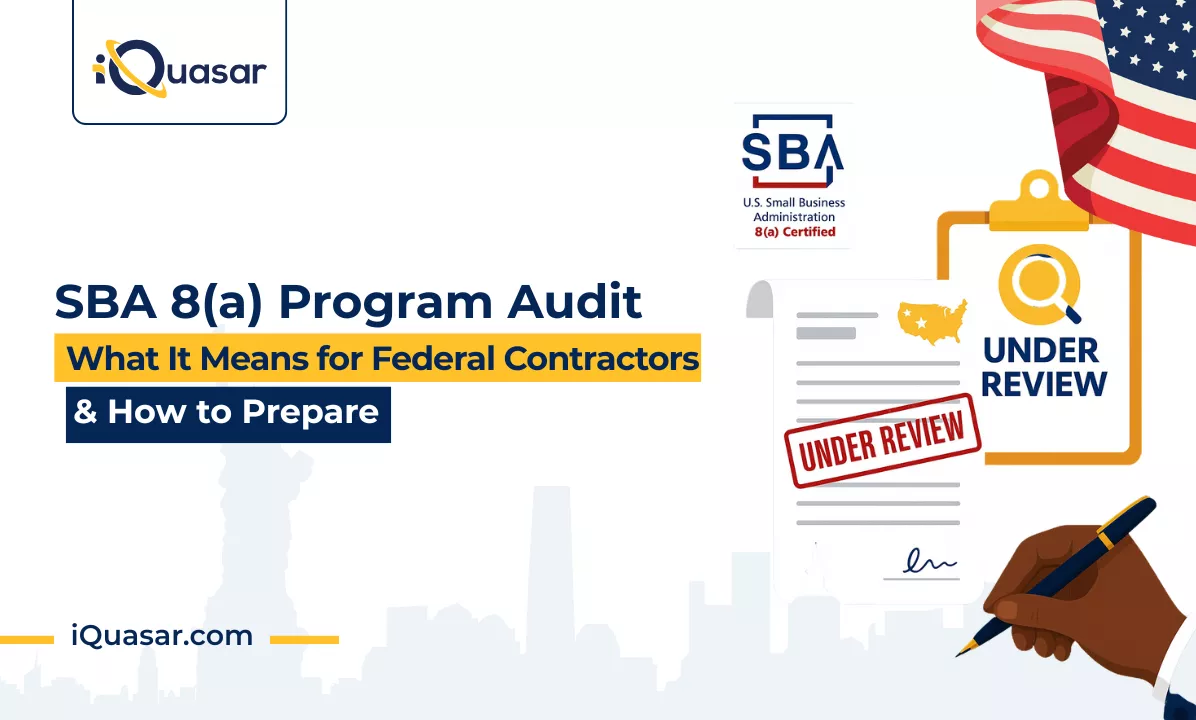
In June 2025, the U.S. Small Business Administration (SBA) launched the 8(a) Program Audit, marking the most extensive review in the program’s 45-year history. This full-scale audit was ordered after the Department of Justice uncovered a $550 million bribery scheme in which a USAID contracting officer steered sole-source contracts to 8(a) firms in exchange for cash, gifts, and employment opportunities. Administrator Kelly Loeffler directed the SBA’s Office of Government Contracting and Business Development to review 15 years of 8(a) awards. Findings will be forwarded to the SBA Inspector General and the DOJ, and the agency is prepared to pursue clawbacks of misused funds.
This blog distills the audit’s background, explains its effects across federal agencies, and highlights best practices for current 8(a) participants and applicants.
Why Is the SBA Auditing the 8(a) Program?
The 8(a) Business Development Program was established to assist small businesses owned by socially and economically disadvantaged individuals in competing for federal contracts. Qualified firms can receive sole-source and set-aside awards, participate in joint ventures, and benefit from mentorship and training opportunities. To qualify, a firm must be a small business, be 51% owned and controlled by U.S. citizens who are socially and economically disadvantaged, meet personal net‑worth and income limits, and demonstrate good character. Certification lasts up to nine years, divided into development and transitional stages, and requires annual recertification.
Despite the program’s noble goals, recent investigations exposed systemic abuses. DOJ prosecutors found that a USAID contracting officer accepted bribes from 8(a) contractors and steered more than $550 million in contracts. Other cases uncovered pass‑through schemes where 8(a) companies served as nominal primes while most of the work and profits flowed to non‑8(a) partners. In one instance, a joint venture won an $800 million contract the same day one of its partners was debarred for lack of “honesty or integrity.” High-profile cases, such as those involving ATI Government Solutions and its tribal owner, the Susanville Indian Rancheria, allegedly subcontracted approximately 80% of the work while collecting management fees; both entities were suspended from federal contracting in October 2025.
These abuses prompted calls for stricter oversight and regulation. Executive Order 14151 (January 2025) directed federal agencies to end diversity‑ and equity‑focused contracting preferences, and the SBA reset its small disadvantaged business (SDB) goal to the statutory minimum of 5% of eligible contract dollars. Previously, the goal was 15%, so this change represented a substantial reduction in set‑aside opportunities. A 2025 SBA table of agency goals confirms that nearly every federal department’s prime SDB goal for FY 2025 is 5%.
Scope of the Audit
The audit is both retrospective and comprehensive in nature. Its key features include:
- Fifteen‑year look‑back: Contracts dating back to roughly 2010 are being scrutinized. The review begins with high-value, sole-source, and limited-competition awards, especially joint ventures where the disadvantaged partner may have played only a nominal role.
- Cross‑agency review: Every federal agency that issued 8(a) contracts is participating. USAID’s authority to independently award 8(a) contracts has been rescinded, and other agencies are reviewing their portfolios.
- Strict enforcement: Findings will be referred to the SBA Inspector General and the DOJ. Contractors found to be non-compliant could face suspension, debarment, False Claims Act liability, and clawbacks equal to the entire contract value.
- Program remains open: Despite the audit, the 8(a) program continues to accept applications and award contracts. The SBA urges agencies to continue using it, especially during end‑of‑fiscal‑year spending surges.
Impact on Agencies and Industry
Federal Agencies
The audit has immediate operational and policy implications across the federal government:
- Reduced set-aside goals: With the shift from 15% to 5%, agencies have fewer dollars to allocate to small disadvantaged businesses. Departments from USAID to the Department of Defense have a 5% prime SDB goal.
- Increased compliance burden: Contracting officers must verify 8(a) eligibility and ensure that prime contractors perform at least 50% of the work. Many agencies have paused 8(a) solicitations to recheck eligibility and avoid awarding contracts to suspended firms.
- Agency‑specific actions: USAID’s 8(a) authority was revoked, the General Services Administration paused ATI Government Solutions’ ability to pursue new work, and other agencies are reviewing their portfolios for similar issues.
Implications for the Market
- Fewer set‑aside opportunities: The lower SDB goal means fewer sole‑source and limited‑competition awards for 8(a) firms. Competition is likely to increase as agencies turn to other socioeconomic categories.
- Delays and uncertainty: Increased reviews may slow down award timelines. Companies should anticipate more questions about eligibility, performance, and joint‑venture structures.
Impact on Current 8(a) Participants
Existing 8(a) firms face heightened scrutiny and new procedural requirements:
Annual Reviews and Site Visits:
The audit indicates that all 8(a) contracts, including those that have been completed, may be examined. Contractors should be prepared for document requests, interviews, and on‑site inspections.
Documentation of Performance:
Firms must demonstrate that they have performed the “primary and vital” requirements and that subcontractors have not exceeded the allowed percentages. Good record‑keeping and job‑cost reporting are essential.
Stricter Eligibility and Recertification:
After the Ultima court decision eliminated the presumption of social disadvantage, individual‑owned 8(a) participants that previously relied on that presumption must submit a social disadvantage narrative through the SBA’s Certify portal. Those who fail to submit are suspended until they comply. Entity‑owned firms (tribes, Alaska Native Corporations, and Native Hawaiian Organizations) are unaffected.
Good Character Requirement:
Principals must have “good character.” Findings of bribery or fraud are likely to lead to suspension or debarment.
Considerations for Firms Seeking 8(a) Certification
Although the audit adds hurdles, the 8(a) program remains open for new applicants. Prospective participants should pay attention to:
Robust Eligibility Documentation:
The SBA requires evidence of both social and economic disadvantage. Applicants must provide detailed personal narratives, financial statements, tax returns, and proof of majority ownership and control. Narratives must clearly link personal experiences to barriers in business.
Financial Reporting Thresholds:
For FY 2025, the SBA requires audited financial statements for firms with revenue exceeding $20 million, reviewed statements for revenue between $7.5 million and $ 20 million, and compiled statements for smaller firms. Prospective applicants should prepare to upgrade their accounting processes accordingly.
Longer Review Timelines:
The audit consumes SBA resources, so new certifications may take longer to complete. Applicants should allow extra time for responding to information requests and potential site visits.
Next Steps for 8(a) Firms and Applicants
The audit is an opportunity to strengthen compliance and demonstrate integrity. Here are practical steps for current 8(a) participants and aspiring applicants:
Conduct a Self‑Audit:
Review all 8(a) contracts back to 2010 and verify that your firm performed the required percentage of work. Document decision‑making processes, joint‑venture agreements, and compliance with limitations on subcontracting.
Update Compliance Policies:
Establish written policies on ownership, control, and subcontracting. Train managers and proposal teams to adhere to these guidelines. Institute segregation of duties in accounting and procurement to detect irregularities.
Prepare Narratives and Financials:
Current participants who relied on the presumption of disadvantage must submit a social disadvantage narrative through the Certify portal. Applicants should begin drafting narratives early and gather documentation of discrimination or disadvantage. Upgrade accounting processes to meet audited or reviewed financial statement requirements.
Also Read: Key Preparation for a Successful SBA 8(a) Audit Response
Respond promptly to SBA Requests for Information or site‑visit notices. Keep contact information current in SAM.gov and Certify, and track agency announcements that could affect your pipeline.
Practice Due Diligence:
Primes should vet 8(a) partners and include anti‑pass‑through clauses in teaming agreements. 8(a) Firms should evaluate prime partners’ ethics policies to ensure they comply with program requirements.
Consider Voluntary Disclosure:
If an internal review uncovers non‑compliance, evaluate whether self‑reporting could mitigate penalties and demonstrate good faith.
iQuasar’s Role in Your 8(a) Journey
The regulatory environment surrounding the 8(a) program has grown more complex. iQuasar has supported small businesses and prime contractors for over 20 years through proposal development, compliance assessments, and certification services. Here’s how we can help:
- Audit readiness assessments: We review your contracts, financial statements, and corporate structure to identify potential vulnerabilities and provide a roadmap to address them before the SBA audit.
- Social disadvantage narrative support: Crafting a compelling narrative requires both legal and storytelling expertise. We guide you through identifying qualifying experiences, organizing evidence, and aligning your submission with SBA guidelines.
- Certification and recertification assistance: From SAM.gov registration to MySBA Certifications, we manage documentation, ensure financial statements meet the correct level of assurance, and track deadlines to keep your application on schedule.
- Compliance training and policy development: We develop customized training programs to educate your team on the limitations of subcontracting, joint-venture rules, and ethics obligations. Policies are tailored to fit your organization’s size, structure, and industry.
The SBA’s 2025 audit signals a decisive shift toward integrity and accountability in federal small business contracting. Heightened scrutiny and reduced set‑aside goals may seem daunting, but firms that embrace compliance and transparency can continue to thrive. The 8(a) program remains open and viable for disadvantaged entrepreneurs, yet success will depend on meticulous documentation, robust internal controls, and an unwavering commitment to ethical business practices.
iQuasar stands ready to help your business navigate this new environment. Our 8(a) audit readiness and certification services are designed to minimize risk and maximize opportunity, enabling you to focus on what you do best—delivering outstanding solutions to federal customers.
Disclaimer: This blog is for informational purposes only and does not constitute legal advice.