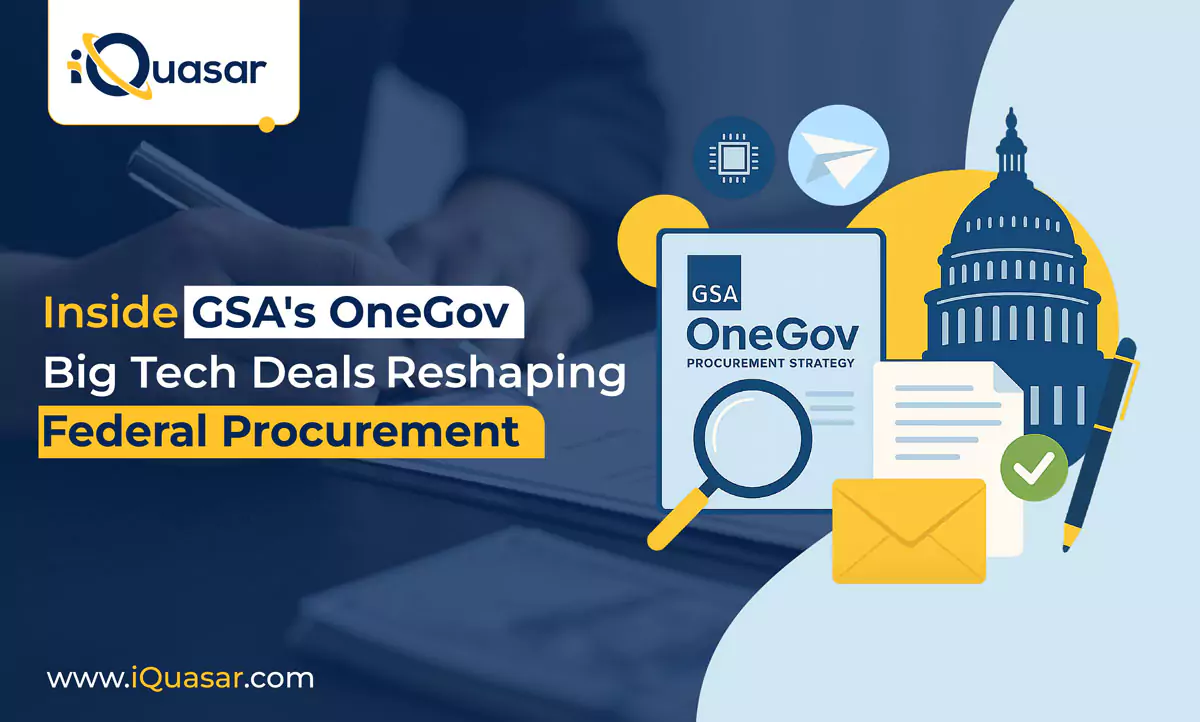
When the General Services Administration (GSA) launched its OneGov Strategy in April 2025, it promised something federal buyers have wanted for years: a more innovative, faster, and more unified way to get the technology agencies actually need.
Since then, under the OneGov strategy, GSA has made headlines with significant deals involving the biggest names in tech, particularly in AI. Alongside a lot of enthusiasm and excitement, there has been pushback, tough questions, and genuine concerns raised by various quarters. Let’s dig right into the blog.
Recent Milestones
1. Meta’s Llama Open Source AI Models (September 2025)
On September 22, GSA added Meta’s Llama open-source AI models to the OneGov portfolio. Agencies now have streamlined access under pre-negotiated terms, eliminating duplicative acquisition processes.
Why it matters: Open-source AI provides agencies with more flexibility and control—whether for research, mission-specific AI solutions, or custom development. This reduces vendor lock-in and broadens innovation opportunities. Contractors skilled at fine-tuning and operationalizing Llama models will be in high demand.
2. Microsoft Cloud and AI Savings Package (September 2025)
On September 2, GSA announced its largest OneGov deal yet with Microsoft, projected to save the government $3.1 billion in the first year. The agreement includes Microsoft 365, Copilot, Azure, Dynamics 365, and cybersecurity tools. Eligible agencies can access Microsoft 365 with Copilot at no cost for one year, and all offerings remain open for opt-in through September 2026.
Why it matters: Microsoft is at the heart of federal IT. By embedding Copilot and offering substantial discounts, GSA is helping agencies modernize their day-to-day productivity and security without sparking budgetary disputes. Contractors should anticipate demand for deployment, training, and workflow redesign around Microsoft’s ecosystem.
3. ServiceNow Workflow Modernization (September 2025)
On September 3, GSA and ServiceNow struck a OneGov deal aimed at transforming government workflows. Agencies can upgrade to ITSM Pro or ITSM Pro Plus at up to 70% off, or purchase ITSM Pro standalone with a 40% discount. The platform brings predictive analytics, process mining, and workforce optimization—features projected to improve efficiency by 30% or more.
Why it matters: Outdated systems bog down federal operations. ServiceNow’s platform introduces automation and intelligence that can cut delays and free staff for higher-value work. Contractors who act as workflow architects and integrators will find fertile ground here.
4. Google Gemini for Government (August 2025)
GSA and Google announced Gemini for Government for just 47 cents per agency.
What’s included – Agencies get access to Google’s whole AI ecosystem: Gemini models, NotebookLM for research support, enterprise search, AI agents, and even multimedia generation tools. The offering also comes wrapped in FedRAMP High compliance, addressing one of the biggest barriers agencies face with commercial AI adoption.
Why it matters: The pricing is symbolic—it’s less about cost and more about signaling. For less than a dollar, agencies can begin experimenting with advanced AI tools in a secure environment. That could unlock faster adoption across missions ranging from data analysis to citizen services.
5. Anthropic’s Claude Across All Three Branches (August 2025)
GSA cut a OneGov deal with Anthropic that made waves for a different reason: it covers all three branches of government—executive, legislative, and judicial.
For $1 per agency, Claude AI (Enterprise and Government editions) is now available as a standard tool across the federal government. This is the first time OneGov has crossed beyond executive agencies, signaling a new level of coordination across branches that historically have bought separately.
Why it matters: This agreement is about reach. By covering multiple branches, it sets a precedent for AI tools becoming as common as email or office software in government. It also signals a shift toward treating AI as infrastructure, not just “emerging tech.”
6. Box Collaboration and Content Management (August 2025)
On August 13, GSA announced a deal with Box offering up to 75% discounts on Box’s Enterprise Plus and Enterprise Advanced for Government platforms.
Box AI—built directly into the platform—allows agencies to automate workflows, search across massive datasets, and streamline document-heavy processes. And because it’s FedRAMP High and DoD IL4 compliant, agencies can adopt it without the need for lengthy security approvals.
Why it matters: Federal agencies are drowning in content and paperwork. By putting AI inside content management, Box is helping shift government work away from manual document handling to smarter, automated processes. Think faster claims processing for veterans or quicker disaster response coordination.
7. AWS $1 Billion in Cloud Credits (August 2025)
Amazon Web Services and GSA unveiled a landmark OneGov agreement worth up to $1 billion in direct credits across civilian agencies through 2028.
The deal doesn’t just provide cloud capacity. It includes training credits, modernization support, and a streamlined engagement model designed to reduce the complexity agencies often face when dealing with large cloud migrations.
Why it matters: Many agencies struggle to find a budget for modernization. By offering credits upfront, AWS is essentially subsidizing the cost of cloud adoption. This accelerates not just AI integration but also long-overdue infrastructure upgrades.
8. Oracle’s Deep Discounts (July 2025)
GSA announced a OneGov deal with Oracle, offering 75% off license-based technologies, including Oracle Database 23ai running on Oracle Cloud Infrastructure (OCI).
The agreement also waives data egress fees (a common pain point when agencies move workloads between providers), includes migration support, and guarantees parity with commercial pricing.
Why it matters: Oracle’s inclusion shows OneGov isn’t just about flashy new AI tools. It’s also about making core, mission-critical technologies—like databases—more affordable and easier to modernize. For agencies locked into legacy systems, this is a way forward without the typical sticker shock.
Also Read: GSA MAS Refresh #29 – All You Need to Know
Strategic Evolution of GSA OneGov
When OneGov launched, GSA promised transformation, but didn’t actually publish a formal strategy document. Even without that, the results have been showing up fast:
- By mid-2025, half of GSA’s workforce was using its internal generative AI platform daily—saving 300,000 work hours in just six months.
- Vendors are lining up, and agencies are starting to get comfortable with the idea of “buy once, use everywhere.”
OneGov may not be perfectly polished, but it’s proving that the government can move fast when it needs to.
Challenges & Oversight
Of course, speed comes with scrutiny. In August, Ask Sage filed protests with GAO over the OneGov deals with OpenAI and Anthropic, led by former Air Force software officer Nicolas Chaillan.
Their concerns boil down to:
- Did GSA skip traditional acquisition safeguards?
- Are these vendors fully FedRAMP authorized?
- Are agencies being misled about pricing or data security?
Whether or not those protests hold, they highlight the balancing act OneGov faces: delivering efficiency without compromising compliance, fairness, or trust.
Preparing as a Contractor
For government contractors, OneGov is both an opportunity and a wake-up call. With GSA brokering direct agreements with major OEMs, the landscape for resellers, integrators, and service providers is shifting. Here’s how to get ready:
- Know what’s in OneGov: If your agency customers can already access Gemini, Claude, Box, AWS, or Oracle through GSA, your role changes. Instead of selling licenses, your value is in integration, customization, and mission support.
- Shift from “product” to “services”: Agencies will still need help deploying these tools, training staff, and adapting workflows. Contractors who can translate technology into mission impact will be in demand.
- Lean into compliance and security: With protests already underway, agencies will look to partners who understand FedRAMP, CUI, and acquisition rules. Position yourself as the contractor who can navigate the gray areas with confidence.
- Stay close to your customer: OneGov deals are moving fast. Contracting officers and program managers may not fully understand what’s available yet. Helping them connect the dots makes you a trusted advisor.
The GSA’s OneGov Strategy is bold, disruptive, and moving at a pace that’s unusual for federal acquisition. Deals with Google, Anthropic, Box, AWS, and Oracle are already reshaping how agencies access AI, cloud, and enterprise tools—often at a fraction of the cost they’d pay on their own.
But this is still the early phase. OneGov will ultimately be judged not just on savings or speed, but on whether it can also maintain the security, oversight, and transparency that federal procurement demands.
At iQuasar, we are closely following all updates on GSA OneGov, as well as other developments in federal procurement. We provide the latest updates on federal procurement on a weekly basis. Feel free to contact us to know more about how we can help you succeed in government contracting.