Imagine a project where a single missed security clearance triggers delays worth millions, or where a gap in cybersecurity skills risks your eligibility for a top federal contract. With the advent of CMMC 2.0 & TSW 2.0, these scenarios are no longer hypothetical; they’re urgent realities for federal contractors navigating today’s tighter compliance landscape.
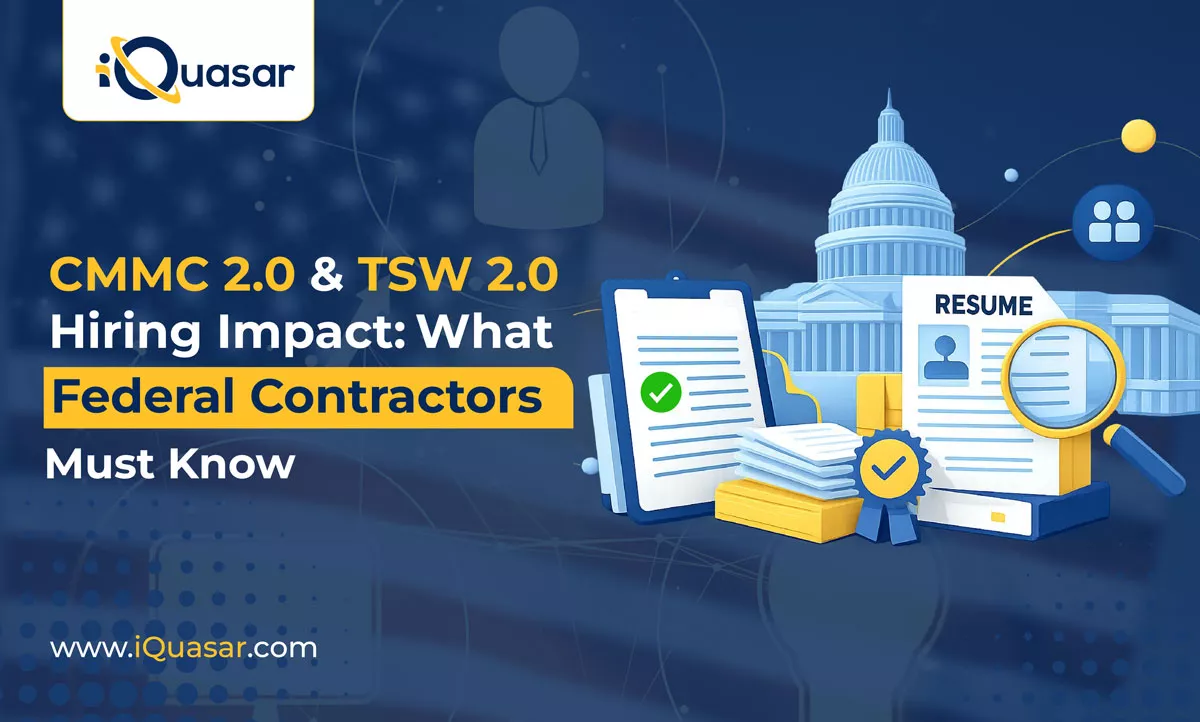
Both Cybersecurity Maturity Model Certification (CMMC) 2.0 and Trusted Workforce 2.0 (TSW 2.0) are reshaping federal acquisition and security hiring practices. This blog decodes their impact, focusing on talent pipelines, job descriptions, and must-have skills, so you can adapt and thrive in this new environment.
The New Landscape of Compliance: CMMC 2.0 & TSW 2.0
CMMC 2.0 Overview
CMMC 2.0 is an updated cybersecurity framework mandated by the Department of Defense. Unlike its predecessor, CMMC 2.0 reduces the number of compliance levels from five to three, placing a tighter focus on core cybersecurity practices and aligning more closely with NIST SP 800-171.

CMMC 2.0 Levels at-a-Glance:
- Level 1 – Basic cyber hygiene; focuses on 17 key practices (mainly access controls).
- Level 2 – Advanced practices; includes 110 controls mapped to NIST SP 800-171.
- Level 3 – Expert protections; adds NIST SP 800-172 controls for contractors with critical roles.
TSW 2.0 Overview
Trusted Workforce 2.0 (TSW 2.0) is the federal government’s overhaul of security clearance and personnel vetting, championed by the Office of the Director of National Intelligence (ODNI).
- Dynamic Vetting: TSW 2.0 replaces periodic, static clearance checks with continuous vetting, allowing for ongoing review of employees’ eligibility and risk.
- Integrated Systems: Agencies are merging background checks, adjudications, and suitability processes under one digital umbrella for greater speed and accuracy.

Impact for Contractors:
- Personnel must be ready for real-time clearance reviews
- Staffing can’t rely on one-time background checks; everyone is subject to ongoing monitoring
Understanding the Shift: Why CMMC 2.0 and TSW 2.0 Matter Together
While CMMC 2.0 and TSW 2.0 are separate initiatives, they intersect at a critical point: people.
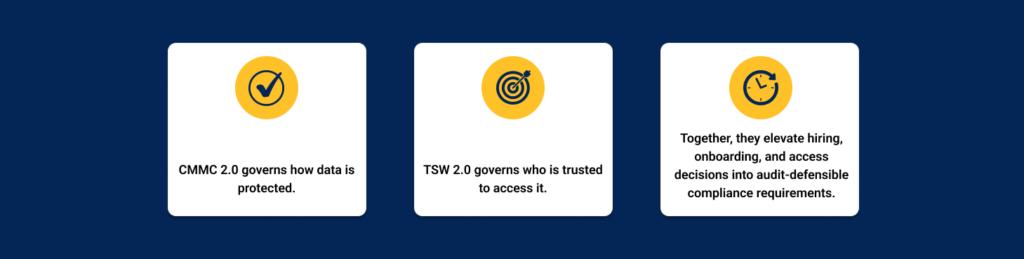
- CMMC 2.0 governs how you protect Controlled Unclassified Information (CUI)
- TSW 2.0 governs who is trusted to access systems, data, and missions
Together, they elevate workforce scrutiny, making hiring, onboarding, and workforce planning central to compliance.
CMMC 2.0: The Hidden Hiring Implications
Most conversations around CMMC focus on tools, controls, and assessments. But people are one of the highest-risk compliance vectors.
Key Hiring Impacts
- Security-aware talent is no longer optional: Even non-IT roles interacting with CUI now require cybersecurity awareness and policy adherence.
- Role-based access matters more than headcount: Contractors must clearly define who can access what, and justify it during audits.
- Documentation expectations are rising: Hiring records, access control decisions, and training logs are now compliance artifacts, not HR paperwork.
Bottom line: Hiring the wrong person, or onboarding them incorrectly, can jeopardize your CMMC posture.
TSW 2.0: Faster Clearances, Higher Accountability
TSW 2.0 aims to modernize federal vetting by improving speed, reciprocity, and continuous evaluation. But for contractors, it also introduces new workforce pressures.
What’s Changing
- Clearance velocity is improving, but scrutiny remains high: Faster processing does not mean lower standards. Continuous vetting increases post-hire accountability.
- Trust is role-based, not blanket-based: Access decisions must align precisely with job functions and mission needs.
- Workforce mobility is increasing: Cleared professionals can move faster, raising retention risks for contractors.
Bottom line: Contractors must compete harder for cleared talent while maintaining tighter internal controls.
Adapting Job Descriptions for CMMC 2.0 & TSW 2.0
Cybersecurity Role Requirements
- List certifications as requirements (e.g., CISSP, CompTIA Security+, CISA, and specific CMMC qualifications).
- Specify experience with NIST standards.
- Require demonstrable compliance and risk management skills in federal contexts.
Top requirements: Certifications (CISSP, Security+), Federal sector experience, NIST SP 800-171 familiarity.
Personnel Security Role Requirements
- Knowledge of continuous vetting and clearance management.
- Experience with digital documentation and clearance verification.
- Familiarity with automated vetting and compliance tools.
Look for: FSO experience, Vetting oversight skills, Automated clearance tracking proficiency.
Where Contractors Are Feeling the Pressure Most
- Cleared Cybersecurity Talent Shortage: CMMC-aligned cybersecurity professionals with active clearances are in short supply—and high demand.
- Contract Staffing Risk: Winning a contract without proven, compliant staffing readiness increases performance and CPARS risk.
- Audit-Driven Hiring Decisions: Hiring is no longer just about skills; it’s about audit defensibility.
What Federal Contractors Should Do Now
1. Align Hiring with Compliance, Not Just Delivery
HR, security, and program teams must collaborate. Hiring decisions should map directly to:
- CMMC access controls
- TSW trust requirements
- Contract-specific security clauses
2. Build a Clearance-Ready Talent Pipeline
Reactive hiring won’t work. Contractors need:
- Pre-vetted cleared candidates
- Contingency staffing plans
- Scalable cleared recruitment partners
3. Treat Workforce Planning as a Compliance Function
Your workforce strategy should answer:
- Who accesses CUI?
- Why do they need access?
- How is access reviewed, revoked, and documented?
Also Read: Trusted Workforce Initiative 2.0: Revolutionizing Vetting
What Workforce Readiness Looks Like Under CMMC 2.0 & TSW 2.0
True readiness means more than passing audits; it means sustained compliance. Signs of readiness:
- Staff routinely participate in compliance and security refreshers
- HR and security teams collaborate for full-cycle clearance oversight
- Automated tools track workforce eligibility in real-time
Preparing for the Future: 5 Actionable Takeaways
Start building your talent pipeline now for cybersecurity and clearance-driven roles before contracts demand them.
Invest in continuous training so your teams remain up-to-date on CMMC 2.0 & TSW 2.0 standards.
Adapt job descriptions to reflect new certifications, both technical and compliance-focused.
Monitor regulatory updates (e.g., Federal Acquisition Regulation changes, CMMC, TSW) and align hiring targets accordingly.
Integrate compliance monitoring tools to streamline readiness checks and react swiftly to audit requirements.
If you’re evaluating CMMC 2.0 & TSW 2.0 Hiring Impact for your organization, our expert recruitment team can help you assess options and build a pragmatic roadmap. Explore how our workforce solutions at iQuasar support outcomes like compliance-ready talent pipelines and ongoing regulatory alignment, or get in touch to discuss your scenario.