In FY 2024, the federal government awarded more than $183 billion in contracts to small businesses, 28.8% of all federal contracting dollars, according to the U.S. Small Business Administration. This record-setting performance underscores the central role that small business programs, particularly the 8(a) Business Development Program, play in expanding disadvantaged firms’ access to federal opportunities.
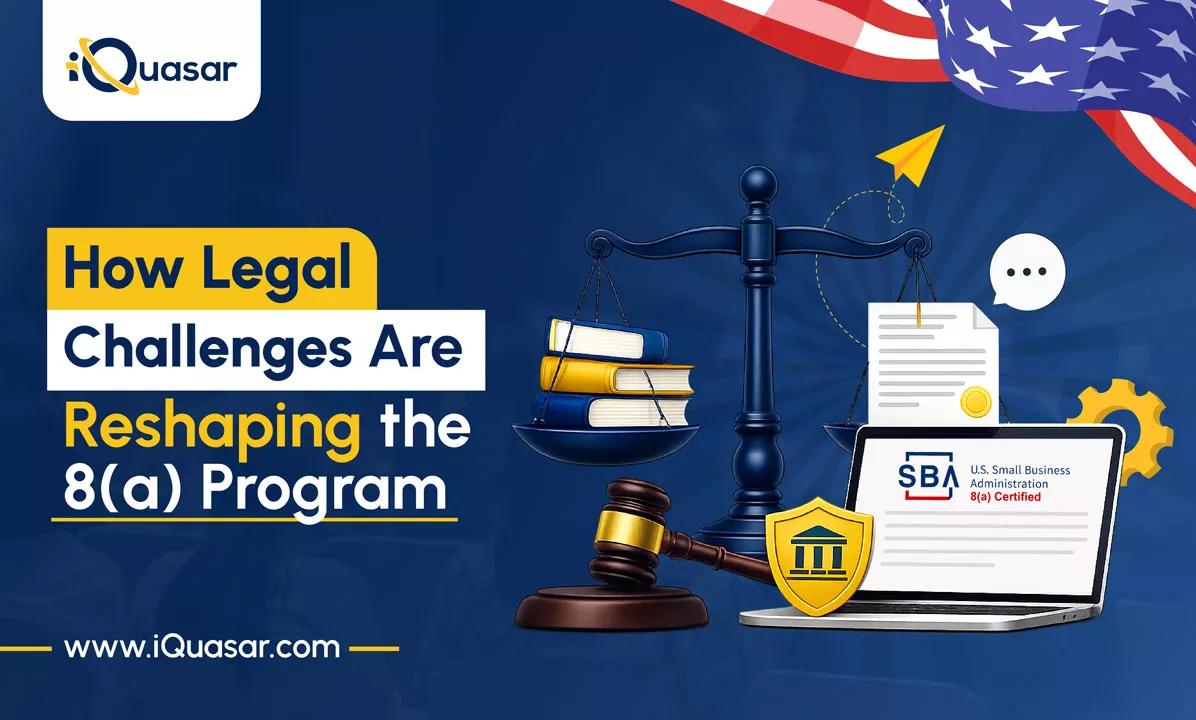
For decades, the 8(a) program has served as a gateway into federal contracting, enabling eligible businesses to access sole-source awards, set-aside competitions, and structured developmental support designed to help them mature into long-term federal contractors. However, 2026 may represent a structural turning point for the program. Increasing legal scrutiny surrounding race-based presumptions of social disadvantage has prompted courts, agencies, and policymakers to revisit how the program is administered. These developments are not theoretical but are actively reshaping eligibility requirements, tightening documentation standards, and influencing how contracting officers evaluate and award 8(a) contracts.
This raises an important question for the GovCon community: Is the 8(a) landscape permanently changing? While the program itself remains a cornerstone of federal small business policy, the rules of the game are evolving. Contractors that understand these shifts and adapt early will be far better positioned to sustain growth in this new environment.
A Quick Refresher – What the 8(a) Program Is Designed to Do
The 8(a) Business Development Program, administered by the U.S. Small Business Administration, is designed to expand access to federal contracting for small businesses owned by socially and economically disadvantaged individuals. More than just a contracting vehicle, the program serves as a structured development pathway, equipping firms with the tools, experience, and opportunities needed to compete in the federal marketplace long after they exit the program. Here’s what it offers:
- Structured Development Lifecycle: The program provides a nine-year participation period, divided into developmental and transitional phases. This phased approach allows firms to build capacity gradually while increasing their exposure to competitive federal opportunities.
- Preferential Contracting Access: Participants gain access to set-aside and sole-source contracting opportunities, enabling agencies to award contracts directly to 8(a) firms below defined thresholds or limit competition to other 8(a) participants for larger requirements.
- Business Development and Mentorship: Beyond contracts, the program offers technical assistance, mentoring, and training to help firms strengthen internal operations, improve compliance, and scale effectively within the federal environment.
- A Bridge to Full and Open Competition: The program is intentionally developmental, not permanent. Its core objective is to prepare firms to compete independently by the end of the nine-year term, with stronger capabilities, past performance, and a more diversified federal customer base.
The Legal Challenges Reshaping the 8(a) Program
Recent legal challenges have focused primarily on the program’s historical reliance on presumptions of social disadvantage tied to certain racial and ethnic groups. Courts have increasingly questioned whether such presumptions align with constitutional equal protection standards. As a result, agencies and the SBA have been forced to adjust how disadvantage is evaluated. Instead of relying primarily on categorical assumptions, the program now places greater emphasis on individualized narratives of social disadvantage supported by clear documentation.
These legal developments have led to several policy shifts. The SBA has updated guidance on how applicants must demonstrate disadvantage, requiring more detailed personal narratives and supporting evidence. Contracting agencies, meanwhile, have become more cautious when issuing sole-source awards through the 8(a) program, often ensuring that eligibility documentation is thoroughly reviewed before proceeding. The certification process itself has also become more rigorous. Firms seeking entry into the program must provide clearer documentation regarding ownership, control, and management authority, along with credible narratives explaining the social and economic barriers they have faced.
Collectively, these changes have created a more documentation-intensive environment for firms seeking to participate in the program.
Immediate Impacts on Federal Contractors
- Longer Application Timelines
- Eligibility narratives now face heightened scrutiny.
- SBA review cycles have lengthened.
- Applicants must invest more time preparing detailed, well‑supported submissions.
- Stricter Eligibility Verification
- Ownership, management, and control structures are being examined more closely.
- Increased scrutiny applies to both new applicants and existing 8(a) participants.
- More Cautious Procurement Behavior
- Contracting officers are being more careful with issuing 8(a) sole‑source awards.
- Additional review steps and potential delays are becoming more common.
- Stronger Documentation Requirements for New Applicants
- New entrants must produce more robust and defensible documentation packages.
- Supporting evidence is expected to be more comprehensive.
- Increased Oversight for Current 8(a) Participants
- Firms already in the program may face closer monitoring of compliance posture.
- Greater emphasis on continual eligibility verification.
- Heightened Pressure on Joint Ventures
- JV agreements must align precisely with SBA requirements.
- Any deviation can increase risk or delay approvals.
- Greater Uncertainty for Prime Contractors
- Primes relying on 8(a) partners may need to anticipate longer timelines.
- Execution risks are increasing due to added scrutiny and procedural delays.
The net effect is clear: the 8(a) landscape is becoming more exacting, and success within it now depends heavily on rigorous compliance, airtight documentation, and proactive preparation.
Strategic Implications for Small Business Positioning
As the 8(a) program evolves, small businesses should carefully consider how heavily their growth strategies depend on it. While 8(a) opportunities remain valuable, relying exclusively on the program creates strategic risk in an environment where eligibility standards and procurement practices are tightening.
Many firms are responding by diversifying their positioning across multiple small business programs. Expanding into programs such as HUBZone, SDVOSB, or WOSB can provide additional contracting pathways and reduce dependence on a single designation. Equally important is the need to build competitive strength beyond status-based advantages. Agencies continue to prioritize vendors that demonstrate strong past performance, technical capability, and reliable program delivery. Firms that develop these capabilities remain competitive whether or not they operate within a specific socioeconomic program.
Mentor-protégé relationships may also require reassessment. While these arrangements remain valuable tools for capability development, they must be structured carefully to ensure compliance with SBA regulations and evolving program expectations. Ultimately, diversification and operational excellence provide the most reliable path for long-term GovCon growth.
Action Plan – What 8(a) Firms Should Do Now
In the current environment, 8(a) firms should treat compliance and documentation readiness as strategic priorities. Several practical steps can help firms maintain stability while the program evolves.
- First, companies should review and strengthen their social disadvantage narratives to ensure they are credible, well-documented, and aligned with SBA guidance. Clear, evidence-based narratives reduce the risk of eligibility questions during reviews.
- Second, firms should maintain organized documentation related to ownership structure, management control, and operational governance. Accurate records help demonstrate compliance if eligibility is questioned.
- Third, contractors should focus on building stronger past performance credentials. Delivering measurable results on current contracts improves competitiveness in both 8(a) and non-8(a) procurements.
- Diversifying contract vehicles is also important. Participating in multiple federal procurement channels helps firms maintain stable revenue even if program conditions change.
- Finally, companies should monitor SBA regulatory updates closely and remain prepared for increased protest activity related to 8(a) procurements. Taken together, these actions form a stability checklist that helps firms navigate uncertainty while maintaining growth momentum.
What the Future May Hold for Socioeconomic Programs
Looking ahead, most experts expect federal socioeconomic contracting programs to continue evolving rather than disappearing. Congress and federal agencies remain committed to supporting small business participation in government contracting, but the mechanisms used to achieve that goal may continue to adapt in response to legal rulings and policy debates. Future changes could include revised eligibility standards, adjustments to documentation requirements, or expanded oversight mechanisms designed to ensure program integrity. At the same time, the balance between legislative priorities and judicial interpretations will likely continue shaping how these programs operate.
One trend appears clear: compliance sophistication will become increasingly important. Firms that invest in strong governance, documentation discipline, and strategic diversification will be better positioned to navigate the changing landscape.
Also Read: SBA 8(a) Program Audit: What It Means for Federal Contractors and How to Prepare
Top FAQ About 8(a) Program Legal Changes
Are recent legal challenges eliminating the 8(a) program?
No. The program itself remains in place. The primary changes involve how eligibility is evaluated and how social disadvantage must be documented.
What changed in the 8(a) application process?
Applicants must now provide stronger, individualized narratives of social disadvantage, along with supporting documentation, rather than relying on presumptive categories.
Are 8(a) sole-source contracts still available?
Yes, but agencies are applying greater scrutiny before issuing them, particularly regarding eligibility verification and documentation.
How should current 8(a) firms prepare for increased scrutiny?
Companies should maintain clear documentation of ownership, control, and eligibility while strengthening past performance and compliance practices.
Should businesses rely solely on 8(a) status for growth?
Most experts recommend diversification. Expanding into additional small-business programs and building competitive capabilities beyond the status quo provides greater long-term stability.
Conclusion – The 8(a) Program Is Evolving, Not Disappearing
Despite the legal challenges surrounding the program, the 8(a) Business Development Program remains an important component of federal small business policy. What is changing is not the program’s existence but the level of scrutiny applied to eligibility and procurement practices. For contractors, the message is clear: proactive positioning matters more than ever. Firms that maintain strong documentation, diversify their contracting strategies, and strengthen their past performance portfolios will be better prepared to succeed as the program evolves.
If your organization relies heavily on 8(a) sole-source opportunities, now is the time to scenario-plan for potential policy changes. A diversified strategy that combines 8(a) participation with broader GovCon capabilities can provide stability in an evolving marketplace.
At iQuasar, we help federal contractors navigate these complexities through proposal writing, capture strategy development, compliance readiness, and small business positioning support. Our team works closely with GovCon firms to strengthen their competitive posture and build resilient pipelines across multiple contract vehicles. If you’re evaluating how recent 8(a) program developments may affect your growth strategy, contact us, and our experts can help you assess options and develop a practical roadmap for continued success in the federal marketplace.