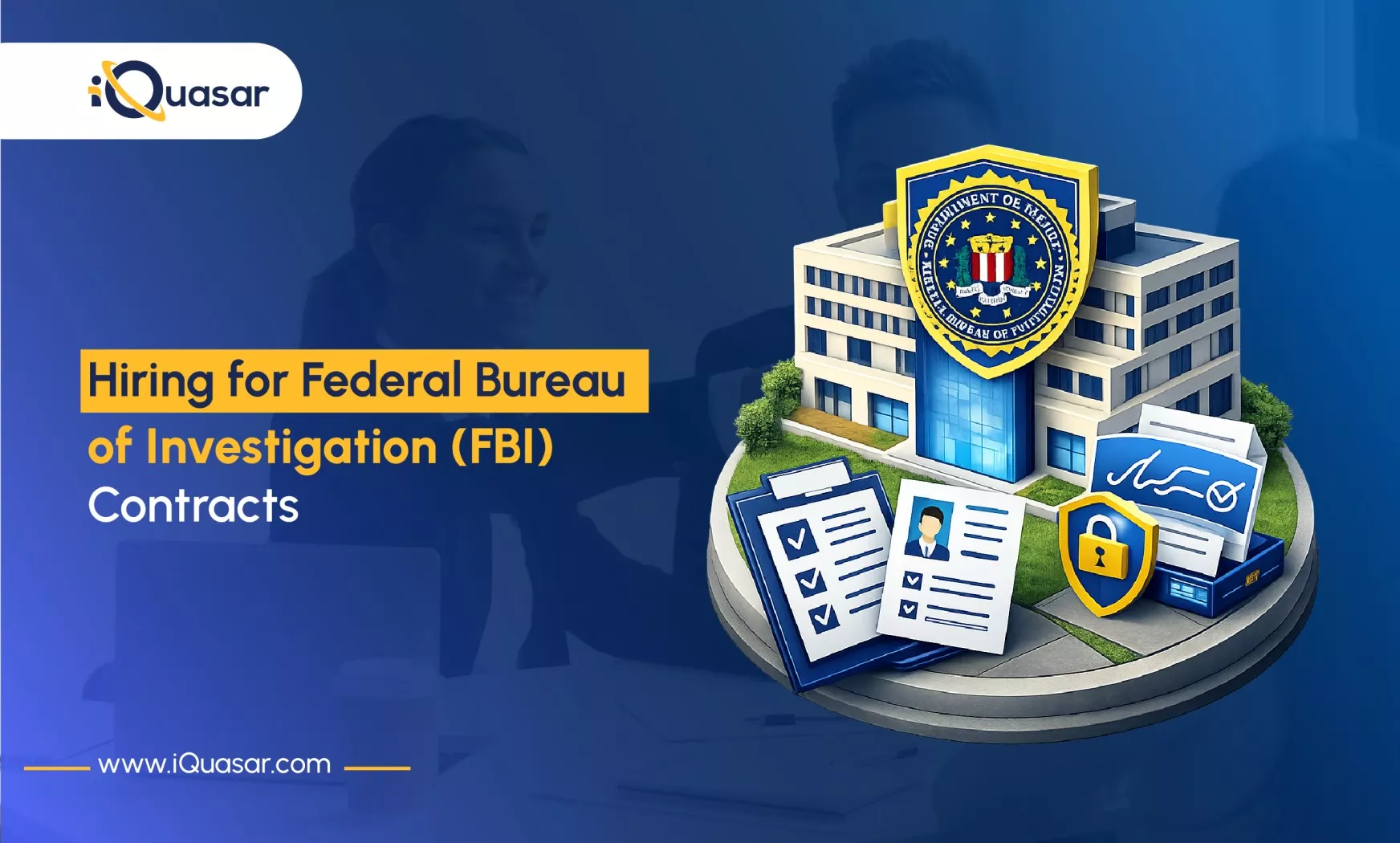
Federal Bureau of Investigation (FBI) contracts require more than a cleared workforce; they demand candidates who can pass one of the most rigorous suitability and fitness review processes in the federal government. The standard cleared hiring playbook isn’t enough. You need to understand the FBI’s unique vetting standards and build a staffing strategy explicitly designed around them. In this blog, we break down the critical clearance, suitability, and compliance requirements contractors must understand to successfully hire for FBI-supported contracts.
Top 6 FBI Clearance, Suitability, and Hiring Requirements Every Contractor Must Know
Successfully staffing FBI contracts requires more than meeting baseline clearance standards. Contractors must navigate a dual-layer vetting system, extended timelines, and strict compliance obligations that directly impact hiring success. Here are the six critical factors shaping FBI’s hiring strategy:
1. FBI Clearances vs. FBI Suitability: Two Different Hurdles
The FBI applies two distinct screening criteria simultaneously:
- Security Clearance: Typically, Top Secret or TS/SCI, processed through DCSA
- Suitability/Fitness Determination: An FBI-specific review covering character, honesty, financial responsibility, and personal conduct
Both must be satisfied independently. A candidate with a valid DoD TS/SCI may still be rejected on FBI suitability grounds and often is. Prepare your candidates for this dual-track process during prescreening.
2. What Triggers Suitability Concerns at the FBI
The FBI applies fitness standards that are stricter in several areas than standard DoD adjudicative guidelines:
- Any history of illegal drug use within the past 3 years, sometimes longer, depending on the substance and frequency
- Significant financial delinquency, including credit card charge-offs and unresolved judgments
- Any dishonesty during the application or vetting process, even omissions are treated seriously
- Prior association with criminal organizations, extremist groups, or individuals under federal investigation
- Certain foreign national contacts, foreign financial interests, or prior foreign government employment
The FBI suitability denial process offers limited appeal options. Rigorous pre-screening conversations before submitting any candidate are non-negotiable. Contractors who work with experienced, cleared recruiters benefit from having specialists who understand these filters and apply them before any formal submission, dramatically reducing late-stage attrition.
Contractors should review the FBI’s published contractor employment standards and background requirements as a baseline for candidate evaluation.
3. Polygraph Requirements
Depending on the contract, a polygraph examination, typically a Counterintelligence (CI) polygraph, may be required. Some sensitive programs require full-scope polygraphs. Confirm polygraph requirements with your COR before recruiting begins, as this materially affects both your candidate pool and time-to-fill timeline.
4. Background Investigation Timelines for FBI Roles
FBI-supported contractors working in law enforcement-sensitive (LES) or national security capacities are subject to DCSA Tier 5 investigations. As of 2025–2026, these typically run 9–14 months for initial investigations. Add FBI suitability review time, and contractors may be looking at a total vetting window of 12–18 months for candidates without existing clearances.
The Lesson: Never build a staffing plan for FBI roles that relies on initiating new clearances. Always prioritize candidates with active or recently-expired clearances at the appropriate level.
5. Contractual Compliance Obligations
FBI-supported contractors are typically subject to enhanced obligations beyond standard government contracting requirements:
- Enhanced insider threat monitoring and reporting procedures
- Mandatory annual counterintelligence briefings for all personnel
- Restrictions on media engagement, public disclosure, and social media activity related to work scope
- Specific handling requirements for Law Enforcement Sensitive (LES) and Protected Disclosure information
Ensure your Program Security Officer is current on the DOJ and FBI contractor security requirements before onboarding any personnel.
Also Read: Recruiting for FBI Headquarters at Quantico, Virginia
6. Practical Hiring Recommendations
- Pre-screen rigorously: Ask candidates directly about disqualifiers before investing resources in formal vetting
- Document everything: FBI suitability processes require thorough documentation of prescreening steps
- Use LE-focused recruiters: Generalist recruiters rarely understand FBI-specific suitability requirements or how to set candidate expectations correctly
- Maintain a buffer: With attrition factoring in, maintain 1.5x your target headcount in active candidates
- Set honest expectations: Candidates unfamiliar with FBI vetting are frequently surprised by its depth; prepare them early to reduce dropout
The Bottom Line: Filling Federal Bureau of Investigation (FBI) roles requires mastery of a dual-track vetting system that blends clearance standards with law enforcement fitness requirements. Contractors who invest in pre-screening rigor, candidate education, and compliance readiness will dramatically reduce time-to-fill.
Work With iQuasar Cleared Recruitment Services
iQuasar Cleared Recruitment Services understands the FBI dual-track vetting process. We pre-screen for both clearance eligibility and suitability alignment before presenting candidates, protecting your pipeline from late-stage attrition on FBI-supported contracts.
Whether you’re staffing a new contract award, managing a critical vacancy, or building a long-term pipeline strategy, iQuasar can compress your time-to-fill without sacrificing candidate quality or compliance rigor. Reach out to the iQuasar Cleared Recruitment team to discuss your next hire.