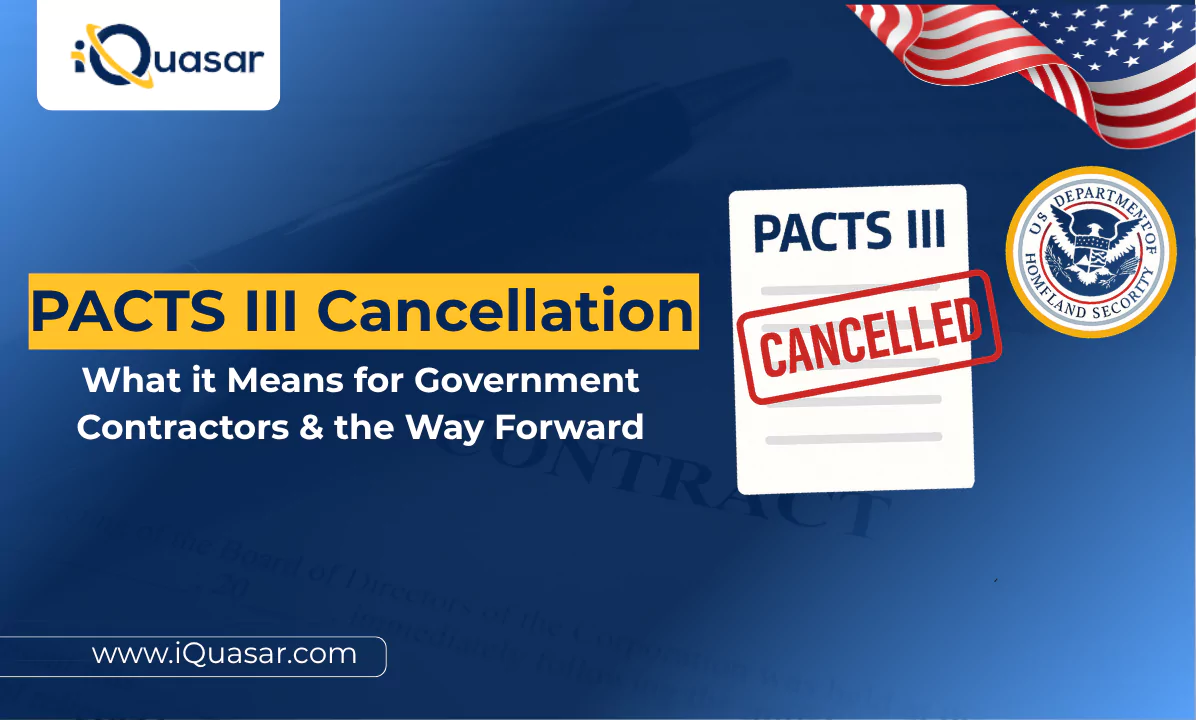
On June 27, 2025, the Department of Homeland Security (DHS) announced the cancellation of the evaluation of proposals submitted under its Program Management, Administrative, Clerical, and Technical Services III (PACTS III) Department-wide contract vehicle solicitation. This decision marks a significant and unexpected shift in the federal contracting landscape, particularly for the numerous government contractors who had invested considerable time and resources in pursuing this lucrative opportunity. The cancellation, attributed to PACTS III being deemed a “non-mission-critical contract that would provide redundant offerings available through existing General Services Administration (GSA) solutions,” aligns with Executive Order 14240, “Eliminating Waste and Saving Taxpayer Dollars by Consolidating Procurement.” This executive order calls for the consolidation of federal procurement for common goods and services under GSA solutions.
This article aims to address this update head-on, providing clarity on its implications for contractors and outlining the strategic path forward in this evolving environment.
Implications for Contractors: Disappointment and a Call for Strategic Re-evaluation
The cancellation of PACTS III has undoubtedly caused significant disappointment among government contractors, especially those who dedicated substantial effort and resources to preparing proposals. As noted in online discussions, such as those on Reddit, the sentiment among contractors is one of frustration over the wasted effort, particularly given that no awards were made, leaving questions about potential settlement options. This situation highlights the inherent risks in the competitive federal contracting arena, where even well-prepared bids can be nullified by shifts in government procurement strategy.
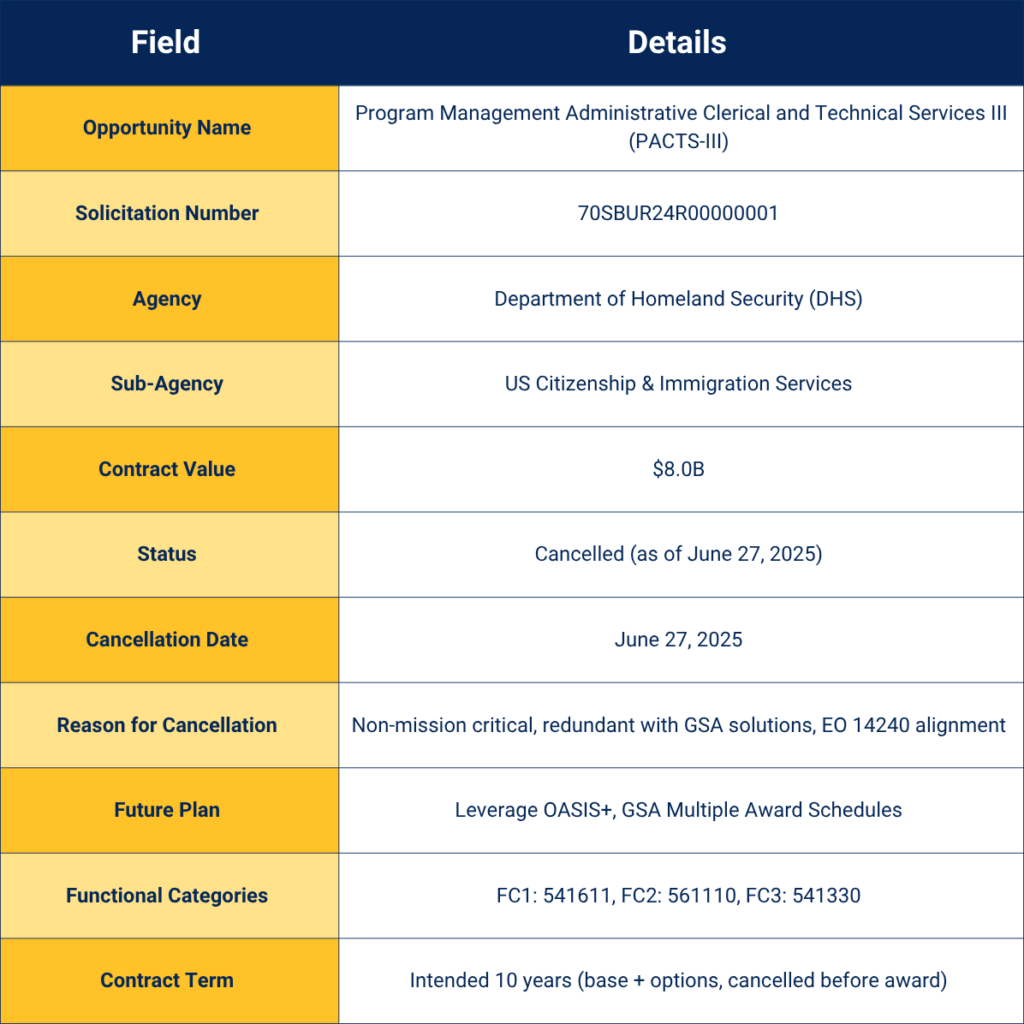
PACTS III was designed as a department-wide Indefinite-Delivery Indefinite-Quantity (IDIQ) contract, with an estimated ceiling of $8.4 billion over a potential 10-year period. It was structured across three functional categories (FCs) targeting various services, including program management, administrative, clerical, technical, and engineering services, with specific NAICS codes and set-asides for small businesses, including SDVOSB, WOSB, HUBZone, and 8(a) entities. The cancellation impacts all these categories, meaning contractors who prepared proposals for any FC will not proceed to awards. This particularly affects small businesses that had invested in pursuing these set-aside opportunities.
The DHS’s decision to cancel PACTS III is rooted in a strategic pivot towards procurement consolidation, aligning with Executive Order 14240. The analysis conducted by DHS identified overlaps between PACTS III’s scope and existing GSA contracts, particularly OASIS+ and the GSA Multiple Award Schedules. This redundancy, coupled with the determination that PACTS III was non-mission critical, led to the termination of the solicitation process. This move underscores a broader trend within federal procurement to streamline processes, eliminate waste, and leverage existing, proven contract vehicles.
Key Data on PACTS III Cancellation:
This cancellation, while disruptive, serves as a crucial reminder for government contractors to remain agile and adaptable in their business development strategies. The focus must now shift to understanding and leveraging the alternative contract vehicles that DHS intends to utilize for these services.
The Way Forward: Embracing OASIS+ and GSA Multiple Award Schedules
With the cancellation of PACTS III, the Department of Homeland Security has clearly stated its intention to leverage existing contract solutions, specifically GSA’s One Acquisition Solution for Integrated Services+ (OASIS+) and the GSA Multiple Award Schedules (MAS), to support its requirements for program management, administrative, clerical, and technical services. This strategic pivot necessitates a thorough understanding of these vehicles for contractors seeking to continue or begin working with DHS.
One Acquisition Solution for Integrated Services Plus (OASIS+)
OASIS+ is a comprehensive suite of governmentwide, multiple-award contracts designed to support federal agencies’ procurement requirements for services-based solutions. It is an Indefinite Delivery, Indefinite Quantity (IDIQ) contract with a base period of five years and one five-year option period, potentially extending the cumulative contract ordering period to 10 years. OASIS+ contracts are available for use by all federal agencies, including the Department of Defense and Federally Funded Research and Development Centers (FFRDCs).
This streamlined program expands upon legacy OASIS, Building Maintenance & Operations (BMO), and Human Capital & Training Solutions (HCaTS) contracts, incorporating new areas of service. GSA is responsible for the award, administration, and management of OASIS+ IDIQ contracts, which are designated as Best-in-Class (BIC) solutions by the Office of Management and Budget. Key benefits of OASIS+ include:
- Fulfilling federal agencies’ non-IT services requirements through highly qualified contractors and a simpler buying experience
- Expanding access to Best-in-Class non-IT service contracts for highly qualified contractors by providing increased small business opportunities and an improved selling experience
- Encouraging competition among service contractors to provide the best value mission outcomes
- Maximizing small business participation by removing barriers to entry and helping customer agencies acquire the best professional services solutions to meet their requirements
OASIS+ offers flexibility, with no contract ceiling or cap on awards, global access to commercial and noncommercial structures, and an open on-ramping process after initial awards, allowing new industry partners to obtain contracts at any time if they qualify. Task order solicitations will be managed through GSA eBuy, a centralized portal for increased acquisition efficiency and transparency.
GSA Multiple Award Schedules (MAS)
The GSA Multiple Award Schedules (MAS) program, also known as the Federal Supply Schedule, is a long-standing and widely used governmentwide contract vehicle. It consolidates GSA’s product and service offerings into a single contract, providing federal agencies with a streamlined process to acquire a vast array of commercial products and services at fair and reasonable prices. MAS contracts are awarded for an initial period of five years, with three additional five-year option periods, potentially totaling a 20-year life for each schedule.
For contractors, obtaining a GSA MAS contract provides access to the federal marketplace and positions them as pre-vetted suppliers. The process involves several steps, including:
- Deciding if a MAS contract is in your best interest: This involves mandatory training and assessing if your company aligns with the requirements and benefits
- Readiness assessment: A designated Authorized Negotiator must complete this assessment
- Reading the entire MAS solicitation: Understanding the detailed requirements, evaluation criteria, and terms and conditions
- Reviewing the new offeror checklist: Ensuring all minimum submission requirements are met
- Completing required registrations: Registering in the necessary government systems
- Gathering required information for your offer: Compiling all necessary documentation and using GSA templates where applicable
- Finalizing and submitting your offer: Submitting the completed offer through the eOffer system
The GSA MAS program offers a wide variety of products and services, competitive prices, and streamlined procedures, making it an attractive avenue for government contractors. Its broad scope and long contract periods provide stability and numerous opportunities for businesses of all sizes, including those in socioeconomic categories targeted for set-asides.
What Contractors Should Do: Pivot and Prepare
In light of the PACTS III cancellation and DHS’s clear intent to leverage OASIS+ and GSA MAS, government contractors must quickly pivot their strategies to remain competitive and pursue new opportunities. The time to act is now, as early movers will gain a significant competitive advantage.
Here are key actions contractors should undertake:
- Thoroughly Understand OASIS+: For those not already familiar, delve deep into the structure, scope, and requirements of OASIS+. Identify how your services align with its functional areas and explore the open on-ramping process. Given its Best-in-Class designation and broad applicability across federal agencies, OASIS+ is poised to become a primary vehicle for a wide range of professional services.
- Evaluate GSA MAS Alignment: If you do not already hold a GSA MAS contract, now is the opportune moment to assess its relevance to your business. The MAS program offers unparalleled access to the federal marketplace. Understand the process for obtaining a MAS contract, including the mandatory training, readiness assessment, and detailed solicitation review. Identify the Special Item Numbers (SINs) that best fit your offerings.
- Proactive Engagement and Networking: Actively engage with GSA and DHS to understand their evolving procurement needs and priorities. Attend industry days, webinars, and outreach events related to OASIS+ and GSA MAS. Network with other contractors, both large and small, to explore potential partnerships and subcontracting opportunities.
- Review and Update Marketing Materials: Ensure your company’s capabilities statements, websites, and other marketing materials clearly articulate your expertise in areas covered by OASIS+ and GSA MAS. Highlight past performance that demonstrates your ability to deliver services relevant to these vehicles.
- Seek Expert Guidance: Navigating the complexities of federal contracting, especially during periods of significant change, can be challenging. Engaging with experts who specialize in government contract vehicles and GSA MAS can provide invaluable support. Their insights can help streamline the process of understanding new requirements, preparing competitive proposals, and positioning your firm for success.
By proactively adapting to this shift, contractors can transform the disappointment of the PACTS III cancellation into a strategic opportunity for growth within the dynamic federal marketplace.
Partnering for Success in the Evolving Federal Landscape
The cancellation of PACTS III underscores the dynamic nature of government contracting and the critical need for contractors to remain agile and well-informed. At iQuasar, we understand the challenges and opportunities presented by these shifts. We have a proven track record of guiding our clients through complex contract vehicles, including OASIS+, NASA SEWP, MAPS, PACTS III (during its active phase), Polaris GWAC, CIO-CS, Alliant 3, and other GWACs.
Our expertise extends to comprehensive GSA MAS Services, where we provide end-to-end support for:
- GSA Schedule Application: Guiding you through the intricate application process to secure your MAS contract
- GSA Schedule Consulting: Offering strategic advice and insights to optimize your MAS presence and maximize opportunities
- GSA Schedule Modifications: Assisting with necessary updates and changes to your existing MAS contract
- GSA Schedule Renewal: Ensuring seamless renewal of your MAS contract to maintain your access to the federal marketplace
Don’t navigate this evolving landscape alone. Partner with us to gain a competitive edge, streamline your efforts, and secure your position for future success in federal contracting. Contact us today to learn how we can help you pivot effectively and thrive in this new environment.