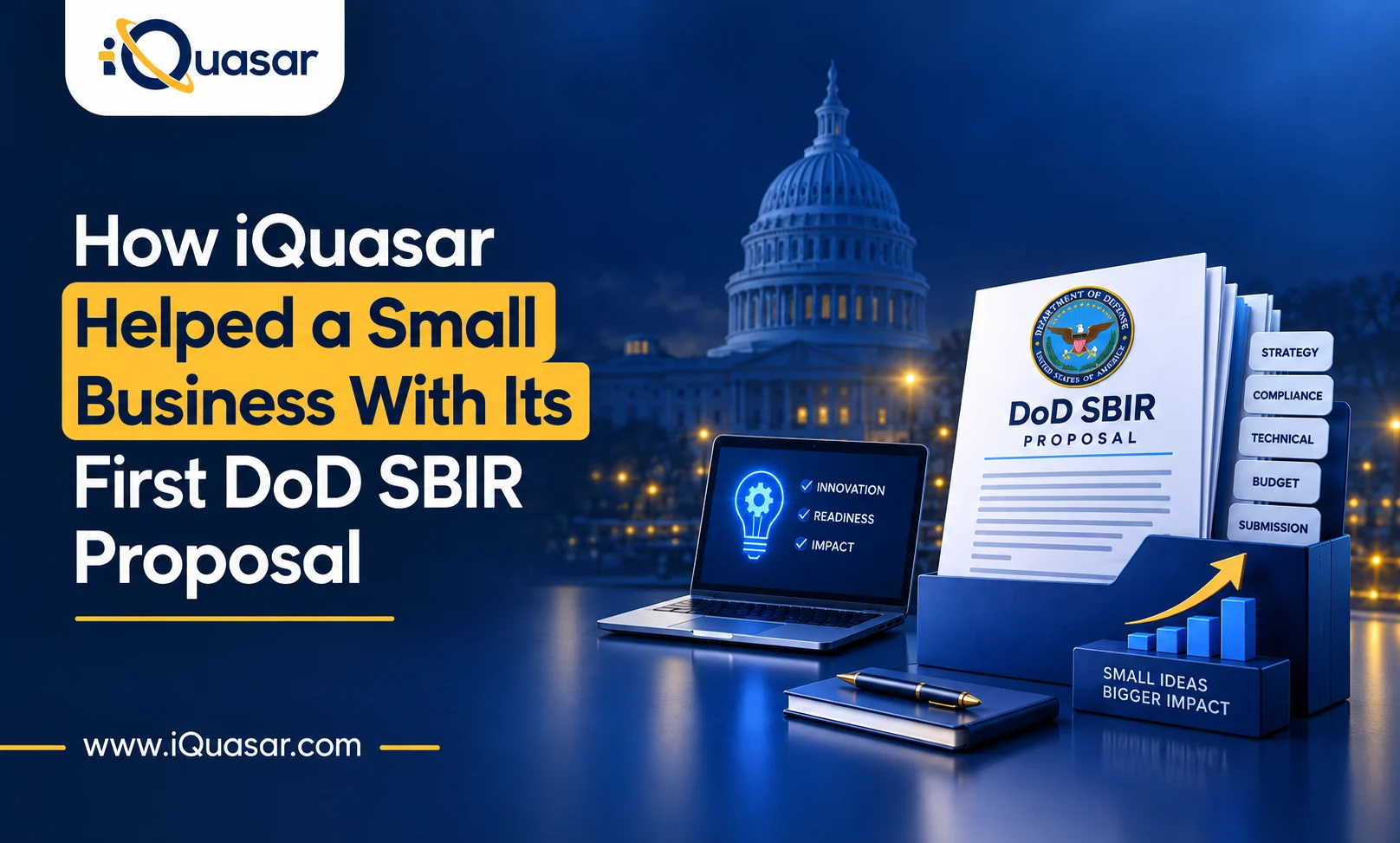
The Federal Small Business Innovation Research program opens significant doors for small businesses with innovative technology solutions. But the SBIR process is procedurally demanding in ways that catch first-time pursuers off guard. The submission is not a single document. It is a multi-volume grant proposal package, each volume with its own format requirements, portal submission method, compliance dependencies, and evaluation implications. For a small business with no prior SBIR experience, the distance between a strong technical idea and a compliant, submitted grant proposal can be substantial.
When a small business client approached iQuasar with a compelling AI/ML solution for modernizing JAG data management and decision-making within the Department of the Air Force, the opportunity was genuine. The technology was credible. But the client had never pursued an SBIR grant before and had no framework for what the process required, how the portal worked, or what a compliant submission looked like across seven volumes.
This case study examines how iQuasar guided the client through every stage of the pursuit, from foundational SBIR program education to final portal submission, delivering a complete and fully compliant DoD Phase I grant proposal package on time and without gaps.

Client Overview
The client is a small business with a developed AI/ML capability focused on legal data management and decision support. The company identified a Department of the Air Force SBIR Phase I topic aligned with its technology and saw the opportunity as a meaningful entry point into the federal market.
The client had no prior experience with the SBIR grant program. It had not previously registered on the Defense SBIR/STTR Innovation Portal, had not completed the required federal registrations, and had no internal understanding of how SBIR grant proposals are structured, evaluated, or submitted. The client needed a partner who could close every one of those gaps while keeping the pursuit on schedule.
Problem/Opportunity
SBIR grant proposals are more complex than they appear from the outside. Unlike standard federal solicitations, SBIR opportunities do not provide a defined scope of work or Performance Work Statement. The agency publishes broad focus areas, and the offeror must independently translate them into a credible technical strategy. For a first-time pursuer with no institutional knowledge of SBIR, that translation is not straightforward.
The submission structure added further complexity. The DoD SBIR Phase I grant package required seven volumes, each with its own requirements, character limits, portal upload method, and compliance implications. Critical submission information was distributed across multiple documents rather than consolidated in one place, making it easy to miss requirements and difficult to confirm completeness without a disciplined tracking approach.

Key challenges included:
- No prior SBIR program knowledge, including how volumes are structured, submitted, and evaluated
- No existing registrations on the Defense SBIR/STTR Innovation Portal or America’s Seed Fund
- No predefined agency scope of work to develop the technical approach against
- No understanding of Technology Readiness Levels or how they affect grant proposal positioning
- No existing Company Commercialization Report, requiring one to be built from scratch
- No familiarity with required support documents, training certifications, or FOCI disclosure requirements
- A CMMC Level 2 self-assessment certification is required as a condition of submission
iQuasar’s Solution
iQuasar engaged as the client’s dedicated grant proposal development partner and took a structured, volume-by-volume approach to the engagement. Before any writing began, the team established three core management tools that governed the entire pursuit.
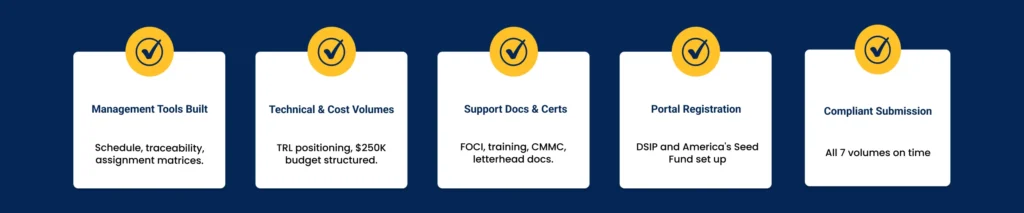
A proposal schedule matrix mapped every deadline, portal registration step, certification requirement, draft review, client input, and final upload milestone, creating a sequenced execution roadmap, eliminating the risk of missed dependencies or late submissions. A traceability matrix linked every solicitation instruction, volume requirement, character limit, and evaluation criterion to the corresponding grant proposal response, creating a compliance control point across all seven volumes. An assignment matrix defined clear ownership for every volume, technical input, cost detail, certification, and support document across the iQuasar and client teams, preventing gaps and ensuring nothing was missed or duplicated/ duplicated.
Our support included:
- Volume 1: Cover Sheet Development
iQuasar worked directly with the client’s technical team to develop a fully compliant cover sheet response within the DSIP portal’s strict character limit, ensuring all required content was captured without triggering a compliance disqualification before the technical merits were ever evaluated.
- Volume 2: Technical Strategy and Key Personnel
iQuasar held structured working sessions with the client to translate the Air Force’s broad focus areas into concrete technical objectives with a credible, well-supported approach. The team walked the client through Technology Readiness Levels (TRL) and how TRL positioning affects the evaluator’s perception of a proposed solution.
In parallel, iQuasar conducted research to identify the right Principal Investigator for the grant proposal, determining the qualifications and experience profile the PI needed to reflect direct alignment with the topic requirements.
- Volume 3: Cost Proposal
iQuasar provided the client with detailed, step-by-step guidance for completing the cost volume, structuring the full $250,000 Phase I budget across direct labor, fringe, overhead, general and administrative expenses, and profit in a format that met SBIR expectations and presented a complete, supportable pricing structure.
- Volume 4: Commercialization Report
With no prior SBIR grant history to draw from, the client needed a Commercialization Report built from scratch. iQuasar researched the requirements through America’s Seed Fund and led a dedicated working session with the client to complete the report.**
- Volume 5: Support Documents
iQuasar guided the client in securing all support documents, including Letters of Support, Funding Agreement Certification, Life Cycle Certification, Technical Data Certification, and Additional Cost Information, finalizing all documents on the client’s letterhead.
- Volume 6: Fraud, Waste, and Abuse Training
iQuasar identified the required training certification source, provided step-by-step completion instructions, and held a working session with the client to confirm successful completion before submission.
- Volume 7: Foreign Ownership Disclosure
iQuasar prepared and submitted a fully compliant Foreign Ownership, Control, or Influence (FOCI) disclosure in accordance with agency requirements, ensuring the client’s FOCI documentation met all conditions for a compliant grant submission.
- Portal Registration and CMMC Certification
iQuasar guided the client through registration on both the Defense SBIR/STTR Innovation Portal and America’s Seed Fund, and supported the client in obtaining CMMC Level 2 self-assessment certification ahead of the submission deadline.
Also Read: How iQuasar Helped a Federal Contractor Recruit Key Personnel for a Healthcare IT Modernization Proposal
How Our Solution Helped the Client
Results
iQuasar’s structured engagement delivered a complete, fully compliant DoD SBIR Phase I grant proposal package, submitted on time via the DSIP portal, with all seven volumes, certification, registration, and support documents in place.
- All required seven grant proposal volumes completed and submitted ahead of the DSIP deadline
- Technical objectives developed from high-level agency focus areas without a predefined scope of work
- Commercialization planning integrated into the grant proposal approach from scratch
- All required certifications, portal registrations, and compliance requirements validated and completed
- Consistent messaging maintained across technical, cost, and commercialization content
- Client equipped with reusable SBIR knowledge and infrastructure for future grant pursuits

iQuasar’s proposal development team gave the client more than just a submitted grant proposal. The engagement delivered a foundational understanding of how the SBIR program works, a set of registered accounts and completed certifications that reduce the barrier to future pursuits, and a structured proposal management approach the client can apply to the next opportunity. The schedule, traceability, and assignment matrices iQuasar built remain available as reusable infrastructure for Phase II and future SBIR grant submissions.
For a first-time applicant, the compliance demands of a seven-volume DoD grant submission can be genuinely disorienting. The requirements are real, the deadlines are firm, and the consequences of a missed volume or an incomplete certification are immediate. What iQuasar provided was not just writing support. It was structured program guidance that turned an unfamiliar process into a manageable, sequenced, trackable execution effort from the first working session to the final portal upload.
Beyond securing an on-time submission, the client now has registered accounts, completed certifications, and a clear understanding of SBIR grant requirements, making every future pursuit faster and less resource-intensive. The groundwork iQuasar laid does not expire when the Phase I deadline passes. It compounds. For small businesses with strong technology but no SBIR experience, the path from innovation to a compliant federal grant submission requires more than good writing. It requires a partner who understands the program, manages the process, and delivers a proposal that can compete on its merits. iQuasar provided exactly that.
IN THIS STORY
- The Client: Small business with an AI/ML solution pursuing its first DoD SBIR Phase I grant.
- The Challenge: Seven-volume grant submission with no prior SBIR knowledge, registrations, or scope of work.
- The Solution: Volume-by-volume grant development with schedule, traceability, and assignment matrices governing every milestone.
- The Outcome: Fully compliant seven-volume DoD SBIR grant submitted on time with all certifications and registrations complete.