
For federal systems integrators competing on large civilian agency recompetes, the workforce section of a proposal is rarely a formality. Government evaluators assessing bids on established programs know what experienced performance looks like, and they know the difference between a staffing plan built around real incumbent talent and one assembled from generic resumes. In competitive recompete environments, demonstrating access to professionals with direct program knowledge and agency-specific experience is often as consequential as the technical approach itself.
Incumbent search, the structured identification and engagement of professionals currently supporting a target contract, has become a core capability for contractors pursuing recompete opportunities. When done well, it compresses post-award recruitment timelines, reduces transition risk, and enables proposal teams to identify qualified candidates with verifiable program backgrounds. Done poorly, or not at all, it leaves a contractor relying on a staffing section that evaluators can immediately recognize as aspirational rather than grounded.
This case study examines how iQuasar partnered with a leading federal systems integrator to execute a strategic incumbent search ahead of a large civilian agency recompete, identifying and mapping more than 75 incumbent professionals, building a qualified candidate pipeline aligned to the proposal, and strengthening the client’s workforce strategy from the bid stage through transition readiness.
Client Overview
The client is a leading federal systems integrator with a broad portfolio of civilian and defense agency programs. The company was preparing for the recompete of a large civilian agency contract, an established program with a defined incumbent workforce whose institutional knowledge represented both the highest performance value and the most significant transition risk for any incoming contractor.
The client’s bid strategy required more than a competitive technical approach. It required a demonstrable workforce plan built around professionals with direct experience supporting the program. To achieve that, the client needed a recruiting partner capable of identifying, mapping, and engaging incumbent talent before the proposal was submitted, under confidential and compliant outreach conditions, and within a timeline that aligned with the proposal schedule.
Problem/Opportunity
Recompete pursuits create a structurally difficult recruiting environment. The most valuable candidates are embedded in an active program, performing well, and being actively retained by the incumbent contractor. They are not looking for new opportunities. They may not even be aware that their contract is being recompeted. Reaching them requires workforce intelligence, targeted outreach, and a candidate engagement approach calibrated for professionals who have no immediate reason to respond. The client’s visibility into the existing workforce was limited at the start of the engagement. The program’s functional scope spanned multiple disciplines, and the client needed incumbent coverage across all of them before proposal submission. Every day without a clear workforce map was a day spent preparing proposals built on assumptions rather than intelligence.

Key challenges included:
- Limited visibility into the incumbent workforce structure supporting the civilian agency contract
- Strong retention efforts by the incumbent contractor are actively working to keep its personnel
- Tight proposal timelines requiring incumbent identification and engagement well ahead of submission
- Candidates required to have direct program knowledge and agency-specific experience
- Outreach required to be confidential, compliant, and professionally executed throughout
- Competition from multiple bidders targeting the same incumbent workforce simultaneously
iQuasar’s Solution
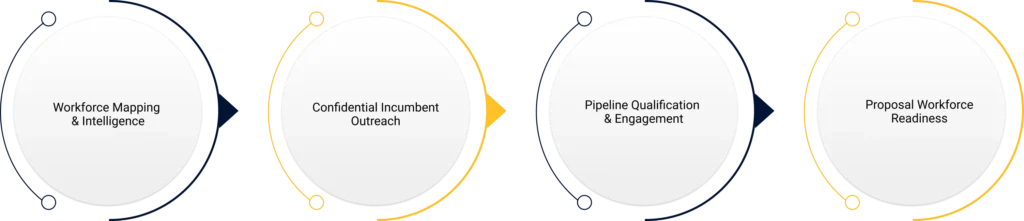
iQuasar integrated with the client’s capture and proposal teams to design and execute a structured incumbent search strategy built around three sequenced workstreams: workforce intelligence, targeted engagement, and pipeline development. The approach was calibrated for the specific conditions of a competitive recompete, operating with discretion, moving with urgency, and delivering results that translated directly into proposal strength. Our support included:
1. Workforce Mapping and Intelligence
iQuasar opened the engagement with a structured research effort to build a comprehensive picture of the incumbent workforce supporting the target contract. The team applied organizational mapping techniques, publicly available workforce data, proprietary recruiting databases, professional network analysis, and sourcing resources to identify professionals across the program’s key functional areas.
The output was not a list of names. It was a workforce map that gave the client’s capture team a clear view of who was supporting the program, in what roles, at what seniority levels, and with what relevant experience profiles. That map became the foundation for every subsequent outreach and qualification decision in the engagement.
2. Confidential and Compliant Incumbent Outreach
With the workforce map established, iQuasar recruiters executed personalized, discipline-specific outreach campaigns targeting identified incumbents. The outreach was designed from the ground up for a passive candidate audience in a competitive, confidential environment. Messaging was professional, specific, and carefully positioned to engage without disclosing sensitive pursuit details or creating compliance exposure for the client.
Outreach emphasized long-term career opportunities, program continuity, and the professional value of supporting an established civilian agency mission under a well-resourced systems integrator. For professionals who had built careers around a specific program, these were meaningful considerations. iQuasar’s approach created genuine engagement where undifferentiated recruiting outreach would have generated silence or resistance.
3. Pipeline Qualification and Engagement
As incumbents responded to outreach, iQuasar conducted structured qualification assessments aligned to the contract’s functional requirements. Candidates were evaluated on program familiarity, agency-specific experience, technical and functional competencies, and availability for transition. Each qualified candidate was documented in a pipeline format that the client’s proposal team could reference directly when developing the staffing section.
Pipeline integrity was maintained through the full proposal period. iQuasar kept candidates engaged, informed at appropriate levels of detail, and committed to the opportunity through regular follow-up, preventing the attrition that commonly erodes talent pipelines during long competitive pursuits.
Also Read:How iQuasar Helped a Federal IT Contractor Recruit Incumbent Help Desk Personnel for a DHS Contract Transition
How Our Solution Helped the Client
Results
iQuasar’s incumbent search initiative delivered a workforce intelligence foundation and a qualified candidate pipeline that materially strengthened the client’s proposal and positioned the organization for a faster, lower-risk transition following award.
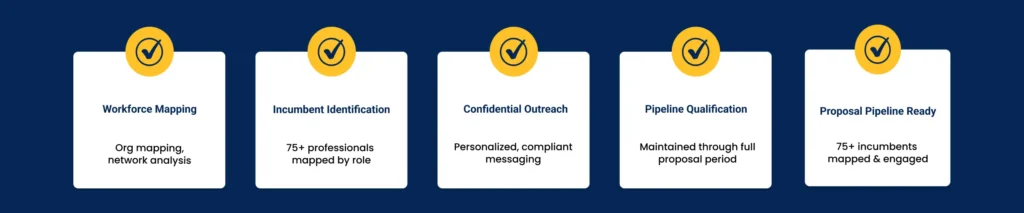
- More than 75 incumbent professionals were identified and mapped across key functional areas
- A qualified pipeline of engaged candidates built and maintained through the proposal period
- Proposal staffing section strengthened with experienced incumbent talent and documented pipeline depth
- Post-award recruitment timelines reduced through pre-built incumbent engagement
- Transition readiness improved and operational risk minimized through early workforce alignment
- Workforce transition supported by mission-ready professionals with direct program knowledge and agency familiarity

iQuasar’s cleared recruitment and staffing approach gave the client a workforce strategy grounded in real program intelligence rather than assumptions. By completing the incumbent mapping and engagement work ahead of the proposal submission, the team ensured that the client’s staffing plan reflected an actual candidate pipeline rather than a projected one. The depth of the pipeline, more than 75 professionals mapped across functional areas with a qualified subset actively engaged, gave the proposal team the material it needed to write a staffing section that evaluators could assess with confidence. In a competitive recompete environment where every bidder is making workforce commitments, the ability to support those commitments with documented incumbent engagement is a meaningful differentiator.
iQuasar identified and mapped more than 75 incumbent professionals for a civilian agency recompete, delivering a qualified pipeline that strengthened the proposal, compressed post-award recruitment timelines, and supported a workforce transition built on mission-ready talent.
In competitive recompete environments, the contractors who win are increasingly those who can demonstrate workforce readiness before the contract is awarded. iQuasar gave this client exactly that foundation, a pipeline of real, qualified, engaged incumbents that turned the staffing section from a risk into a strength. iQuasar’s Cleared Recruitment services help federal systems integrators and contractors build incumbent talent pipelines for competitive recompete pursuits and complex program transitions. By combining workforce intelligence, confidential incumbent outreach, and disciplined pipeline management, we deliver staffing strategies that strengthen proposals and support mission-ready workforce transitions.
IN THIS STORY
- The Client: Federal systems integrator pursuing a large civilian agency contract recompete.
- The Challenge: 75+ incumbents to identify and engage confidentially ahead of proposal submission.
- The Solution: Three-workstream incumbent search combining workforce mapping, confidential outreach, and pipeline management.
- The Outcome: 75+ incumbents mapped, proposal strengthened, and post-award recruitment timelines compressed.