Department of Homeland Security IT support contracts carry a workforce continuity requirement that leaves almost no margin for error. When thousands of end users across multiple locations depend on uninterrupted help desk services, a staffing gap at contract start is not an inconvenience. It is a mission failure. Federal IT service contractors who win DHS programs must be prepared to demonstrate, from the moment of award, that their workforce strategy can sustain service levels throughout every phase of the transition.
The Federal Acquisition Regulation and agency-specific transition requirements impose strict timelines on incoming contractors, often compressing the window between award notification and start of performance to 45 days or fewer. In that window, a contractor must simultaneously assess incumbent interest, execute targeted outreach, qualify replacement candidates, and build contingency pipelines, all while coordinating with program management and government customer stakeholders. For IT service contracts where technical knowledge of DHS systems and processes is a day-one requirement, the stakes of getting staffing wrong are immediate and visible.
This case study examines how iQuasar partnered with a federal IT support contractor to execute a targeted incumbent recruitment strategy for a DHS help desk and end-user support program, identifying and engaging more than 30 incumbent professionals, transitioning 18 employees to the new contract, and achieving 100 percent staffing coverage for all critical service desk positions before contract launch.
Client Overview
The client is a federal contractor with an established portfolio of IT support services for U.S. government agencies. The company had been awarded a contract to support a Department of Homeland Security help desk and end-user support program, characterized by high user volume, multi-location coverage, and a zero-tolerance threshold for service disruption during transition.
The contract scope required coverage across Tier 1, Tier 2, desktop support, and service desk leadership roles. Each position demanded familiarity with DHS-specific systems, ticketing processes, and service management protocols that could not be quickly developed in candidates without prior program exposure. Retaining or replacing the incumbent workforce was not a preference. It was the operational foundation on which day-one performance depended.
Problem/Opportunity

The 45-day window between award notification and start of performance defined every aspect of the client’s staffing challenge. There was not enough time to build a qualified replacement workforce from scratch, and barely enough time to identify, engage, qualify, and onboard incumbent personnel, particularly in an environment where the outgoing contractor was actively working to retain the same employees the incoming contractor needed to recruit.

The client’s visibility into the existing workforce was limited at the outset. Without a clear map of who was supporting the program, in which roles, and at which locations, the transition strategy could not be built on solid ground. Every day spent developing workforce intelligence was a day not spent on outreach, and the timeline allowed for neither delay nor inefficiency.
Key challenges included:
- Limited visibility into the incumbent workforce structure supporting the DHS program
- Active competition from the outgoing contractor seeking to retain the same personnel
- A 45-day transition timeline with strict onboarding and clearance requirements
- Positions requiring prior federal help desk experience and DHS system familiarity
- The risk of service disruptions to thousands of end users if critical roles remained vacant at contract start
iQuasar’s Solution
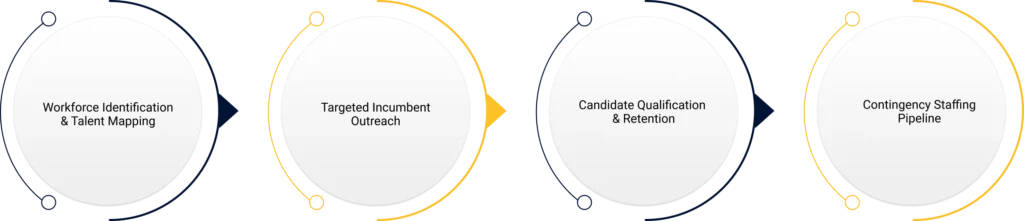
iQuasar worked directly with the client’s program management and transition teams to design and execute a dual-track staffing strategy. Incumbent engagement ran in parallel with contingency pipeline development from day one. The approach was structured to provide the client with maximum workforce coverage regardless of how many incumbents chose to transition, while maintaining the primary focus on retaining the experienced personnel who posed the lowest transition risk and delivered the highest day-one performance value. Our support included:
1. Workforce Identification and Talent Mapping
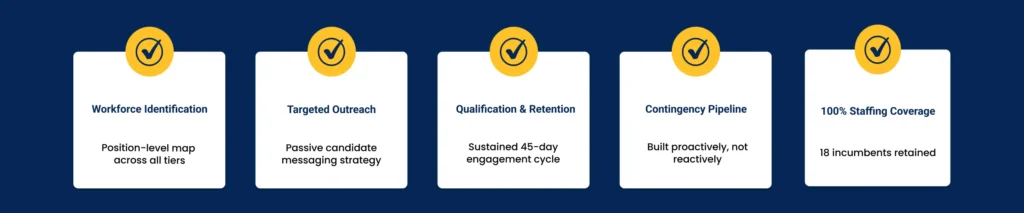
iQuasar opened the engagement with a structured workforce intelligence effort to identify help desk and IT support professionals currently supporting the DHS contract. The team conducted organizational and workforce research using LinkedIn Recruiter, proprietary recruiting databases, professional referral networks, and internal sourcing resources, building a position-level map of the incumbent workforce across Tier 1, Tier 2, desktop support, and service desk leadership functions.
This upfront investment in workforce intelligence allowed the outreach phase to begin with precision rather than volume, targeting the right people in the right roles rather than casting a wide net and hoping for engagement from a workforce that was not actively looking to move.
2. Targeted Incumbent Outreach
With the workforce map in place, iQuasar recruiters launched personalized outreach campaigns tailored to employees participating in an active government program. The outreach was built for a passive candidate audience, professionals who were performing in their current roles and had no particular reason to engage with generic recruiting approaches.
Messaging emphasized career stability during the transition period, professional growth opportunities available under the incoming contractor, the benefits of the move, and the importance of maintaining continuity of mission support for DHS users. This last element, the mission dimension of the opportunity, proved meaningful for help desk professionals whose work directly supported government operations. iQuasar’s outreach positioned the transition as a career decision with both personal and programmatic significance.
3. Candidate Qualification and Retention
As incumbents entered the pipeline, iQuasar conducted structured qualification assessments covering federal IT support experience, help desk certifications, knowledge of ticketing systems and service management processes, customer service capabilities, and transition readiness. Qualification criteria were aligned directly with the contract’s performance requirements to ensure that every candidate in the pipeline represented a credible day-one performer.
Qualification was the beginning of the engagement, not the end. iQuasar maintained regular communication with every interested candidate throughout the 45-day transition period, addressing questions, reinforcing commitment, and monitoring for signs of attrition before they became losses. In competitive transition environments where the outgoing contractor is actively counter-recruiting, sustained candidate engagement is as important as initial outreach.
4. Contingency Staffing Pipeline
Recognizing from the outset that some incumbents would choose not to transition regardless of outreach quality, iQuasar simultaneously built a pipeline of replacement candidates for every critical position on the contract. The contingency pipeline was developed in parallel with incumbent outreach, not triggered by attrition after it occurred, but built proactively so that any vacancy could be filled quickly without impacting contract performance or service continuity.
This dual-track discipline meant the client entered contract launch with confidence on both fronts: a strong incumbent retention rate and a qualified backup for every seat.
Also Read: How iQuasar Helped a Federal IT Contractor Staff 25 Positions Within a 30-Day Contract Transition
How Our Solution Helped the Client
iQuasar’s incumbent recruitment strategy delivered full staffing coverage for the DHS help desk program before the contract start date, achieving both the retention and replacement outcomes the client needed to launch with a stable, experienced, mission-ready workforce.
- More than 30 incumbent help desk professionals successfully identified and engaged
- 18 incumbent employees transitioned to the new contract
- All remaining vacancies filled with qualified replacement candidates before contract startup
- 100 percent staffing coverage achieved for all critical service desk positions
- Uninterrupted DHS end-user support maintained throughout the contract transition
iQuasar’s cleared recruitment and staffing approach gave the client something that reactive hiring could not: a workforce strategy built around program intelligence and proactive engagement rather than last-minute sourcing under pressure. By mapping the incumbent workforce before outreach began and running contingency development in parallel with retention efforts, the team ensured that no outcome, whether high retention or low retention, left the client exposed at contract start.
The 18 incumbents who transitioned brought with them something no replacement hire could immediately provide: direct knowledge of DHS systems, established relationships with the government customer’s users, and operational familiarity with the service environment that typically takes months to develop. Their retention reduced onboarding costs, compressed the performance ramp, and materially improved the client’s standing with the government customer from the contract’s first day. Beyond the transition itself, the engagement demonstrated the compounding value of a well-executed incumbent strategy. Workforce stability during the critical post-award window improved team cohesion, reduced training burden, and sent a clear signal to the DHS customer that the incoming contractor had invested in continuity, not just capability.

For IT service contracts where institutional knowledge and system familiarity are day-one requirements, incumbent recruitment is not a staffing tactic. It is a mission continuity strategy. iQuasar gave this client the workforce foundation to launch with confidence, perform without disruption, and build customer trust from the first day of the contract.
iQuasar’s Cleared Recruitment services help federal IT contractors build stable, experienced workforces for high-stakes DHS and government program transitions. By combining workforce intelligence, targeted incumbent outreach, and proactive contingency recruiting, we deliver staffing coverage that holds, even when timelines are tight and the competition is active.

IN THIS STORY
-
- The Client: Federal IT contractor supporting U.S. government help desk programs.
- The Challenge: 45-day window to recruit and retain 30+ incumbent DHS help desk staff.
- The Solution: Dual-track incumbent outreach and contingency pipeline built simultaneously.
- The Outcome: 100% staffing coverage, 18 incumbents retained, zero service disruption.