
Aerospace engineering contracts supporting NASA programs represent some of the most technically demanding workforce challenges in all of federal government contracting. The engineers and technical professionals who support these missions develop specialized knowledge over years of program involvement, including mission architectures, systems interfaces, hardware integration protocols, and operational procedures that cannot be replicated through traditional hiring. When a federal contractor pursues or transitions into a NASA engineering program, the caliber and continuity of its proposed workforce can be as decisive as its technical approach.
Incumbent recruitment, the strategic identification and engagement of professionals already supporting a target program, has become a critical capability for contractors competing in this environment. Demonstrating access to experienced incumbents signals workforce readiness, reduces transition risk, and materially strengthens the staffing sections of competitive proposals. For programs where technical continuity is a mission requirement rather than a preference, a well-executed incumbent strategy is often the difference between a credible bid and a winning one.
This case study examines how iQuasar partnered with a federal aerospace contractor to build a qualified pipeline of incumbent engineering professionals supporting a major NASA program, delivering more than 20 engaged candidates, strengthening the client’s proposal submission, and establishing the workforce foundation for successful contract execution.

Client Overview
The client is a federal contractor with established capabilities in aerospace engineering and technical services, supporting mission-critical programs across the U.S. government space and defense sectors. The company was actively pursuing a contract supporting a major NASA program, a competitive opportunity that required not only a strong technical approach but a demonstrably qualified and experienced engineering workforce.
The program’s requirements spanned multiple complex disciplines, including systems engineering, software development, mission operations, and hardware integration. Each of these areas demanded candidates with direct program familiarity and a track record of supporting NASA mission environments, a talent profile that the open job market alone could not reliably supply within the available proposal timeline.
Problem/Opportunity
The central challenge facing the client was not a shortage of engineering talent in the abstract it was a shortage of the right engineering talent with the right program experience, available within a compressed timeframe. The professionals best positioned to support the target NASA contract were already working on it. They were not browsing job boards or responding to generic recruiter outreach. Reaching them required a different approach entirely.

The client’s visibility into the incumbent workforce was limited. Without a clear picture of who was supporting the program, in what roles, and through which contract vehicles, building a competitive staffing strategy was difficult. The proposal timeline added urgency the client needed an engaged, qualified candidate pipeline in place before submission, not after award.
Key challenges included:
- Limited visibility into the incumbent workforce structure supporting the target program
- Highly specialized engineering skill requirements across systems, software, operations, and hardware disciplines
- A competitive hiring environment where multiple contractors were pursuing the same talent pool
- Tight proposal and transition timelines that compressed the available recruiting window
- The need to preserve institutional knowledge and demonstrate technical continuity to the government customer
iQuasar’s Solution
iQuasar integrated directly with the client’s capture, proposal, and recruiting teams to design and execute a comprehensive incumbent talent acquisition strategy. The approach was built around three sequential but overlapping workstreams: workforce intelligence, targeted outreach, and sustained candidate engagement, each feeding into a unified pipeline that supported both the proposal submission and long-term transition planning.
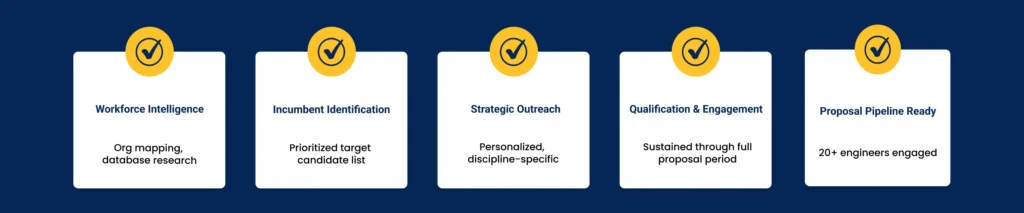
Our support included:
- Talent Mapping and Workforce Research
iQuasar’s recruiting team began the engagement with a structured workforce intelligence effort to identify engineers and technical professionals likely to support the target NASA program. This was not a passive sourcing exercise; it was an active research process designed to build a clear picture of the incumbent workforce before any outreach began.
The research included organizational mapping of incumbent contract structures, analysis of publicly available workforce data, application of proprietary recruiting databases, and discipline-level identification of the engineering functions critical to the program. The output was a prioritized list of target candidates segmented by role, experience profile, and strategic value to the client’s proposed team.
- Strategic Candidate Outreach
With the talent map established, iQuasar recruiters executed personalized, discipline-specific outreach campaigns targeting identified incumbents. The outreach strategy was designed for an audience that was not actively seeking new employment professionals who were performing well, embedded in their current programs, and largely unreachable through standard job posting channels.
Messaging was built around career growth opportunities available under the incoming contractor, the program’s stability and long-term mission impact, and the direct alignment between each candidate’s experience and the client’s requirements. This approach established trust with passive candidates and created meaningful engagement where generic recruiting outreach would have generated silence.
- Candidate Qualification and Engagement
As candidates entered the pipeline, iQuasar conducted structured qualification assessments evaluating aerospace and engineering experience, direct NASA program familiarity, technical certifications, specialized competencies, and demonstrated ability to support mission-critical objectives.
Qualification was not a one-time gate; it was an ongoing process. Throughout the proposal period, iQuasar maintained regular communication with engaged candidates to sustain interest, confirm availability, and address questions about the transition. Candidate attrition during long proposal cycles is a common risk in competitive pursuits; iQuasar’s sustained engagement discipline kept the pipeline intact from initial identification through submission.
Also Read: How iQuasar Helped a Woman-Owned Small Business Secure a GSA MAS Contract Award
Results
iQuasar’s incumbent recruitment initiative delivered a qualified, engaged engineering pipeline that materially strengthened the client’s proposal and established the workforce foundation for successful contract execution. The results reflected both the depth of iQuasar’s talent research capabilities and the discipline of its candidate engagement process across a technically demanding, time-compressed pursuit.
- More than 20 engineering professionals supporting the target program have successfully identified and engaged
- A highly qualified pipeline of incumbent candidates was submitted in alignment with contract requirements
- Expanded access to experienced aerospace talent with direct NASA program knowledge
- Enhanced workforce continuity planning integrated into the client’s transition strategy
- Staffing sections of the proposal were strengthened through demonstrated incumbent engagement and pipeline depth
iQuasar’s cleared recruitment and staffing support gave the client something that generic recruiting could not a workforce strategy grounded in real program intelligence rather than assumptions. By mapping the incumbent landscape before outreach began, the team was able to focus every recruiting effort on the candidates most likely to strengthen the proposal and perform on the contract.

The engagement also demonstrated an important principle for competitive aerospace pursuits: workforce readiness is not a post-award problem. The contractors who win technically complex programs are increasingly those who can demonstrate, at the proposal stage, that their staffing plan is built around real people with real program experience, not a generic roster assembled after the award is in hand. Beyond the proposal itself, the pipeline iQuasar built created lasting value for the client’s transition planning. Incumbent candidates who were engaged early developed relationships with the incoming contractor’s program and recruiting teams, reducing the friction and risk typically associated with workforce changeover on technically complex NASA programs.
For aerospace programs where institutional knowledge is mission-critical, the contractors who win are those who demonstrate workforce readiness before the contract is awarded, not after. iQuasar’s incumbent recruitment strategy gave this client exactly that foundation.
iQuasar’s Cleared Recruitment services help federal contractors build qualified engineering pipelines for technically complex government programs. By combining workforce intelligence, targeted incumbent outreach, and disciplined candidate engagement, we deliver staffing strategies that strengthen proposals and support successful contract execution.
IN THIS STORY
- The Client: Federal aerospace contractor pursuing a major NASA engineering and technical services program.
- The Challenge: Identifying and engaging 20+ incumbent NASA engineers within a compressed proposal timeline.
- The Solution: Three-track incumbent strategy combining workforce intelligence, targeted outreach, and sustained candidate engagement.
- The Outcome: 20+ engineers engaged, proposal strengthened with qualified incumbent pipeline, and workforce transition risk reduced.