Latest Updates:
July 21, 2026:
FAA SAVES Amendment 0009 Issued with Extended Proposal Due Date and Conformed Solicitation
The Federal Aviation Administration (FAA) has issued Amendment 0009 for the Screening Information Request (SIR) 697DCK-25-R-00302 for the Strategic Sourcing for the Acquisition of Various Supplies and Equipment (SAVES) procurement.
Amendment 0009 extends the proposal due date to August 12, 2026, at 5:00 PM ET. The amendment also releases a conformed solicitation incorporating all changes to date, reissues updated attachments, and includes the Government’s official responses to industry questions.
Additionally, the FAA noted a document access correction: the conformed solicitation and updated attachments have been reattached as public documents, replacing previously locked versions that were published in error.
Contractors pursuing FAA SAVES should update their internal proposal timelines, review the conformed solicitation and Government responses, and confirm access to the reattached public documents
June 25, 2026:
FAA SAVES Amendment 0008 Issued with Revised Proposal Due Date
The Federal Aviation Administration (FAA) has issued Amendment 0008 for the Screening Information Request (SIR) 697DCK-25-R-00302 for the Strategic Sourcing for the Acquisition of Various Supplies and Equipment (SAVES) procurement.
Amendment 0008 extends the proposal due date to July 21, 2026, at 5:00 PM ET. The FAA also noted that a subsequent amendment will be issued to address questions received under Amendment 0006.
Contractors pursuing FAA SAVES should update their internal proposal timelines and continue monitoring the posting for the follow-on amendment addressing industry questions.
June 9, 2026:
FAA SAVES Amendment 0007 Issued with Revised Proposal Deadline and Updated Submission Contacts
The Federal Aviation Administration (FAA) has issued Amendment 0007 for the Screening Information Request (SIR) 697DCK-25-R-00302 for the Strategic Sourcing for the Acquisition of Various Supplies and Equipment (SAVES) procurement.
Amendment 0007 extends the proposal due date to July 7, 2026, at 5:00 PM ET. The FAA also noted that a subsequent amendment will be issued to address questions received under Amendment 0006.
In addition, an additional Point of Contact has been added for proposal submissions. Offerors should ensure future proposal submissions are sent to all three listed contacts:
Contractors pursuing FAA SAVES should update their internal proposal timelines and confirm that all future submissions include the revised list of proposal submission contacts.
13 May, 2026:
FAA SAVES Amendment 0006 Issued with Updated Solicitation and Revised Deadlines
The Federal Aviation Administration (FAA) has issued Amendment 0006 for the Screening Information Request (SIR) 697DCK-25-R-00302 for the Strategic Sourcing for the Acquisition of Various Supplies and Equipment (SAVES) procurement.
Amendment 0006 updates the solicitation package with a conformed copy, sets a new deadline for submitting additional questions, and extends the proposal due date.
Key updates include:
- An updated/conformed solicitation copy has been issued.
- Additional questions must be submitted by May 27, 2026, at 5:00 PM ET.
- The proposal due date has been extended to June 24, 2026, at 5:00 PM ET.
Offerors pursuing FAA SAVES should review the updated solicitation package carefully and ensure their proposal timelines reflect the revised submission deadline.
January 22, 2026:
FAA SAVES Amendment 0006 Announcement
The Federal Aviation Administration (FAA) has announced that Amendment 0006 for the FAA SAVES contract is currently being finalized. As a result, the acquisition process has been temporarily paused to allow for necessary adjustments.
Once released, Amendment 0006 will include:
- Clarification on the reasons for the amendment
- Any new or updated attachments, if applicable
We’ll continue to monitor the release and share the next steps once Amendment 0006 is posted.
30 December, 2025:
FAA SAVES Amendment 0005 Issued to Correct Amendment 0004 Error
The Federal Aviation Administration (FAA) released Amendment 0005 for the FAA SAVES contract to correct an error that appeared in Amendment 0004.
In Amendment 0004, language from Section L.11.2.2.1, originally revised in Amendment 0002, was inadvertently reinserted. To avoid confusion, the FAA has now removed this language in its entirety.
As a result, offerors are no longer required to:
- Cite at least three (3) and no more than four (4) Past Performance examples as standalone references, and
- Include OEM-specific past performance details (e.g., contract numbers, dollar values, and task/delivery orders within the last 12 months) for OEMs such as Adobe, Cisco, Dell, Oracle, Salesforce, ServiceNow, VMware, Zscaler, and others.
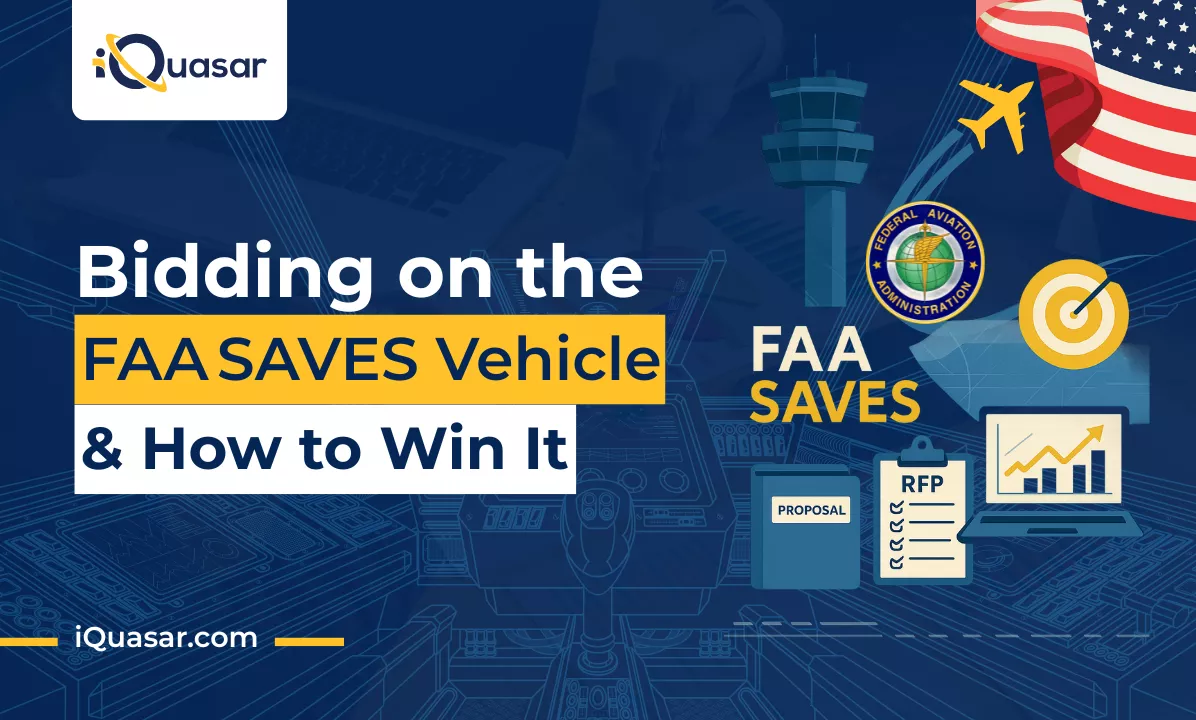
If you’re in the government contracting world and particularly focused on technology/hardware/COTS services, the Federal Aviation Administration’s Strategic Sourcing for the Acquisition of Various Equipment and Supplies (SAVES) vehicle is one you’ll want to have on your radar. With a ceiling of approximately US $4.1 billion, the vehicle presents a meaningful growth pathway for firms in the federal IT hardware and supply chain space.
This blog unpacks what the SAVES vehicle covers, its evolution and latest updates (as of November 2025), why it matters to your business, how the evaluation works, proposal tips, timeline, eligibility criteria, and why teaming with a seasoned proposal development firm can give you an edge. At iQuasar LLC, we believe playing this vehicle strategically can help drive growth for firms targeting the federal market.
What is FAA SAVES?
The SAVES suite is a strategic procurement vehicle managed by the FAA to centralize and streamline the purchase of various equipment and supplies.
It covers a broad set of categories, including (but not limited to):
- IT hardware (servers, storage, networking, desktops/laptops) and COTS software.
- Equipment and supplies more broadly (depending on the specific SAVES subvehicle) for the FAA enterprise and its customers (DOT, etc).
- Under recent recompete activity, an IT supply/IT hardware contract with an approximate value of up to $4.1 billion ceiling, multiple award (up to eight firms), and Firm-Fixed price.
In short, if you deliver IT hardware, software, or related services at scale for a large agency, and you want to tap into the FAA market, SAVES is one of the key vehicles to target.
Latest Updates (as of December 2025)
Here are the recent key developments that every bidder should know:
- On December 10th, 2025, Amendment 0004 was issued for FAA SAVES, it includes the conformed solicitation copy, the Q&A, and extends the proposal due date to January 16, 2026, at 1700 ET
- Previously, in August 2025, the FAA had opened a proposal window for a new “IT supply” recompete under the SAVES umbrella, described as an approximately US $4.1 billion multiple-award IDIQ vehicle.
- A recent solicitation listing shows the response date has been moved/updated (Jan 12, 2026) for “IT and telecom – data center products (hardware and perpetual license software)”.
- The FAA Small Business Office still lists SAVES as one of its strategic sourcing vehicles covering office products, facilities maintenance services, and IT products & services.
Why It’s Valuable to Bid on the FAA SAVES Contract
From a business development and strategic growth perspective, SAVES offers several advantages:
High volume, recurring spend:
The size and ceiling (US $4.1 billion) mean there is meaningful business potential.
Streamlined procurement:
As a strategic sourcing vehicle, once you are under contract, you are eligible to receive task orders rather than compete from scratch for each requirement.
Brand/industrial scale visibility:
Winning a seat gives you credibility in the federal IT hardware space and with the FAA.
Cross-selling potential:
Once you’re on the vehicle and delivering hardware/software, you can position related services (lifecycle management, support, etc) to the FAA or other agencies leveraging the vehicle.
Competitive advantage:
Firms not on the vehicle will often be excluded from many Task Orders, so being awarded unlocks a privileged position.
In short: If your firm fits the hardware/software/IT supply chain model, gaining a spot on SAVES is a strategic platform for growth—not just a one-off bid.
Key Task Areas & Scope of FAA SAVES (What Work “Looks Like”)
While the exact scope will be defined in the solicitation, existing public information shows the following task areas:
- Commercial-off-the-shelf (COTS) hardware and software procurement: servers, switches, storage arrays, desktops/laptops, networking devices.
- Software licensing and cloud-based services are tied to the hardware procurement.
- Technical and professional support services that enable full lifecycle management of assets.
- Ordering, delivery, configuration, and maintenance of IT equipment for the FAA and its enterprise.
- Possibly other categories under the broader SAVES umbrella (office supplies, facilities maintenance, etc), though the current focus appears tightly on IT supply.
Understanding this means your capture/pursuit strategy must align your offering (hardware + value-add services) exactly with these task areas.
FAA SAVES Evaluation Methodology & Proposal Requirements
- This is a multiple-award, firm-fixed-price contract with an economically priced structure.
- The FAA will use the Lowest Price Technically Acceptable (LPTA) approach for evaluating the proposals.
- Key proposal requirements include past performance (hardware/IT supply), pricing competitiveness, letters of authorization, supply chain capability, delivery/logistics capability, and compliance with security/IT standards in the federal environment. (Based on best practices and earlier article commentary)
What to Emphasise in your SAVES Proposal:
- Competitive Pricing Model: Given LPTA, cost will likely be the dominant factor. You need to show cost efficiencies, volume discounts, and supply chain robustness.
- Technical Acceptability: You must meet or exceed the stated hardware/IT specifications and delivery requirements, with minimal “must fix” items.
- Past Performance: Demonstrate similar large-scale supply contracts, particularly with federal agencies or large clients.
- Logistics/Fulfilment/Risk Mitigation: Show you can deliver across multiple sites/regions, have inventory/lead time management, and handle supply chain risk.
- Compliance and Security: Federal IT hardware has specific security/governance requirements (cybersecurity, data sanitization, configuration, etc.); highlight your understanding and processes.
- Value-added Services: Although the vehicle is supply-oriented, emphasizing lifecycle support improves your competitiveness.
- Teaming Strategy: For firms that are not yet large primes, proposing teaming or subcontracting can enhance your strength.
FAA SAVES Timeline & Journey So Far
Here’s a snapshot of the vehicle’s journey and upcoming timeline:
- SAVES has been around for several years as the FAA’s strategic sourcing program for “various equipment and supplies”.
- The current major recompete/new solicitation opened in August 2025 (proposal window) for the IT supply vehicle (approximately US $4.1 billion), with up to eight awards.
- According to the update published by the FAA on November 18, 2025, the response date has been extended to January 12, 2026.
- Firms currently in the “capture/proposal readiness” phase should prepare to respond, build capture assets, refine pricing, and teaming strategies.
For you, this means that now is the right time to mobilize: capture strategy, teaming, pricing modeling, and proposal development need to start well ahead of the final RFP release.
Predecessor Vehicles (What Has Come Before)
- Earlier versions of SAVES vehicles included COTS IT hardware supply under FAA and DOT vehicles with multiple IDIQ awards/ceiling contracts. For example, a “SAVES COTS Information Technology” contract with a ~US $687 million ceiling.
- The current $4.1 billion vehicle appears to be the next iteration/recompete, scaling up and consolidating the hardware supply needs for the FAA.
- Recognising the predecessor vehicles matters because you can study who won those, how they structured pricing and delivery, and what lessons can be learned.\
FAA SAVES Eligibility & Set-Aside Considerations
To participate in SAVES, firms will need to meet standard federal contracting eligibility criteria:
- Be registered in SAM.gov, have a valid Unique Entity Identifier (UEI), and comply with FAR clauses.
- Demonstrate past performance as relevant.
- Meet any requirement of the solicitation regarding business size or type (some may be large businesses; other task orders may include small business set-asides) — e.g., one solicitation listing indicates “Small Business” set-aside.
- Have appropriate cybersecurity/supply chain/compliance capabilities given the hardware and IT nature of the contract.
For firms in capture mode: if you are a small business, explore teaming with prime contractors; if you are a prime, consider how to structure subcontracting opportunities for small business partners.
Benefits of Partnering with a Proposal Development Firm for the SAVES Contract
While many firms are comfortable executing supply contracts, the competition for large, multi-award vehicles, such as SAVES, is intense. Here’s how a specialised proposal development firm (or partnering with one) can help:
Deep Understanding of Federal Evaluation Criteria:
They know how to tailor your proposal to the LPTA environment, emphasize cost model, past performance, and risk mitigation.
Capture Strategy Support:
They can help you map the vehicle landscape, identify competitors, craft your winning theme, and develop your teaming strategy.
Proposal Management:
Coordinate proposal schedule, allocate sections (pricing, technical, past performance), manage reviewers, and ensure compliance with RFP instructions.
Price Modelling:
For hardware supply vehicles, you need aggressive pricing while protecting margin—proposal firms can help model costs, margins, supply chain risk, and build credible cost narratives.
Compliance and Formatting:
Federal proposals have strict compliance and formatting rules; any misstep could result in disqualification.
Teaming/Subcontractor Management:
If you’re teaming, a proposal firm can help draft teaming agreements, clarify roles, and craft past performance narratives across firms.
Post-Award Support Readiness:
Winning is only half the battle; proposal development firms often assist with transition planning, performance metrics, and risk registers, ensuring you’re ready to execute and meet contract requirements once the award is made.
For a vehicle like SAVES, working with a firm experienced in large federal supply chain hardware vehicles can accelerate your path to a competitive proposal, reduce risk, and potentially increase your win probability.
Getting Started: FAA SAVES Action Plan
Here’s how we at iQuasar would recommend you move forward:
- Conduct a Gap Analysis: Review your hardware/IT supply capabilities, past performance, pricing model, and logistics/fulfilment strengths. Identify gaps relative to what the FAA will demand under SAVES.
- Develop a Capture Plan: Map the competition, decide whether you’ll pursue a prime or subcontractor role, and identify teaming partners now.
- Build a Pricing and Business Model: Develop a cost model that demonstrates how you can deliver at scale, meet volume commitments, demonstrate supply chain robustness, and provide lead time assurances.
- Prepare Your Proposal Development Readiness: Assign resources (or engage a proposal firm) to develop the following sections: technical/management, past performance, and pricing. Prepare templates and compliance checklists now rather than waiting.
- Focus on Differentiation: While LPTA often means lowest price wins among technically acceptable bidders, you still need to ensure “technically acceptable” is met, and you mitigate any risk items. Present your supply chain risk mitigation, logistics, warranty/support, and service adjuncts.
- Ensure performance readiness: Even before the award, ensure you have back-office, supply chain, fulfillment, and compliance capabilities in place so you can mobilize quickly if awarded.
- Monitor the Solicitation: Keep a close eye on updates to the RFP (including amendments, due dates, and eligibility criteria) and adjust your capture/proposal plan accordingly.
The SAVES vehicle represents a significant strategic opportunity for firms in the IT hardware/software supply chain to establish a foothold (or expand their presence) in the FAA and federal marketplace. With a multi-billion-dollar ceiling (~US $4.1 billion), a recompete currently underway, and a clear scope focused on IT supply, this is a vehicle you don’t want to overlook.
However, success depends on disciplined capture planning, competitive pricing, strong past performance, supply chain/logistics readiness, and often teaming. Moreover, because the evaluation aims to deliver value at scale (often via LPTA), you must position yourself as both cost-efficient and technically solid.
If your firm is considering pursuing SAVES (either in a prime or teaming role), now is the time to mobilize. And if you are comfortable partnering with a proposal development firm to sharpen your pursuit and increase chances of award, we at iQuasar would be glad to support that journey.