

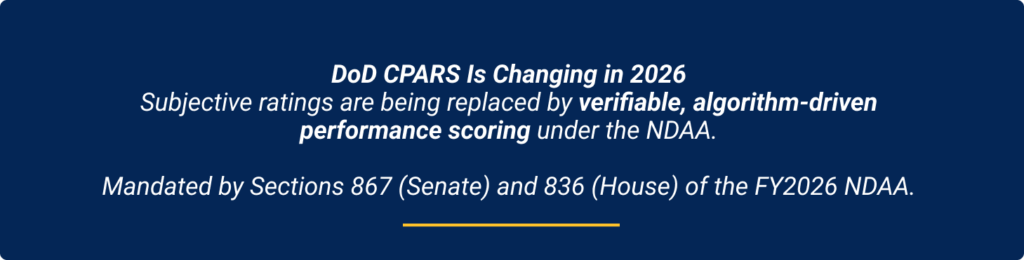
Sweeping reforms are set to redefine how the Department of Defense (DoD) evaluates contractor performance, pivoting from subjective ratings to objective, evidence-driven metrics through the 2026 National Defense Authorization Act (NDAA). Both House and Senate versions of the 2026 NDAA contain mandates, detailed in Section 867 of the Senate bill and Section 836 in the House bill, for a major overhaul of the Contractor Performance Assessment Reporting System (CPARS). While there are differences in the bill texts, both chambers have passed their versions, and the core requirements are highly likely to become law after House-Senate reconciliation. For contractors, this means that verifiable data, not impressions, will dictate future opportunities, making mastery of the new DoD CPARS system indispensable for compliance and competitiveness.
What Is CPARS – and Why It Matters for Contractors
The Contractor Performance Assessment Reporting System (CPARS) is the federal government’s official platform for assessing contractor performance across domains such as quality, cost control, schedule adherence, regulatory compliance, and the rationale for any ratings assigned. CPARS evaluations, especially for the DoD, traditionally relied on contracting officers’ subjective judgments, using five-point scales and narrative commentary.
Why Is CPARS So Critical? The CPARS record functions as both a performance log and a gatekeeper for future contract eligibility. Past performance captured in the system directly influences contractor competitiveness, reputation, and the ability to secure new awards, making CPAR certification and accurate assessments pivotal. Yet, reliance on subjective scores has challenged contractors aiming to build robust, consistent performance profiles.
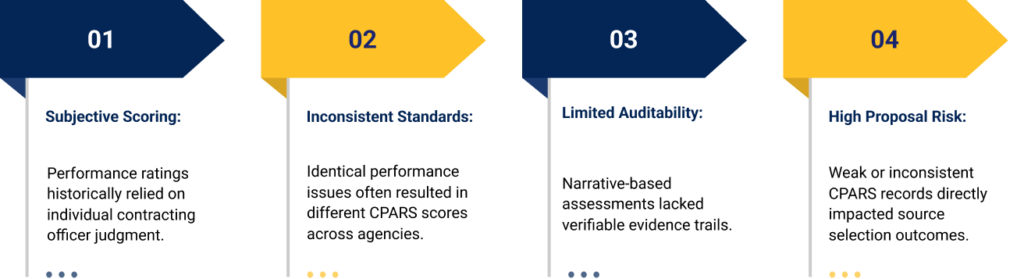
Key Takeaway: Traditional CPARS ratings have exposed contractors to personal bias, inconsistency, and variable standards due to the inherently subjective nature of performance evaluation.
The 2026 NDAA Vision: CPARS Becomes Objective, Fact-Based, and Automated
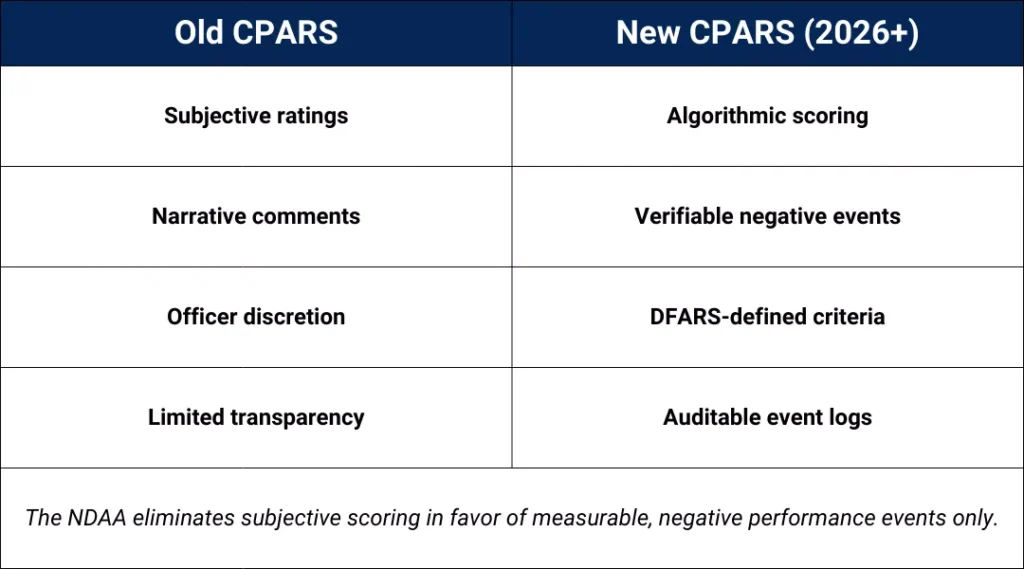
CPARS ratings will shift from human discretion to an objective, algorithm-driven, auditable system. Both House Section 836 and Senate Section 867 require the DoD to amend the Defense Federal Acquisition Regulation Supplement (DFARS) to create a performance reporting system focused exclusively on negative performance events that are verifiable and measurable, eliminating subjective commentary or non-specific praise.

What Will Change for Contractors?
- Scoring will be based strictly on documented, negative performance events, not general impressions or anecdotes.
- The scoring algorithm will normalize performance by the number of contracts or total dollar value, ensuring fairer cross-comparison among contractors of varying sizes and scopes.
- Human discretion is minimized, increasing transparency and consistency across evaluations.
“Negative Performance Events”: The New Backbone of CPARS Ratings
“Negative performance events” refer to explicit, verifiable incidents that indicate failed contract execution or noncompliance, as outlined in the NDAA. Categories Mandated for Reporting (per Sections 867 & 836):
- Defective products: Delivery of items not meeting contractual requirements, verified by inspection, QA records, or test results.
- Delinquent deliveries: Missed deadlines or delivery schedules, documented in milestones or official correspondence.
- Defective pricing: Submission of faulty, incomplete, or misleading pricing data, e.g., as flagged by DCAA audits.
- Subcontractor flow-down failures: Not enforcing mandatory clauses with subcontractors, as identified in contract reviews.
- Regulatory/safety violations: Breaches of safety, environmental, or regulatory requirements, backed by inspections or citations.
- Cybersecurity failures: Major lapses or breaches caused by contractor negligence, substantiated by government assessments.
- False claims/misrepresentation: Filing fraudulent invoices or false information, as found in investigations or official records.
- Improper markings on technical data: Unauthorized or incorrect labeling on data or software that affects rights, found through government review.
The DoD will also have authority to establish additional negative performance categories, as long as they are objective, verifiable, and published with clear criteria in the DFARS.
Automated Scoring: How the New CPARS System Will Operate
The reformed CPARS process will utilize a standardized scoring mechanism, where **composite scores are algorithmically calculated** based on the number, frequency, and severity of negative performance events relative to contract transactions and dollar volume. These composite scores will be used in source selection decisions and as part of the official CPARS record.

What Contractors Can Expect
- Real-time access: Immediate visibility into composite scores and underlying negative events.
- Transparency: Event logs and scoring calculations will be accessible for review, offering clarity into how scores are determined.
- Rights to rebuttal: Contractors can comment on or rebut any reported event or score, with their statements preserved in CPARS as part of the official record.
- Normalization: Scores are standardized relative to contract value and transaction number, reducing disadvantages for high-volume contractors.
Composite score is the calculated total representing a contractor’s performance, derived from all reported negative events and normalized by contract size and volume.
Implementation Status, Timeline, and Applicability
Both chambers have passed their respective NDAA bills, with Sections 867 and 836 substantially aligning on CPARS reform. The remaining differences will be reconciled in the conference committee, but contractors can confidently anticipate that the overhaul is imminent.
- Implementation Timeline: DoD must update the DFARS to reflect the new CPARS system within 180 days of NDAA enactment, potentially by mid-2026 if the bill is signed before the new year.
- Training: DoD will produce updated guidance and training materials for contracting officers to ensure proper use of the revamped CPARS.
- Applicability: Contracts awarded before the effective DFARS date may continue under the old regime; contracts awarded afterward will be governed exclusively by the new system.
Key Takeaway: The timeline for DoD CPARS change is aggressive—contractors should prepare now to operate under stricter, data-focused scrutiny by the middle of 2026.
Impact Analysis: Contractor Adaptation Is Essential
Anticipating CPARS transformation requires decisive action in several operational areas:
- Proposal and Risk Management Overhaul: Contractors must spotlight data-backed performance, hard evidence, not anecdotes, in all DoD proposal submissions. Proposal narratives need to be supported by records proving the absence of negative performance events.
- Real-Time Past Performance Monitoring: Success under the new CPARS will require robust systems for instant logging and review of all negative events. Contractors should formalize event tracking, quickly verify any reported incidents, and respond before scores are finalized.
- Enhanced Subcontractor Oversight: Mandatory flow-down compliance is non-negotiable. Track subcontractor deliverables and contract clauses digitally; audit and document enforcement routinely to prevent negative events cascading from the supply chain.
- Continuous Quality and Compliance Assurance: Every mistake, even accidental or quickly corrected, could affect your CPARS score. Adopt recurring internal audits, universal incident templates, and automate documentation retention for QA and regulatory adherence.
- Bolster Cybersecurity Response: Cybersecurity is now a direct risk factor for **DoD CPARS** scoring. Maintain compliance with CMMC, deliver ongoing cyber training, and keep thorough logs of any incidents or government reviews.
Five Immediate Actions for Contractors:
To excel under the incoming DoD CPARS framework:
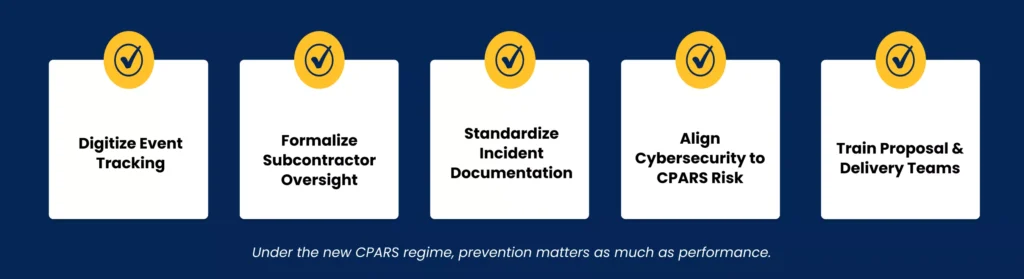
1. Digitize Subcontractor Management:
- Deploy checklists, audits, and digital flows for clause enforcement and compliance documentation.
2. Establish Real-Time Quality Logs:
- Log every delivery, milestone, and issue correction.
- Conduct and record regular QA/QA audits.
3. Enhance Cybersecurity and Regulatory Resilience:
- Shore up systems to meet DoD cyber standards and document all incidents.
- Retrain teams on new compliance policies as soon as updates are released.
4. Standardize Internal Reporting:
- Implement universal templates for event logging and dispute documentation.
- Reconcile all records before contract closeout.
5. Monitor Regulatory Updates:
- Assign teams to track SAM.gov and NDAA progression; hold quarterly briefing sessions on compliance changes.
The transition from subjective to fully automated, evidence-based CPARS scoring will redefine how contractors compete and succeed within DoD procurement. Performance will be judged by documented facts—requiring new rigor, discipline, and oversight from all contractors. Adaptation means not just demonstrating the absence of negative events but building organizational systems that prevent their occurrence.
For contractors, these reforms mark a clear inflection point. Our expert team at iQuasar stands ready to guide you through proposal compliance and proposal strategy necessary for success under the new DoD CPARS regime.