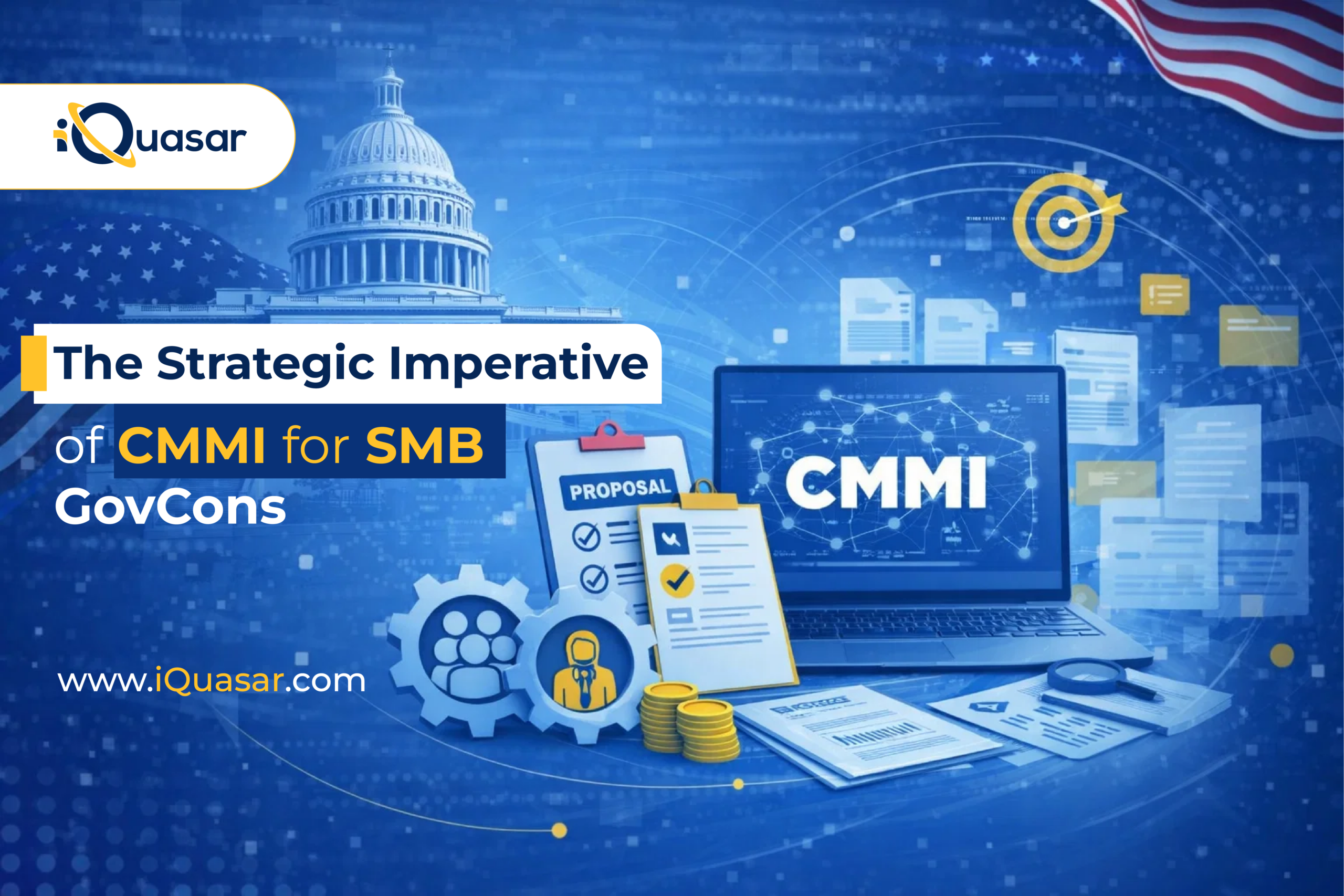
Aggregated data from client initiatives compiled by the CMMI Institute show that organizations achieving CMMI maturity routinely experience meaningful, measurable improvements up to 25–30% reductions in rework and 20–35% faster cycle times across projects. These gains translate directly into more predictable proposals, tighter control of costs, and better delivery outcomes in demanding government programs. For more on these framework-level benefits, see the official model information at the CMMI Institute and SEI’s CMMI topics.
This blog analyzes CMMI as a strategic asset for small and medium government contractors (GovCon). Rather than viewing CMMI as a compliance checkbox, the framework is presented here as a disciplined approach to elevating organizational capability, reducing performance risk, and enabling scalable growth in a competitive federal market.
The Strategic Business Case for CMMI Implementation
The CMMI framework offers a structured, evidence-backed path to elevate core business processes. Its value for GovCon is multifaceted and tightly aligned with key performance indicators that matter in source selection and program execution. A defined CMMI maturity level provides objective, externally verifiable evidence of process capability that enhances bid credibility and reduces perceived risk in evaluations.
Why it matters in federal procurement:
- Proposal validation and competitive differentiation: A mature CMMI rating turns a largely subjective capability story into an independently verified, auditable claim. This directly influences evaluation scores and can shift outcomes in tight competitions.
- Predictable execution and risk mitigation: Standardized planning, monitoring, and control reduce performance variance, improve cost and schedule predictability, and strengthen quality outcomes. In GovCon, where overruns and defects are frequent sources of negative evaluations, disciplined execution protects margins and reputation.
- Foundation for controlled growth: Ad hoc, hero-based success often fails at scale. CMMI provides repeatable practices that sustain communication, oversight, and quality as complexity increases across programs and contracts.
- Operational efficiency and cost containment: By identifying and eliminating inefficiencies, redundancies, and gaps, CMMI helps streamline workflows, reduce rework, and improve resource utilization—translating to more favorable unit economics and higher return on investment.
- Key takeaway: CMMI is a strategic driver of proposal strength, program reliability, and scalable growth for GovCon entities, not merely a compliance artifact.
Definitions:
- CMMI (Capability Maturity Model Integration): A process-improvement framework that guides organizations in establishing repeatable, measurable, and optimized practices across product life cycles and service delivery.
- CMMI for GovCon (CMMI for Government Contractors): A domain-specific lens within CMMI that aligns process improvement with government contracting life cycles, contract types, and agency expectations.
A Value-Driven Implementation Pathway
A disciplined, phased approach minimizes disruption while maximizing return. The key is sequencing, alignment with existing workflows, and selecting the right appraisal partner to co-create a tailored system.
- Focused scope and prioritization: Begin with the process areas most critical to current pain points and most valued by target agencies (for example, Project Planning, Requirements Management, and Measurement & Analysis). Avoid attempting “all-at-once” implementation; early wins drive momentum and funding for broader adoption.
- Integration over imposition: Design processes to complement and improve daily work, not to create a parallel bureaucracy. The goal is lean, value-added processes that staff can embrace and sustain.
- Selection of a qualified appraisal entity: Partner with a service provider who can act as a business-process consultant—helping tailor a model that fits organizational culture, strategic goals, and GovCon realities. The right partner will facilitate practical, scalable improvements rather than a one-size-fits-all framework.
Key takeaway: A focused, integrated, and partner-supported rollout accelerates value realization and reduces disruption to ongoing programs.
Implementation Roadmap: Four Phases to Realize CMMI Benefits
A practical roadmap translates strategy into sustainable capability.
- Phase 1 — Assess and Charter:
- Current state assessment against a targeted CMMI model (e.g., CMMI for GovCon).
- Define a realistic scope, governance structure, and success metrics.
- Phase 2 — Pilot and Stabilize:
- Implement a focused subset of process areas with tight feedback loops.
- Establish lightweight measurement and governance to drive early wins and learning.
- Phase 3 — Expand and Integrate:
- Extend process areas across programs, ensuring cross-project consistency, and begin preparing for active appraisal.
- Phase 4 — Sustain and Mature:
- Institutionalize governance, continuous improvement, and ongoing measurement.
- Prepare for formal SCAMPI assessments and, if appropriate, a higher maturity level.
Key takeaway: A staged, outcomes-driven roadmap reduces risk, accelerates value, and aligns with GovCon program portfolios.
Measuring ROI: What Maturity Delivers in Practice
While every organization’s context differs, several recurring metrics illustrate the practical value of CMMI adoption in GovCon environments:
- Proposal credibility and win rate: Mature process claims backed by demonstrable evidence tend to strengthen proposals and reduce the perceived risk of execution challenges.
- Schedule and cost performance: Standardized planning, monitoring, and control reduce variation, leading to more reliable delivery timelines and budget adherence.
- Quality and defect management: Systematic measurement and analysis reduce rework, improve defect containment, and raise the overall quality of outcomes.
- Growth and scalability: Consistent practices enable smoother onboarding of new programs, facilities, or teams, supporting controlled expansion without repeating past inefficiencies.
- RCA and ROI modeling: A typical ROI calculation considers the cost of CMMI implementation (training, assessments, process redesign, and governance) against the anticipated annual benefits from reduced rework, improved on-time delivery, and increased proposal success. A simple framework can be used to estimate payback period and multi-year ROI, with examples grounded in your current program mix and target agencies.
Key takeaway: ROI from CMMI is best assessed with a structured measurement plan that links specific process improvements to program outcomes and to bid performance in source selections.
Viewed through the lens of GovCon strategy, CMMI is a deliberate investment in institutional resilience and credible market positioning. It turns process claims into demonstrated capabilities, enabling more reliable program execution, stronger competitive standing, and scalable growth across federal opportunities. The federal acquisition environment increasingly rewards contractors who can substantiate disciplined execution and reliability with objective evidence.
For executive leadership seeking to formalize operational excellence as a catalyst for business development, a structured dialogue is warranted. iQuasar is prepared to conduct a formal briefing on constructing a targeted CMMI implementation strategy designed to achieve your specific organizational and financial objectives. For more background on the framework, you can review official model information at the CMMI Institute and SEI CMMI topics.
For executive leadership seeking to formalize operational excellence as a catalyst for business development, a structured dialogue is warranted. We facilitate that critical analysis. iQuasar is prepared to conduct a formal briefing on constructing a targeted CMMI implementation strategy designed to achieve your specific organizational and financial objectives.