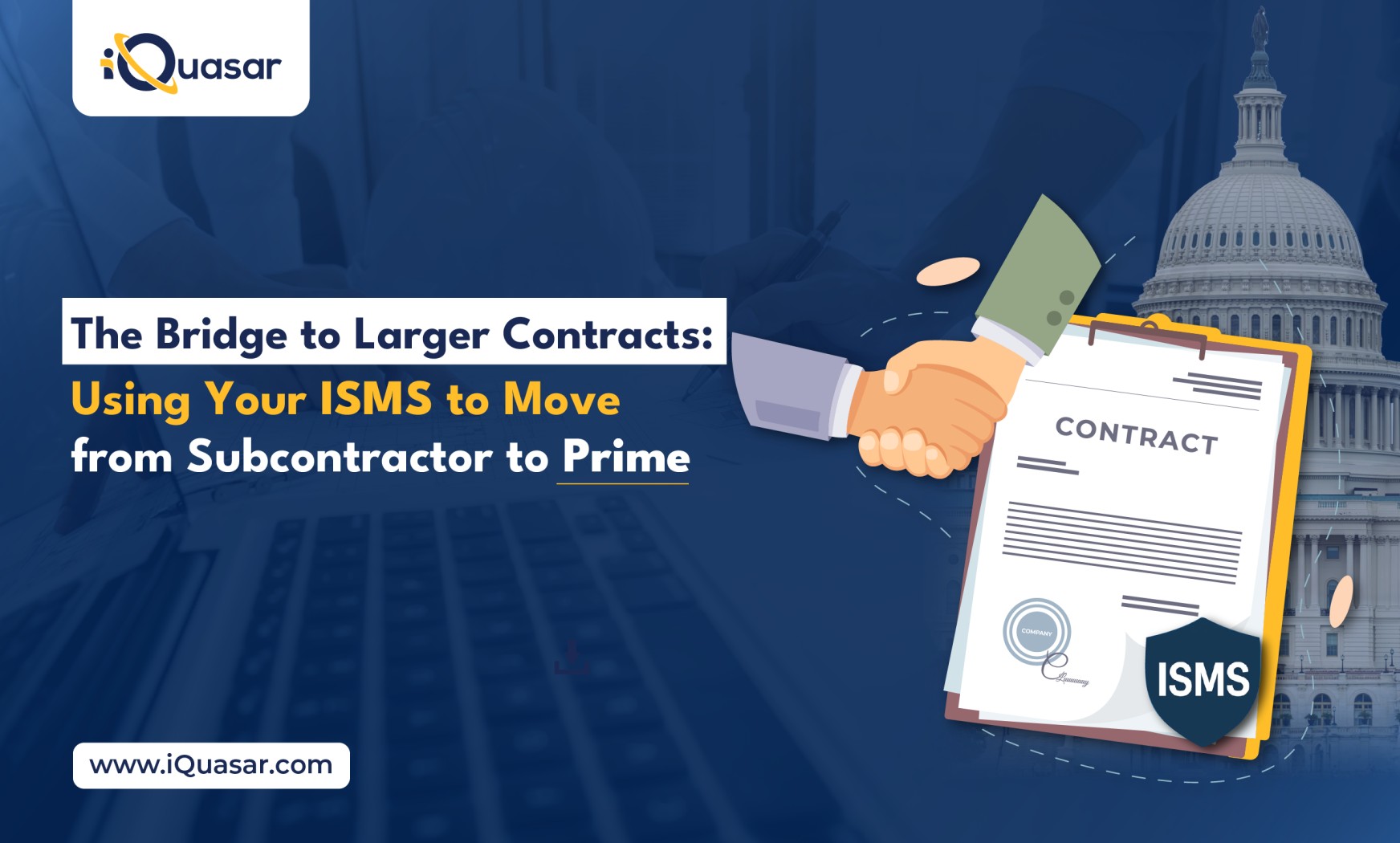
Your organization has executed its duties as a subcontractor with precision and reliability. Your technical performance is consistently exemplary, and your project management team maintains the confidence of prime contractors. Yet the most substantial and strategically significant opportunities, those involving direct contractual relationships with federal agencies and the authority of a prime contractor, persistently remain beyond attainment. The critical differentiator is increasingly not operational capability alone, but the ability to demonstrate disciplined, enterprise-wide security governance. A mature Information Security Management System (ISMS) serves as the foundational evidence required to navigate this transition from a sub contractor to a prime.
In this blog, we will cover how you can utilize ISMS from a compliance obligation into a definitive business development instrument. You will learn a structured framework for utilizing established security postures to cultivate advantageous teaming partnerships, respond with authority to direct solicitations, and position a small or medium-sized enterprise as a mature, low-risk contender for prime contracts.
Why Federal Agencies and Prime Contractors Prioritize Security Risk Management
The role of a subcontractor is principally defined by the execution of a defined statement of work. The prime contractor retains responsibility for the overarching client relationship, program management, and, most significantly, absolute accountability for supply chain risk. When a federal agency selects a prime contractor, it is delegating total responsibility for the security integrity of the entire operational chain. A single non-compliant subcontractor constitutes a critical programmatic vulnerability.
This environment presents a direct opportunity for the prepared contractor. A certified and operational ISMS, aligned with frameworks such as NIST SP 800-171, CMMC, or ISO/IEC 27001, functions as more than a prerequisite for subcontracting. It is a demonstrable indicator to both prime contractors and agency procurement officials that your organization represents a controlled, auditable, and trustworthy node within the supply chain—thereby actively reducing aggregate program risk.
How an ISMS Enables the Transition From Subcontractor to Prime Contractor
Organizations must cease regarding compliance certification as an archival document. It is a component of corporate credentials. To facilitate the transition to prime status, contractors must proactively employ their security maturity in three critical domains:
1. In Teaming Agreement Negotiations: Articulating Risk Mitigation.
Engagements with potential prime contractors should transcend technical capability discussions to address risk allocation explicitly.
- Recommended Dialogue: “Our proposal includes provision of our current System Security Plan, artifacts from our continuous monitoring program, and summary findings from our most recent internal audit. These materials will substantively reduce your administrative burden in validating our compliance with CUI security requirements.”
- Strategic Impact: This positions your organization not as a compliance liability to be managed, but as a partner that enhances operational efficiency and assurance.
2. In Proposal Development: Demonstrating Organizational Maturity.
Solicitations for prime contracts frequently evaluate “management capability” and “quality assurance processes.” Your ISMS provides the institutional evidence for these criteria.
- Recommended Action: Incorporate a distinct section within proposals titled “Corporate Security Governance and Risk Management.” Detail your formal incident response protocol, security awareness training program, and management review cycle (Plan-Do-Check-Act).
- Strategic Impact: This demonstrates that your corporate governance structure embodies the same rigor required for contract performance, enabling competition on parity with larger entities.
3. During Source Selection: Providing Objective Evidence.
Assertions of capability are commonplace during evaluations; documentary evidence commands superior credibility.
- Preparatory Step: Maintain a readily available “Security Credentials Portfolio” containing your certification, an executive summary of your risk assessment, and a matrix correlating your controls to applicable frameworks (e.g., CMMC, NIST 800-171).
- Strategic Impact: While competitors may delineate proposed future states, your submission provides validated proof of an existing, operational security posture. This evidentiary advantage can be determinative during comparative assessment.
A Practical ISMS Roadmap for Moving From Subcontractor to Prime Contractor
The translation of this strategy into operational reality requires deliberate action. Implement the following steps:
- Conduct a Prime-Oriented ISMS Audit: Evaluate your policies, procedures, and records. Would they provide a prime contractor’s security officer with immediate confidence in your controls? Refine documentation for clarity and auditability.
- Develop a Security Value Proposition: Formulate a concise narrative quantifying the benefits of your ISMS. Example: “Implementation of our ISMS has reduced mean time to incident containment by 60%, and our latest surveillance audit resulted in zero major nonconformities.”
- Revise Corporate Marketing Materials: Prominently feature your ISMS certification on your capability statement and corporate website, adjacent to NAICS codes and past performance profiles. Utilize specific terminology (e.g., “CMMC Level 2 Compliant”).
- Engage in Targeted Business Development: At industry events, introduce your organization by leading with its security posture: “We deliver [service specialty] supported by a formally documented, CMMC-aligned security program designed to meet prime contractor integration requirements.
For small and medium-sized government contractors, the progression from subcontractor to prime is a function of established trust and demonstrable risk mitigation. A formally implemented ISMS provides the verifiable foundation for both. It repositions your organization from a potential supply chain variable into a validated, low-risk partner and, ultimately, a credible prime contractor candidate. The objective is not merely to protect sensitive information, but to enable enterprise growth.
The process of developing, implementing, and certifying a business-enabling ISMS is a complex undertaking requiring specialized expertise. At iQuasar, we provide dedicated advisory services to government contractors navigating this critical transition. We offer end-to-end guidance—from initial gap analysis and policy architecture to implementation management and audit readiness—specifically designed to satisfy the stringent requirements of CMMC and ISO/IEC 27001 within the government contracting sector. We invite you to schedule a free consultation to discuss a structured approach for transforming your security governance into a substantiated competitive differentiator, thereby establishing a clear trajectory toward prime contractor status.