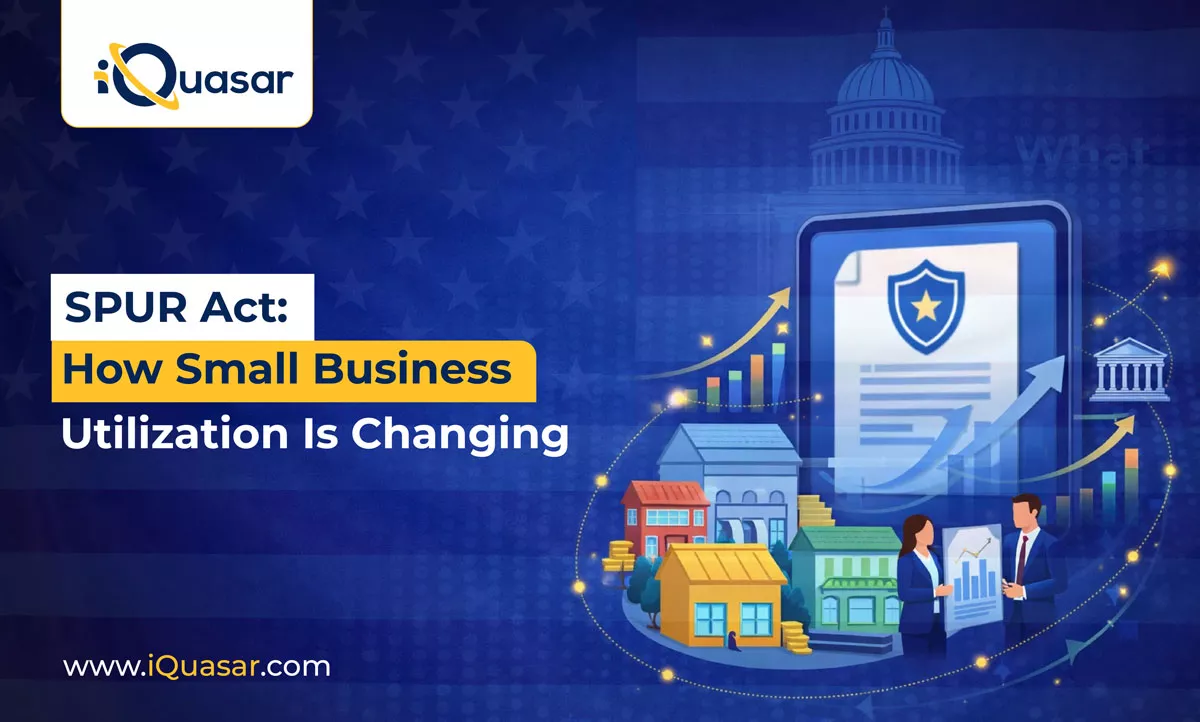
We might now be moving to a federal contracting landscape where a small business’s participation isn’t just checked off on a form, but actively tested for impact in real work and awards. The SPUR Act, if enacted, aims to move small business utilization from a reporting obligation into a measurable performance discipline.
In this blog, we examine what the SPUR Act proposes, why it was reintroduced, and how it could reshape small-business utilization strategies for contractors of all sizes
Small Business Utilization Is Becoming an Accountability Metric
Small business utilization has long been treated as a compliance checkbox: demonstrate some participation, file the right forms, and move on. With the SPUR (Small Business Participation Utilization and Reporting) Act, the lens shifts to accountability.
The core question becomes whether stated small business commitments translate into real work and outcomes on contracts. This is not about sweeping legislative theory; it’s about how agencies and primes are measured when it comes to subcontracting performance. If enacted, SPUR Act provisions could redefine how a company demonstrates value to the federal market, moving from “good faith effort” to verifiable performance. In this blog, we examine what the SPUR Act proposes, why it was reintroduced, and how it could reshape small-business utilization strategies for contractors of all sizes.
What Is the SPUR Act and Why Was It Reintroduced?
The core motivation is not to rewrite the mechanics of contracting but to address three persistent problems:
- Inconsistent enforcement across agencies
- Limited transparency in how small-business goals are tracked, and
- Underperformance in subcontracting plans that don’t translate into meaningful workshare
In other words, the act seeks to shift the culture from lax “reporting” to enforceable accountability. In this sense, SPUR Act language points toward a higher standard of oversight and a clearer tie between commitments and actual outcomes. It’s framed as a shift in enforcement culture rather than a mere procedural tweak, with emphasis on how agencies and primes are held responsible for what happens on the ground. As proposed, the focus is on measurable indicators and stronger governance around small-business utilization, rather than on legislative mechanics alone.
Key SPUR Act Provisions Contractors Should Understand
If enacted, these changes would ripple through how teams operate, plan, and report on small-business goals. Changes to Small Business Utilization Reporting would increase the granularity and cadence of data, pushing contractors to present not just totals but context for how small-business work is allocated, embedded, and sustained across a program. More transparency would accompany this, with clearer visibility into supplier performance, subcontracting plan execution, and the real work shared with OSDBUs and prime partners. Stronger documentation expectations would require teams to preserve evidence of ongoing engagement with small businesses, including contracts, subaward tracking, and performance metrics tied to recompense or future opportunities. A potential performance-based review could translate utilization metrics into concrete outcomes during evaluations, shaping both optimization strategies and award considerations.
- Increased Oversight of OSDBUs: would grant greater authority or formal review mechanisms for how offices oversee the implementation of subcontracting plans. This isn’t about shrinking OSDBUs’ role; it’s about equipping them with clearer leverage to assess real-world progress against commitments. For companies and teaming partners, these shifts would mean revisiting engagement strategies, placing more emphasis on durable capacity-building with small businesses and ensuring that partnerships are designed to deliver sustainable outcomes, not temporary participation.
- Accountability Mechanisms for Agencies and Primes: would create consequences for underperformance, coupled with reporting scrutiny and reputational effects. The downstream impact on subcontracting plans includes tighter scrutiny of workshare commitments and reduced tolerance for token participation. Why this matters operationally: the path from plan to performance becomes a supplier-management discipline, requiring better forecasting, more robust vendor selection, and more intentional risk management in small-business partnerships.
- Consequence-focused sections require constant discipline: if engagements lack depth, expect closer audits, more frequent reporting cycles, and stronger pushback from agency reviewers and OSDBU stakeholders. These shifts drive engagement strategies toward real, verifiable utilization rather than symbolic participation.
How the SPUR Act Could Reshape Contractor Operations
- For Small Businesses, the focus is on increasing visibility into real workshare and ensuring that commitments translate into sustained opportunities. This could empower small firms with stronger leverage in teaming negotiations when a prime must demonstrate credible utilization results, not just a contractual promise. It also means better access to performance data that can support competitive positioning, given that agencies and primes will rely on transparent metrics to evaluate past delivery and future risk.
- For Large Primes, the act tightens control over subcontracting commitments. Expect tighter internal tracking, heightened documentation expectations, and more frequent reviews of how subcontracts are executed. The risk profile for underperforming plans rises, which could influence evaluations, bid strategies, and the economics of partner ecosystems. In practice, this means primes may need enhanced project-level dashboards, formalized OSDBU outreach programs, and stronger governance around subcontracting spend, so the emphasis shifts from “hunting for dollars” to sustaining substantive, verifiable small-business participation.
Thoughts on implementation: this is not about new red tape for its own sake. It’s about translating promises into verifiable, auditable outcomes. If agencies and primes are serious about leveling the playing field for small businesses, accountability tools and documentation standards should be the enabling infrastructure, not a punitive burden. Practically, that means early data capture, consistent requirement parsing in teaming agreements, and clearer consequences for gaps in performance.
Also Read: Past Performance Barriers for GovCons Lowered – Section 824
Practical Steps Contractors Should Take Now
- Audit subcontracting performance versus commitments. Establish a baseline across current programs, identify gaps, and align performance targets with real work allocation. This matters now because the SPUR Act’s enforcement posture could reward programs that demonstrably meet or exceed stated utilization goals.
- Improve utilization tracking systems. Invest in systems that capture not only spend but actual work delivered to small businesses, including subcontracts, task orders, and milestones. This matters now because transparent data reduces variance between reported goals and realized outcomes.
- Revisit teaming agreements. Build in clauses that require quarterly utilization reporting, milestone-based work allocations, and joint accountability with subconsultants. This matters now because it aligns contracts with measurable outcomes rather than passive participation.
- Engage OSDBUs proactively. Create regular touchpoints with OSDBUs to review the pipeline, address barriers, and align on capacity-building initiatives. This matters now because OSDBU oversight may intensify, making proactive collaboration essential for success.
The SPUR Act signals more than a policy update; it represents a structural shift in how small business utilization may be evaluated across the federal marketplace. Moving from intent-based reporting to performance-based accountability means contractors must embed small-business participation into capture strategy, proposal positioning, subcontract management, and ongoing contract governance. Utilization will increasingly need to be traceable, measurable, and defensible — not just stated in a plan, but reflected in real workshare and documented outcomes.
For primes, this means stronger internal oversight and more disciplined supplier management. For small businesses, it creates an environment where meaningful participation and sustained performance carry greater weight in future opportunities. In either case, the competitive advantage will belong to organizations that treat small-business utilization as an operational capability rather than an administrative requirement.
iQuasar supports contractors in aligning strategy, compliance, and execution under evolving federal expectations. Through our GovCon 360 Services, we help firms strengthen contract governance, subcontracting discipline, and compliance infrastructure. Our Proposal Development Outsourcing Services ensure that utilization commitments are clearly articulated, competitively positioned, and aligned with emerging oversight standards.
If your organization is reassessing its small-business strategy in light of increased accountability expectations, Contact us today to discuss how we can help you build a defensible, performance-driven approach.