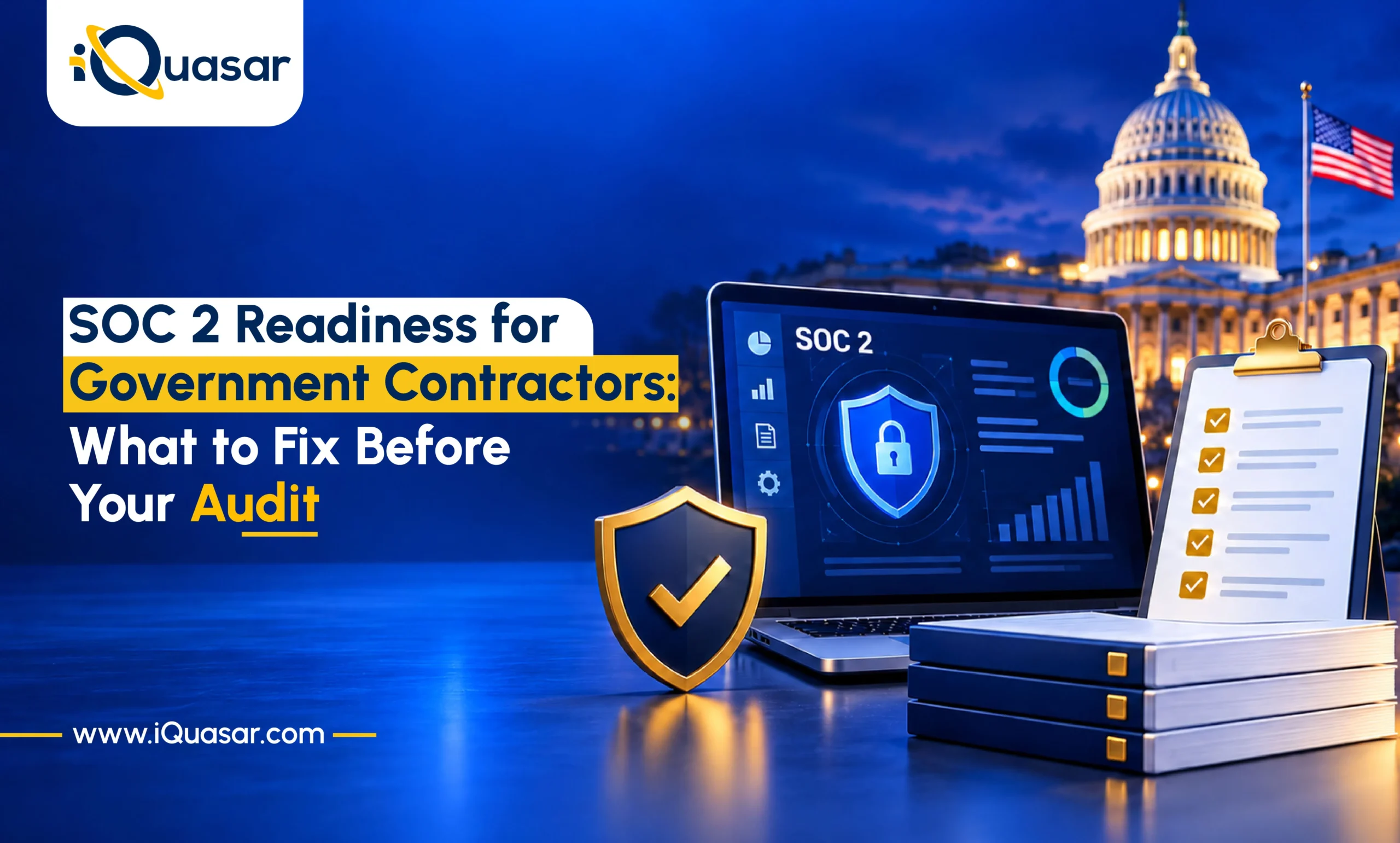
Federal government contractors face increasing scrutiny over how they handle sensitive information and secure internal systems. Organizations increasingly need to demonstrate that security controls are not only documented but consistently implemented and supported by verifiable evidence. Formal SOC 2 assessments often uncover weaknesses such as incomplete access reviews, inconsistent evidence retention, outdated policies, insufficient vendor oversight, or controls that are documented but not consistently followed in practice. SOC 2 readiness focuses on identifying and addressing these issues before the formal audit begins.
The American Institute of Certified Public Accountants (AICPA) established the System and Organization Controls (SOC) framework to provide a standardized mechanism for evaluating internal security controls. A successful SOC 2 audit requires proof that security controls are consistently operational over an extended evaluation window. When contractors prepare without a structured review, formal testing frequently uncovers broken workflows, unverified access lists, and missing evidence. Fixing these operational gaps prior to audit initiation helps protect competitiveness for contracts where independent security assurance is expected.
Start With Scope: Know What the Audit Will Actually Cover
Scoping requires identifying the systems, applications, personnel, processes, facilities, third-party services, and cloud environments that support the delivery of in-scope services or handle customer data. It also requires determining which of the AICPA’s Trust Services Criteria apply to those services. Security is mandatory in every SOC 2 examination, while Availability, Processing Integrity, Confidentiality, and Privacy are included based on organizational commitments, contractual requirements, and the types of information being processed.
Contractors often make the mistake of defining an overly broad audit scope in an attempt to demonstrate comprehensive compliance. Including non-essential internal networks, development applications, or peripheral corporate staff unnecessarily expands the control environment. This expansion increases the number of required control tests, multiplies the volume of evidence collected, and elevates the risk of audit exceptions. Conversely, an improperly narrow scope can fail to satisfy prime contractor or federal agency requirements, rendering the final audit report useless for business development.
What constitutes an effective SOC 2 scoping strategy for federal contractors? An effective scoping strategy isolates the specific Information Technology (IT) systems and personnel that support government deliverables within a clearly defined system boundary. Defining boundaries through network segmentation, strict role-based access controls, and dedicated cloud environments keeps the audit focused on relevant operational assets.
The 5 Areas GovCons Should Fix Before a SOC 2 Audit
1. Controls That Exist on Paper but Not in Practice
Maintaining comprehensive written security policies to satisfy Request for Proposal (RFP) requirements is insufficient if those procedures are not operationalized. During a SOC 2 Type II evaluation, auditors assess actual operational execution over time rather than simple policy documentation. Common audit exceptions stem from unperformed monthly vulnerability scans, skipped quarterly risk reviews, or informal employee onboarding that strays from written protocol. Contractors must systematically audit daily operations against written directives to ensure every documented control maps directly to an active, repeatable workflow.
2. Access Control and User Management
Inadequate user access management remains one of the primary causes of SOC 2 audit exceptions. Auditors review user provisioning logs, role-based access control (RBAC)—a method of restricting system access based on authorized user roles—multi-factor authentication (MFA) enforcement, and termination records. Identity governance failures, such as delayed account revocations for departed personnel or missing quarterly access reviews, rapidly compromise an organization’s overall control environment. Implementing automated user lifecycle management linked directly with HR software guarantees that permissions are granted, modified, and revoked strictly in accordance with security thresholds.
3. Missing or Inconsistent Audit Evidence
Without timestamped, verifiable proof, auditors treat even fully executed controls as non-existent. Contractors frequently perform required security activities—including weekly code reviews, patch management testing, or firewall rule evaluations—without preserving system logs or ticketing records. When auditors request sample evidence spanning a six-month valuation period, missing records force audit delays and lead to qualified notes in the final report. Establishing centralized, immutable evidence collection repositories ensures operational proof remains organized and retrievable on demand.
Also Read: SOC 2 AICPA Consulting Standards: Trust Services Criteria Explained
4. Third-Party and Vendor Risk Management
Government contractors rely heavily on third-party cloud service providers, software vendors, and subcontractors to deliver key capabilities. SOC 2 criteria require organizations to monitor the security posture of all external vendors that access the system boundary or process sensitive client data. How should contractors manage vendor oversight without expanding audit scope unnecessarily? Contractors must obtain and evaluate the annual SOC 2 reports or ISO certifications of critical vendors, document identified supply chain risks, and verify that Complementary User Entity Controls (CUECs)—the specific security controls that service organizations require their clients to implement—are actively operating internally.
5. Incident Response and Change Management
Auditors inspect change management pipelines to verify that system updates follow authorized, documented approval workflows and that security incidents are handled according to formal response plans. Unapproved code deployments, missing peer review sign-offs in ticketing platforms, and undocumented emergency patches directly violate SOC 2 change control criteria. Similarly, failing to execute and document an annual incident response tabletop exercise creates an immediate compliance gap. Contractors must enforce strict segregation of duties between development and production environments while maintaining automated, tamper-proof audit trails for every infrastructure modification.
Run a SOC 2 Readiness Assessment Before the Formal Audit
A formal SOC 2 readiness assessment is a comprehensive practice conducted by an independent advisor or a dedicated internal team. The primary goal is to evaluate current operational controls against applicable Trust Services Criteria before engaging an independent Certified Public Accountant (CPA) firm.
What should a SOC 2 readiness assessment accomplish?
A well-executed readiness assessment should:
- Compare existing controls against applicable SOC 2 criteria to determine whether security and compliance requirements are adequately addressed.
- Identify documentation and evidence gaps by reviewing policies, procedures, logs, tickets, approvals, and other records that auditors may request.
- Determine whether controls are operating as intended, rather than simply existing in written policies or procedures.
- Prioritize remediation efforts based on risk, business impact, and potential audit exposure.
- Create an audit-preparation roadmap that assigns ownership, establishes timelines, and outlines corrective actions needed before the audit period begins.
For government contractors, this process can provide valuable insight into the maturity of existing compliance practices and help teams focus resources on the areas most likely to affect audit outcomes. Addressing identified gaps before formal testing begins can reduce disruption during the audit process and improve overall readiness for independent assessment.
What Should Be Ready Before the Auditor Arrives?
Waiting until formal audit testing begins to identify control gaps can create significant challenges. Issues such as incomplete access reviews, missing evidence, inconsistent change management practices, or undocumented vendor oversight often require time to investigate and remediate. When these weaknesses are discovered during the audit itself, organizations may face increased pressure on internal teams, audit delays, or additional scrutiny. Verifying that controls, documentation, and supporting evidence are in place beforehand allows your organization to address deficiencies proactively and approach the audit process with greater confidence. Contractors should verify that the following core operational requirements are fully satisfied prior to formal audit engagement:
- Scope is clearly defined and documented with system boundaries explicitly identified.
- Control owners are assigned and trained on their evidence-collection responsibilities.
- Policies reflect actual daily operations and bear annual leadership approval signatures.
- Access reviews are current, with documented evidence for user provisioning, modifications, and terminations.
- Evidence is organized, centralized, and retrievable across the entire historical audit window.
- Vendor reviews are documented, including annual SOC 2 evaluations and verified user entity controls.
- Incident response and change management processes are operational, with documented change tickets and exercise records.
- Known gaps have a documented remediation plan showing active resolution steps.
Strengthening Compliance for Long-Term Success
As government agencies, prime contractors, and commercial partners place greater emphasis on security assurance, organizations are increasingly expected to demonstrate that their compliance programs can withstand independent scrutiny. Security and compliance assessments are often part of vendor evaluation processes, making governance, accountability, and operational discipline important business considerations. For contractors in regulated markets, a mature compliance program can help strengthen stakeholder confidence and support future opportunities.
iQuasar helps organizations prepare for SOC 2 assessments and independent audits to establish a stronger foundation for growth and risk management. Connect with our team to learn how iQuasar can support your SOC 2 readiness before the audit occurs.