In federal contracting, proposal development is not just about meeting compliance requirements; it’s about telling a story that resonates with the customer, aligns with the evaluation criteria, and clearly differentiates your solution. This strategic storytelling is achieved through a rigorous Pink Team Red Team Gold Team Review process that ensures proposal drafts at each phase undergo well-defined evaluation involving diverse stakeholders. Such a disciplined process transforms proposals from rough drafts into strategic, compelling submissions that win
Color reviews are a structured, phased approach to proposal evaluation that allows teams to step back at critical milestones, assess the draft’s quality and effectiveness, and refine it from multiple perspectives—strategy, compliance, clarity, and presentation.
Understanding the Pink Team Red Team Gold Team Review: What They Are and Why They Matter
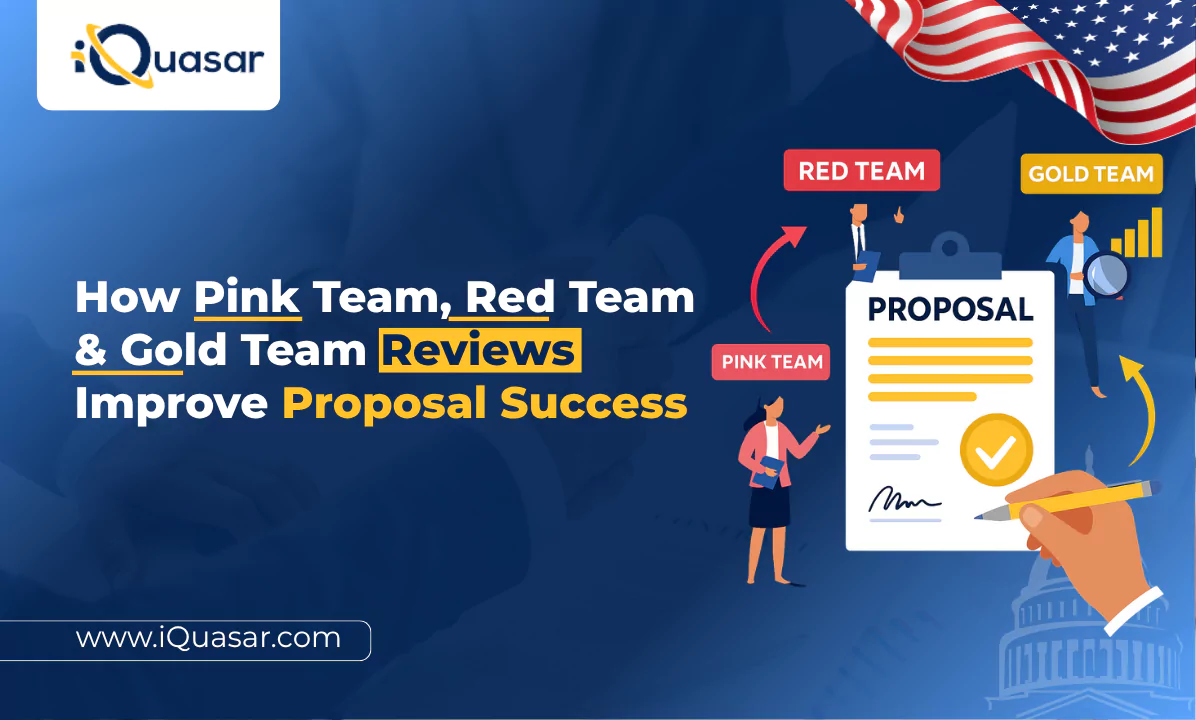
The color-coded review process—Pink Team, Red Team, and Gold Team—is a widely adopted industry standard that helps ensure proposals are compliant, strategic, and compelling. These reviews serve as structured checkpoints throughout the proposal development lifecycle and are endorsed by leading organizations like the Association of Proposal Management Professionals (APMP). Each color review focuses on a specific stage and purpose:
The Pink Team review happens early and checks strategy, structure, and alignment with customer needs and win themes. The Red Team review takes a near-final draft and evaluates it from the customer’s perspective, focusing on clarity, compliance, and persuasiveness. Finally, the Gold Team review ensures the proposal is polished, compliant, and ready for submission. Together, these reviews allow teams to refine content at every stage, significantly improving proposal quality and win potential.
Pink Team Review: Shaping Strategy Early
The Pink Team Review takes place when roughly 60–70% of the proposal content has been developed. This is one of the most critical early steps in the proposal development process because it focuses on shaping the narrative and validating the foundation of the proposal before it’s entirely written. Key focus areas include:
- Compliance and Structure: Is the draft following the RFP’s instructions and evaluation criteria? Are sections organized so that they are easy for evaluators to follow?
- Win Themes and Strategy: Are the key value propositions and differentiators clear? Is the customer’s language being used? Are we telling a story that resonates?
- Alignment with Customer Needs: Does the proposal reflect the customer’s mission, priorities, and pain points? Have we captured their hot buttons and anticipated objections?
Who participates in a Pink Team Review?
Typically, the core proposal team—proposal managers, capture managers, solution architects, and sometimes subject matter experts—conducts this review collaboratively.
What’s reviewed?
Annotated outlines, early drafts of executive summaries, technical volumes, management approaches, and even past performance narratives may be evaluated. These documents are still being shaped to incorporate reviewer feedback more easily.
Red Team Review: Challenging the Proposal Like a Customer Would
The Red Team Review occurs when the proposal is about 90% complete and simulates how an agency evaluator would assess it.
- Evaluator’s Perspective: Reviewers assess the draft against the solicitation’s evaluation criteria to test compliance and responsiveness
- Persuasiveness & Clarity: The focus shifts from structure to messaging—does the proposal clearly convey value and differentiate the offering?
- Narrative Alignment: Ensures the content speaks directly to the agency’s mission and priorities
Who participates?
Senior reviewers not involved in writing—often including former evaluators, capture leads, and proposal quality experts—bring a fresh, unbiased perspective.
What’s reviewed?
Near-final volumes including technical, management, past performance, key resumes, and compliance matrices.
Gold Team Review: Polishing for Final Submission
The Gold Team Review is the final checkpoint, typically held 48–72 hours before submission. With the proposal 100% complete, this review ensures the document is polished, compliant, and ready for delivery.
- Final Validation: Confirms all RFP requirements are addressed and Red Team edits have been fully integrated
- Visual Consistency: Reviews layout, formatting, and graphics for a clean, professional appearance
- Persuasive Presentation: Ensures tone, clarity, and grammar are strong—eliminating errors that could impact credibility
Who participates?
Senior leadership, business development leads, the proposal manager, and an editor—all focused-on presentation and readiness.
What’s reviewed?
The full proposal package, including all volumes, attachments, forms, and graphics, in final submission format.
Also Read: When to Hire a Proposal Writing Consultant for Government Contracts
Benefits of a Structured Color Review Process
A disciplined Pink, Red, and Gold Team Review process goes beyond quality control—it transforms proposal development into a strategic and collaborative effort. By refining the content at each stage, teams produce proposals that are compliant, customer-focused, and competitive.
Key benefits include:
- Sharpened Messaging: Reviews help tailor the narrative to the customer’s mission and evaluation criteria
- Improved Quality and Compliance: Early and repeated checks catch errors before they become costly
- Greater Efficiency: A structured process reduces rework and enables smoother, deadline-driven execution
- Increased Win Probability: Proposals that undergo formal reviews are consistently more compelling and more successful
Best Practices for a Successful Review Process
To truly maximize the value of your pink, red, and gold team reviews, it’s not enough to just schedule them—you need to execute them with intention, structure, and the right team. Here are key practices that make the difference between a review that adds real value and one that just checks a box:
- Choose the Right Reviewers: Bring in a mix of internal team members who understand the solution, and independent reviewers who can offer a fresh, unbiased perspective, especially those familiar with government evaluation standards
- Maintain Version Control: Ensure that everyone is reviewing the same version and that all edits and comments are tracked clearly. Using a centralized document management system or version-controlled workspace prevents confusion and rework
- Set Clear Timelines: Build review windows into the proposal schedule early, assign clear ownership for each review, and enforce deadlines to allow time for incorporating feedback
- Foster a Collaborative Environment: Make reviews constructive, not critical. Encourage reviewers to focus on strengthening the proposal, not just pointing out flaws. A culture of collaboration increases engagement and leads to better results
With the right structure and team dynamics, color team reviews become a powerful tool, not only for catching errors but also for elevating the entire proposal.
At iQuasar, we don’t just help our clients write proposals—we guide them through a structured pink, red, and gold team review process that elevates each draft into a winning, customer-focused submission. Our approach ensures every proposal is strategically aligned, fully compliant, and positioned to score high with evaluators. Let us help you compete with confidence—connect with us today to strengthen your next proposal.