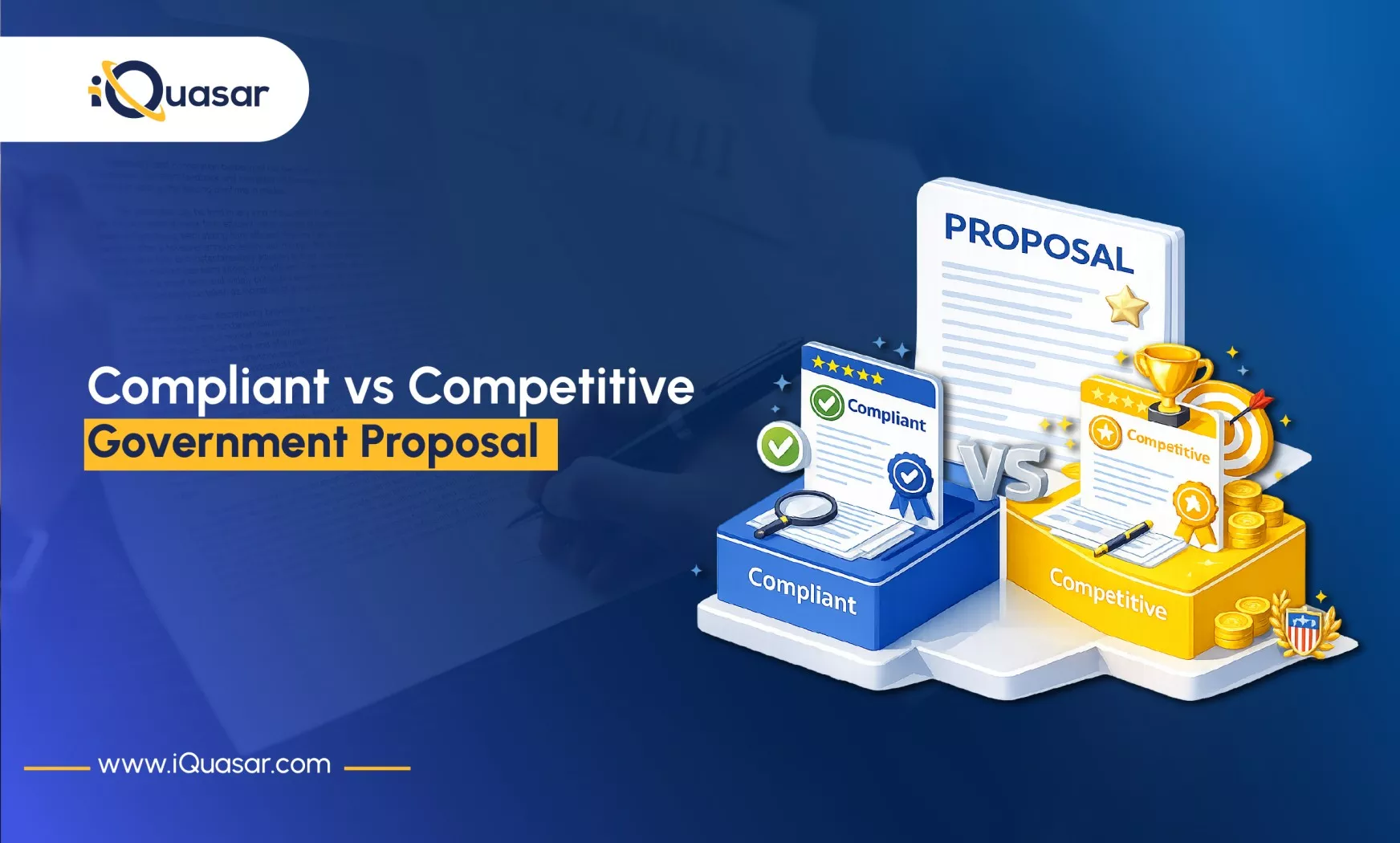
If we’re compliant, we should be fine. That mindset is outdated in best-value procurements because compliance alone does not signal that a proposal will deliver mission-critical value or managed risk at an acceptable cost; even competitive proposals require more than mere compliance. In practice, evaluators separate proposals that merely check boxes from those that demonstrate measurable benefits aligned to the agency’s mission. Compliance remains the price of entry, but competitiveness is what differentiates winning offers. Best-value procurements reward clear alignment to mission, credible risk reduction, and evidence-based advantages that matter to the customer. Understanding this distinction is essential for building a truly competitive government proposal.
In this blog, we clarify the difference between a compliant and a competitive government proposal, explain why many compliant submissions still lose, and outline how proposal teams can shift from baseline acceptance to true best-value positioning.
What “Compliant” Really Means in Federal Proposals
Compliant proposals meet the letter of the solicitation, not just the spirit. A compliant submission follows Section L instructions, responds to the PWS/SOW (or C/SOW), adheres to formatting and submission rules, and includes all mandatory forms. Compliance is binary—you either meet the requirement, or you don’t, and there is no scoring bonus for being further compliant. A compliant proposal may pass the gate of acceptance, but it remains invisible to evaluators if it does not translate into outcomes the agency values. In other words, you can be perfectly compliant and still be a nonstarter in a competitive environment if you fail to connect your capabilities to the agency’s mission in a way that matters under Section M.
The practical implication is stark: you must do more than comply; you must prove why your approach is better, cheaper, faster, or lower risk in a way that aligns with the evaluation framework.
What Makes a Competitive Government Proposal
Competitive proposals are written with the end in mind: the Section M evaluation criteria and the agency’s mission. A competitive government proposal clearly demonstrates alignment to the factors that matter most to evaluators, not only to the requirements stated in the PWS. It shows a deep understanding of how the agency will measure success, reduce performance risk, and differentiate through credible, evidence-backed claims. Competitiveness is inherently comparative: evaluators rank proposals; they do not merely validate capability. To be competitive, you must articulate win themes that tie your strengths directly to the agency’s desired outcomes, provide explicit evidence (past performance, metrics, risk mitigations), and present a clear best-value tradeoff narrative that favorably shifts risk and cost-benefit perception.
In practice, competitiveness means answering the question: Why this team, with this approach, delivers more value than every other option the agency could choose? The strongest proposals connect every claim to a defined benefit for the mission, not just to a feature set.
Why Compliant Proposals Still Lose
A proposal can be compliant and still lose for practical, mission-focused reasons. Restating requirements without solving them leaves evaluators with a perception of “me-too” responses; generic technical approaches fail to distinguish the offer from competitors; weak relevance mapping in past performance undermines credibility; risk is either ignored or inadequately mitigated; and agency-centric benefits are buried under contractor-centric language.
In essence, compliant proposals often resemble checklists applied to a set of capabilities rather than a strategic narrative that links capability to mission impact. This is particularly costly in best-value environments where the goal is to reduce risk while maximizing mission outcomes. A compliant submission may meet the minimum, but it does not persuade the evaluator to choose you over another offer that more convincingly demonstrates relevance, reliability, and measurable impact.
The practical result is predictable: a higher likelihood of a down-select or, at worst, losing on price or risk perceptions. A robust, evidence-backed story of value beats a longer list of features every time.
Evaluation Factors – The Engine of Competitiveness
Competitive proposals are written backwards from Section M. The core discipline is to map every claim to the evaluation criteria, articulate strengths explicitly, and translate capabilities into measurable benefits. Evaluators cannot assume capability; they must see explicit, evidence-backed claims and a risk-aware plan. The scoring rubrics in Section M constrain judgment, so the strongest proposals demonstrate where a strength exists, why it matters, and how it reduces risk or enhances performance. This means you should present a coherent narrative in which capability, performance metrics, and risk mitigations cohere around the agency’s mission.
Evidence of past performance should be framed not as a list of contracts but as demonstrated relevance and impact, with concrete metrics that correlate to the RFP’s success criteria. In short, a competitive proposal does not merely assert capability; it proves it in the lens of the agency’s evaluation framework.
- How Compliance vs Competitiveness Shows Up in Each Section Technical Approach: Compliance greets evaluators with task descriptions and compliance with the PWS. Competitive proposals present outcomes, efficiencies, and measurable results, linking every technical choice to a defined improvement in mission performance. The best proposals quantify performance improvements and tie them to the agency’s success metrics.
- Management: A compliant submission lists processes, roles, and governance structures. A competitive proposal details control, accountability, scalability, and the interplay between teams and outcomes. It shows how the management approach mitigates risk and sustains performance across the contract lifecycle, with explicit governance signals that matter to the customer.
- Past Performance: Compliance might simply enumerate contracts and references. A competitive submission foregrounds relevance and impact, with metrics that mirror the agency’s evaluation criteria. It translates past performance into a track record that speaks directly to the proposed solution’s capability to deliver results in similar environments.
- Risk: Compliance tends to avoid or obscure risk. Competitive proposals identify risks and present concrete, testable mitigations and contingency plans. They demonstrate a proactive stance on risk management, which strengthens the perception of reliability and reduces perceived performance risk.
Also Read: How to Price Competitively for Contracts Without Cutting Your Margin
How Teams Move from Compliant to Competitive Proposals
- Start with a shared Understanding Document (UD) that translates requirements into clear win themes.
- Connect customer pain points to measurable advantages.
- Write strengths with outcomes: X result for Y client with Z metric.
- Involve capture and proposal teams early, not as an afterthought.
- Align every section to Section M evaluation criteria.
- Review drafts with a focus on: alignment, measurable benefits, and risk mitigation.
- Quantify benefits and tie them to risk reduction or performance improvement.
- Maintain a living win strategy throughout the proposal process.
- Test the final draft directly against the evaluation rubric before submission.
Compliance gets you accepted; competitiveness gets you selected. In federal procurements, evaluators use Section M to measure value, and proposals that merely satisfy requirements often fade against stronger, evidence-backed narratives that tie capability directly to mission outcomes. The strongest submissions distinguish themselves by presenting clear win themes, credible proof, and a risk-aware execution plan that demonstrates why the proposed solution delivers greater value than competing alternatives. Evaluator scoring behavior reinforces this reality, strengths must be explicit, benefits must be measurable, and alignment to evaluation factors must be unmistakable.
To move beyond baseline compliance, proposal teams must write with the evaluation criteria in mind, articulate differentiated strengths intentionally, and replace generic capability statements with operational clarity and demonstrated impact. If your organization is looking to elevate proposals from compliant to truly competitive, iQuasar’s Proposal Development Services can help you refine strategy, strengthen evaluation alignment, and build disciplined, evidence-based submissions that improve win rates. Contact us today to get started.