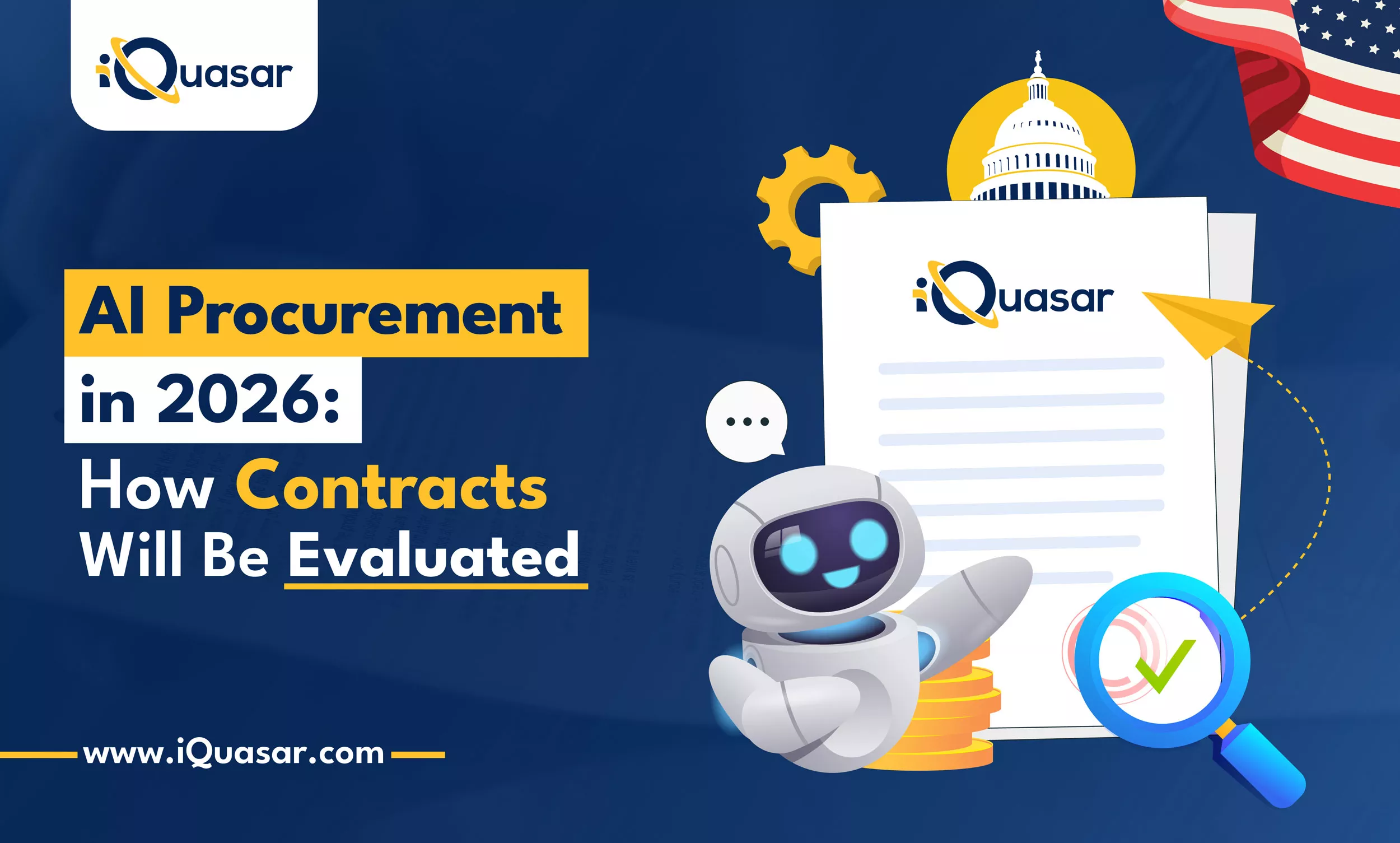
What if the contract you submit in 2026 isn’t reviewed by a person but by an AI trained on thousands of prior awards? In 2026, federal procurement is on the brink of transformation, fueled by the rapid scaling of AI adoption across government agencies. Why is automation not just a technological upgrade, but now a mandate for compliance, fairness, and efficiency? This blog explores how AI-driven procurement will reshape the federal contract landscape, what contractors must do to thrive, and how ethical safeguards will define the next era in government acquisition.
The Rise of AI Procurement in 2026
Federal contract automation isn’t futuristic; it’s happening now, with 2026 projected as the decisive year for large-scale deployment. Agencies such as OMB and GSA have begun piloting sophisticated AI tools to streamline acquisition planning, technical reviews, and compliance scoring, setting new standards for speed and precision. FY2026 stands to be the benchmark for scaling AI in all phases of procurement: from initial evaluation to ongoing monitoring.
Why is AI becoming central to federal procurement? The answer lies in the urgent need for operational efficiency, enhanced risk management, and robust transparency. As AI in government procurement gains traction, agencies can evaluate more proposals with greater objectivity, flag risks faster, and automate audits, creating a fairer playing field for all vendors.
How AI Will Change Federal Procurement
AI in government procurement is not just about digitalizing existing practices; it’s fundamentally altering how contracts are scored, monitored, and awarded.
1. Automated Technical Evaluation
AI systems will automate the technical review of proposals, instantly scoring submissions against predefined benchmarks like solution quality, technical feasibility, and cost risk. Instead of lengthy manual reviews, evaluators gain machine-generated insights in minutes.
- Technical feasibility refers to the likelihood of a proposed solution to meet contract requirements.
- Examples of typical AI scoring criteria:
- Solution quality and innovation.
- Risk of schedule or cost overruns.
- Compliance with cybersecurity standards.
2. Enhanced Risk Flagging
Advanced algorithms will analyze historical contract data, identifying unusual performance trends, reliability issues, or compliance gaps. Contracts with a history of variability in delivery quality or frequent disputes will be flagged automatically, prompting targeted review.
- Automated flagging of risk patterns streamlines early intervention.
- Historical data mining surfaces hidden reliability issues.
- Machine learning adapts risk thresholds based on real federal data.
3. From Manual Reviews to AI-Assisted Evaluation
Traditionally, proposal evaluations relied heavily on human reviewers navigating large volumes of text under tight timelines. AI changes that equation. Agencies will now use AI to:
- Automated compliance validation against solicitation requirements
- Criteria-based scoring support to flag strengths, weaknesses, and gaps
- Cross-proposal comparison to identify inconsistencies or risk indicators
Human evaluators will remain accountable, but AI will act as a force multiplier, improving consistency and reducing evaluation fatigue.
Contractor impact: Proposals must be clearer, more structured, and tightly mapped to evaluation criteria. Generic narratives and filler language will be increasingly penalized.
4. Smarter Pricing and Cost Realism Analysis
AI enables agencies to analyze pricing across thousands of historical contracts in seconds. What Changes:
- Identification of labor rate outliers.
- Detection of unrealistic indirect rates or staffing assumptions.
- -Faster cost realism and price reasonableness determinations.
Contractor impact: Pricing strategies must be defensible and data-aligned. Aggressive underpricing or inflated assumptions will be easier to detect and harder to justify.
5. Continuous Post-Award Monitoring Becomes the Norm
One of the biggest shifts in AI-driven procurement is continuous contract oversight. AI-Enabled Monitoring Areas:
- Schedule and delivery performance
- Cost burn vs. contract value
- Staffing alignment to contract requirements
- Cybersecurity and compliance posture
- CPARS-relevant performance indicators
Rather than waiting for performance issues to surface, agencies can detect risk patterns early.
Contractor impact: Performance management becomes proactive. Poor delivery, staffing gaps, or compliance drift will surface faster and impact future awards.
6. Workforce and Trust Signals Gain Weight
Automation allows agencies to correlate contract outcomes with workforce signals. What Agencies Will Track:
- Clearance readiness and workforce stability.
- Alignment of skills to contract scope.
- Attrition patterns on critical contracts.
Contractor impact: Workforce planning becomes part of acquisition credibility. Contractors must demonstrate not just technical capability, but staffing reliability and continuity.
7. Risk-Based Vendor Profiling
By 2026, agencies will increasingly rely on AI to maintain dynamic vendor risk profiles. These profiles may incorporate:
- Past performance trends.
- Pricing behavior across contracts.
- Compliance and audit history.
- Cyber and workforce readiness signals.
Contractor impact: Trust is cumulative. Every contract contributes to a contractor’s long-term competitive position.
Also Read: Top 5 Contract Vehicles to Pursue in 2026
8. Automated Past Performance Checks
AI will ingest previous contractor evaluations, extract quantifiable metrics, and produce objective reliability scores. Instead of subjectivity, agencies get a consistent data-driven approach.
- AI evaluates proposal content, resumes, and past performance using standard criteria.
Contractors with structured, well-documented histories will rise in rankings.
Ongoing monitoring offers real-time feedback on contractor reliability.
Thought Insight: Automation brings new rigor and consistency to proposal evaluation. Can quality and fairness coexist with efficiency? Evidence suggests automation reduces human bias, driving more objective outcomes, if safeguards are built in.
Adapting to AI-Driven Procurement Standards
Contractors can no longer rely on narrative descriptions or free-form resumes. The age of federal contract automation requires structured, machine-readable submissions and clear, quantifiable metrics. Practical Steps for Vendors:
1. Structured Resumes and Data
Agencies now require resumes and documentation in structured formats (like JSON or XML), allowing AI tools to parse qualifications and experience efficiently.
- Ensure certifications, experience, and qualifications are tagged and standardized.
- Avoid free-text summaries, focus on fields, tags, and clear data structures.
2. Focus on Quantifiable Metrics
AI algorithms excel at comparing clear, numerical indicators:
- Deadlines met (in %).
- Cost savings achieved (in $).
- Defect rate (per contract).
3. Clean Past Performance Data
Standardize prior contract data by removing inconsistencies, correcting missing information, and formatting histories for AI analysis.
- Clean contractor history enables accurate scoring.
- Incomplete data may cause AI to downgrade or make errors.
- Structured files allow direct ingestion by government systems.
Key Takeaway: Successful contractors in 2026 will be those who treat every document as structured, auditable data, maximizing their AI-driven scoring potential.
Preparing for AI-Driven Procurement in 2026
AI-driven procurement is set to redefine federal contracting, placing structured data, quantitative metrics, and impeccable past performance records at the center of robust, fair evaluations. Vendors must adapt quickly, making proposals machine-readable, documenting compliance standards, and continually auditing for accuracy. The new landscape promises efficiency, transparency, and more equitable outcomes, but only for those who prepare and adapt.
If your organization is evaluating AI in government procurement and federal contract automation, our team can help you assess options and build a pragmatic roadmap. Explore how proposal writing services support outcomes like improved contract scoring, streamlined RFP submissions, and reduced compliance risks, or get in touch to discuss your specific scenario.