The federal procurement landscape is on the brink of its most significant transformation in decades. On April 15, 2025, the White House issued the executive order “Restoring Common Sense to Federal Procurement,” launching an ambitious overhaul of the Federal Acquisition Regulation (FAR).
This move aims to streamline federal purchasing, cut red tape, and foster greater competition—especially among small businesses. Yet, for contractors, this simplification also brings new compliance challenges and the need for swift adaptation to evolving rules and requirements.
This blog sheds light on these challenges and strategies that government contractors can use to overcome them.
Understanding the FAR Overhaul
The Rationale Behind the Reform
Federal agencies rely on the FAR—a sprawling 2,000+ page document—for all executive branch procurement. Over time, the FAR has become notoriously complex, often criticized for creating unnecessary barriers to entry and inefficiency in government contracting. The new executive order acknowledges these issues, directing a comprehensive rewrite to retain only those provisions that are required by statute or essential for simplicity, usability, efficacy, and national security.
Key Objectives:
- Accelerate the acquisition cycle
- Lower barriers for small businesses
- Remove duplicative or outdated regulations
- Ensure only essential, statutory, or security-driven provisions remain
What’s Changing: Timeline and Requirements
The executive order sets an aggressive schedule for implementation, with several key milestones:
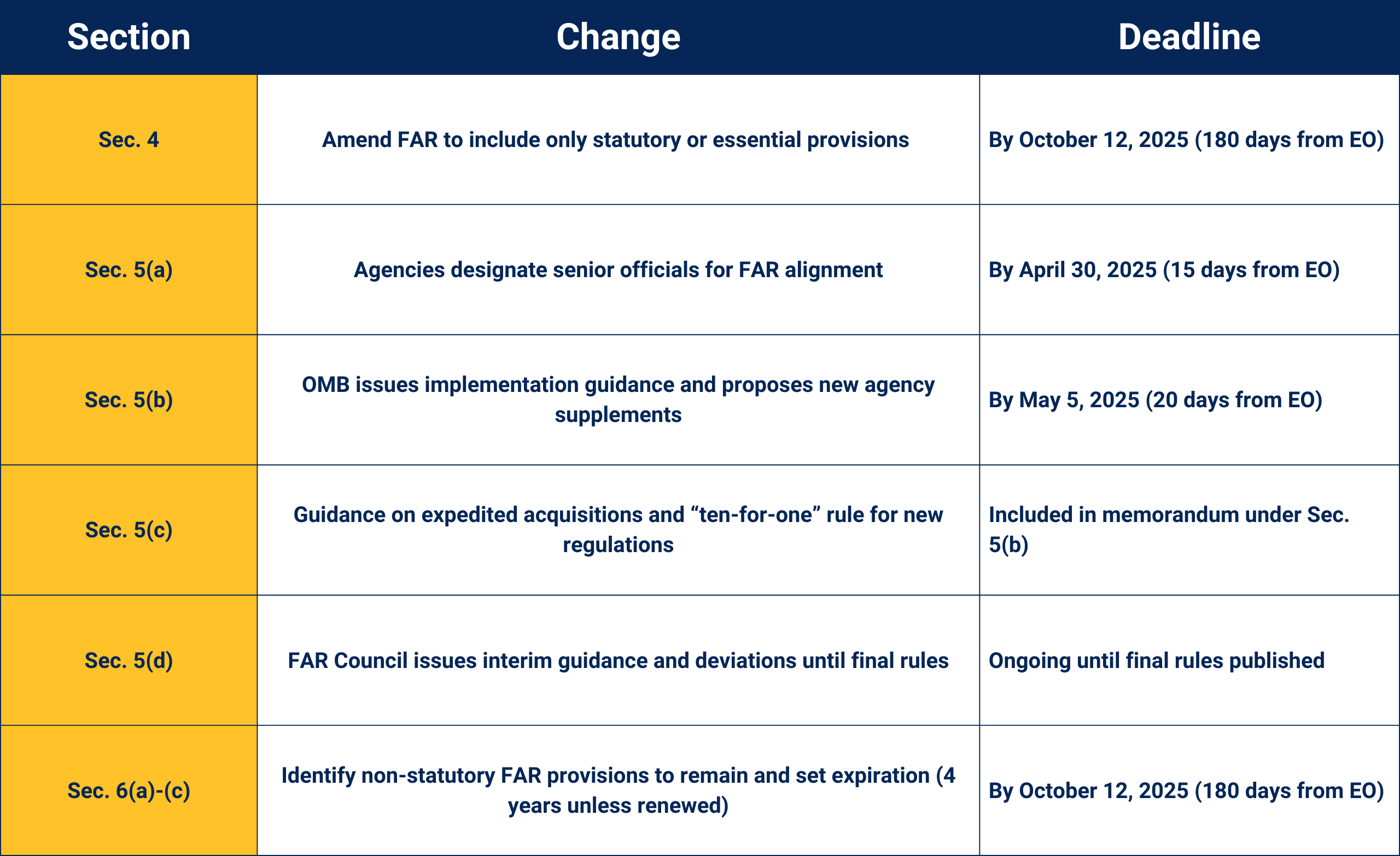
Notably, the “ten-for-one” rule requires agencies to repeal at least ten existing regulations for every new one added, further ensuring a net reduction in regulatory burden.
Also Read: Understanding the Federal Acquisition Regulation (FAR) for Proposal Success
FAR Overhaul – Implications for Contractors
Simplified Acquisition Procedures:
- Lowered barriers mean more opportunities for small and emerging businesses to compete for federal contracts
- Expect streamlined proposal processes, reduced paperwork, and faster award cycles
Compliance Program Overhaul:
- Contractors must closely monitor which FAR provisions are amended, removed, or set to expire
- Compliance programs, internal controls, and training must be updated to reflect the new regulatory environment
- Agencies will issue interim guidance and deviations, requiring contractors to stay agile and responsive to ongoing changes
Impact on Proposal Writing and Bidding:
- Proposal templates and requirements may shift as non-essential clauses are eliminated
- Contractors should revisit their bidding strategies, ensuring alignment with the simplified rules and focusing on value, efficiency, and statutory compliance
Agency-Specific Supplements:
- Agencies will revise their supplemental regulations (e.g., DFARS for DoD) to align with the new FAR, potentially introducing new nuances and requirements
- Senior acquisition officials at each agency will play a key role in shaping these supplements—contractors should track these developments closely
Opportunities and Risks Due to the FAR Overhaul
Opportunities:
- Reduced bureaucracy and clearer rules can make it easier to enter and compete in the federal market
- Small and mid-sized businesses, in particular, stand to benefit from streamlined acquisition and less onerous compliance demands
Risks:
- The transition period may be marked by uncertainty, as agencies issue interim guidance and modify contracts to remove deleted FAR provisions
- Contractors failing to update compliance programs or adapt to new requirements risk noncompliance, lost opportunities, or contract disputes
How to Prepare: Proactive Steps for Contractors
- Monitor Regulatory Updates: Track announcements from the FAR Council, OMB, and agency procurement offices for new rules, interim guidance, and deviations
- Review and Revise Compliance Programs: Audit your current compliance framework and identify areas impacted by FAR changes. Update policies, training, and internal controls accordingly
- Engage with Agency Officials: Build relationships with newly designated senior acquisition officials to understand agency-specific supplements and priorities
- Adapt Proposal Strategies: Stay flexible and ready to revise proposal templates and bidding strategies as requirements evolve
- Seek Expert Guidance: The scale and speed of these changes make expert support invaluable for interpreting new rules and ensuring compliance
The FAR overhaul is a once-in-a-generation opportunity to simplify federal procurement and foster greater competition. For contractors, success will depend on proactive adaptation, close monitoring of regulatory changes, and a willingness to update compliance and bidding strategies. While the path forward brings uncertainty, it also opens the door to growth for those prepared to navigate the new landscape.
iQuasar’s expert team guides you through every step—from registration and certification to compliance and proposal support—ensuring you are well-positioned for success in the evolving government marketplace. Contact us today to ensure your business is ready for the future of federal procurement.