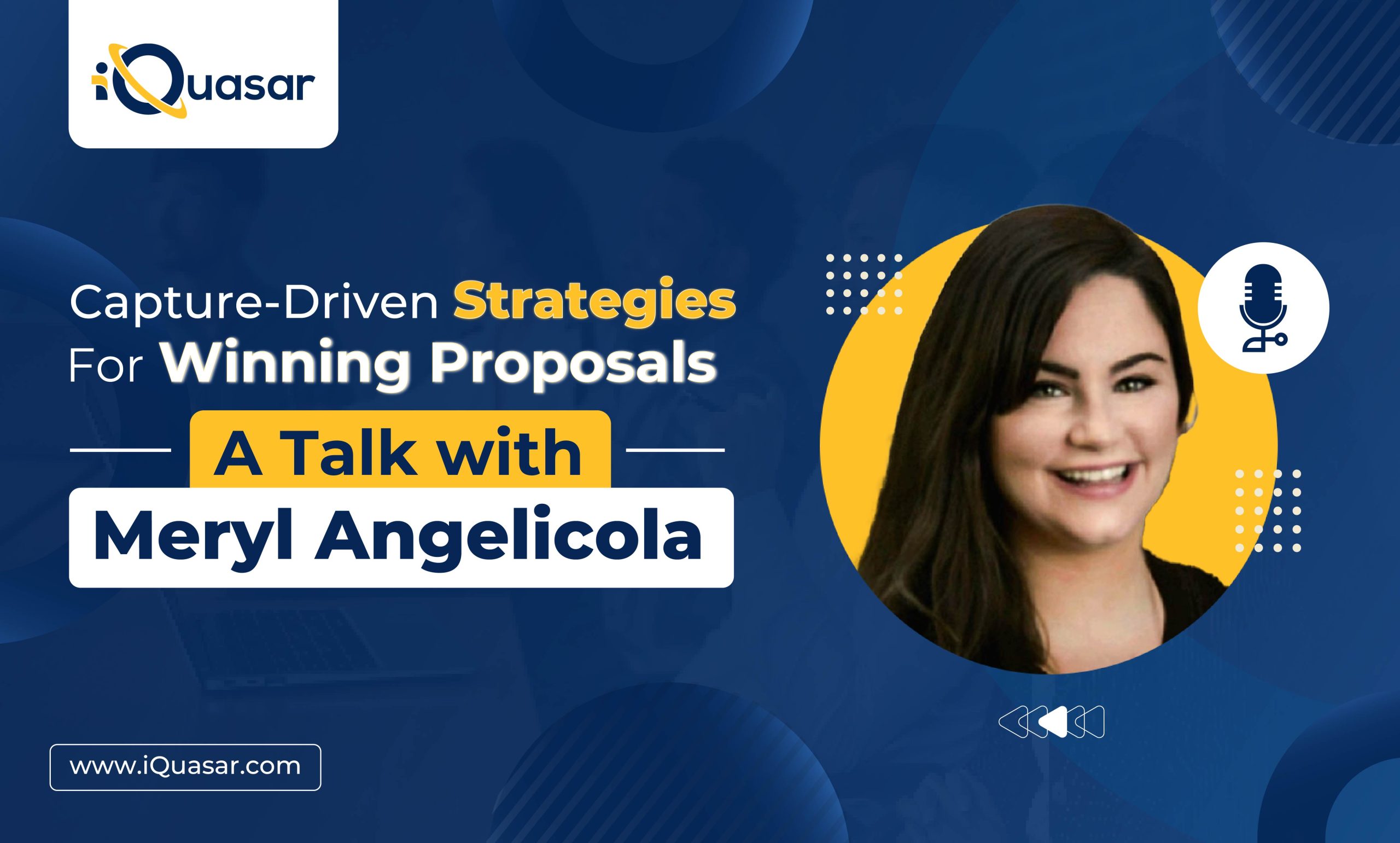
Mastering capture-driven strategies can be the difference between simply submitting proposals and truly winning contracts in government contracting. In an insightful interview, iQuasar connected with Meryl Angelicola, VP of Industry Solutions at GovDash and founder of ProposalTeam, to unpack the essentials of this approach. With nearly 20 years of proposal management expertise, Meryl shared her thoughts on breaking down silos between capture, proposal, and delivery teams and aligning efforts toward one goal: winning.
The conversation offers practical guidance on securing leadership buy-in, fostering team collaboration, and building a strategy focused on success, with real-world examples to help contractors elevate their proposal game.
Interview Transcript
Common Weaknesses in Capture-Driven Strategies for GovCon
Question: You’ve worked with a variety of government contractors. What common challenges or weaknesses do you see in their capture-strategies and proposal processes?
Meryl: Yeah, that’s a great question. First of all, one of my favorite things about GovCon and proposals is that there are many standardized things, right? So, no matter where you work, you’ll see similarities, no matter what the company sells to the government. There are common roles and processes. But that also means there are common struggles. So, I see some repeated struggles or challenges. One is silos in the business development process. So many times, you’ll see a business development team be very segmented. So what I mean by that is there will be the capture team, the proposal team, and the delivery team, and it’s sort of like a baton… passing of the baton during the process rather than folks working together. And the issue with this is that a proposal is not one step of the process. It’s the accumulation of the efforts that happen before the RFP drops and then everybody’s expertise after the RFP drops. So, it needs to be more of a coordinated effort with everybody, but we see companies doing the baton passing siled approach more often than they do that collaborative effort.
Impactful Changes to Improve Proposal Capture Success
Question: If a GovCon firm could only make ONE change to boost their proposal win rate, what would you recommend they focus on first?
Meryl: Yeah, this is actually one of my favorite questions. So, I think the biggest shift will be in the end goal. For many companies, their end goal is to submit the proposal, but when the end goal becomes winning the contract and you make that shift, not just the capture manager or the capture team being responsible for winning the contract. But everybody working together from the very beginning and through every phase of the process, with the same goal, which is to win the contract, not just to get the proposal submitted, then you really begin to align with things that are going to improve your chances of winning.
And what I mean by that is when your goal is to win the contract and not just to submit a lot of proposals, you begin to make more strategic decisions at every phase. So, with capture you’re really looking at, what are our chances of actually winning this? What information do we need to find out before the RFP drops while we can still talk to the customer in order to position ourselves To win it or influence it? How do we get in with the customers, so they know who we are? By the time we write the proposal on the proposal side what that looks like, is how do we write, given this information, know from the capture managers and all the intel they’ve done. What are the win themes, that we really want to push and not just like a buzzword as a win theme, but a win theme being like, what are the main strategic objectives we are pushing within this proposal? What we want them to take away because we know what’s important to them based on our capture efforts? And that’s where this coordinated effort comes in, is that it can’t be siloed, because GovCon and proposals are so dependent on everything that happens before the RFP drops, that will influence your chances of winning and the quality of your content. So really shifting, as a whole team to your goal, being to win the contract and asking yourself, critically. What does that look like? It may look like, you can’t submit as many proposals, but the ones you do submit have a much higher quality, are much more informed by customer needs, and have a much higher chance of winning.
Real-World Examples of Effective Capture-Driven Proposal Techniques
Question: Can you provide a real-world example of a company that successfully used a capture-driven strategy to win a bid? What specific steps did they take during the BD process?
Meryl: Yeah, absolutely. So, I can give you an example from my real-world experience- I had a really unique career trajectory when I first started; I was in proposals, but I was also managing contracts on-site at the CDC and then also was the de facto capture manager for that work. So, we were a small company, and I really got a lot of experience in having it be a collaborative, coordinated effort, mostly because I was doing all three of the jobs. So it actually worked to my benefit because I was able to see that firsthand, but one of the examples of this that I utilize a lot is – I was managing a contract at the CDC, and I was walking the halls, and I knew this customer well because I was walking the halls. I got to meet with this customer in real-time as this was happening. We had reached a ceiling on a BPA contract that people didn’t realize; nobody on this contract, which was multi-award. No one realized we were meeting that ceiling. And so, we ended up having to submit a proposal pretty much within 24 hours for a sole source award to keep this work going. We would have never known about it. Had I not been walking the halls, but if it was not me right, somebody else is going to need to be walking the halls communicating with the customer because of the information we had from talking to the customer in this 24-hour time frame, but also, before that, we were able to understand the level of flexibility, they needed, what was most important to them as far as turnaround time and response time, and we were able to take that and write that into the proposal. And I know that because I also had to write the proposal. So I was able to take this through the process kind of, but we ended up when it was a really good example for me, and your traditional… sole source award is not competitive, but I’ve taken this lesson that I learned because it was 24 hours and we really had to take all of those pieces of the puzzle and put it together. I have taken all those lessons, and I’ve applied them to competitive bids. And so, when I work with the team, if I’m the proposal manager, what I do is get involved early in the process so that I can have that level of communication. When the RFP drops, you cannot talk to the government, in most cases, outside of Q&A, which is not a time for strategy. So I get involved earlier than when the RFP drops, and what I try to do is write an executive summary myself as the proposal manager, and that requires back and forth with the capture manager asking questions, critical questions about what the customer needs, what is most important to them, what challenges, they’ve had where the capture manager believes we align the most. If they can’t answer those questions enough for me to write an executive summary, then it’s almost like a real-time data call where I’ll work with them and have them go back to the customer, help them figure out the information that’s needed and by the time the RP drops that just ensures that we have the information we need for a good capture strategy. It’s been talking to the customer and now what, putting in our proposals, something that’s been socialized, and the customer understands it. And it’s helped me a lot. So that’s one of the strategies that I implement based on that real-life lesson.
Preparing Your Team for a Capture Strategy to Boost GovCon Success
Question: Implementing a capture-driven approach requires a shift in mindset. How can companies prepare their teams and ensure everyone is on board with this way of working?
Meryl: Yeah, it really goes to what I said before – taking away those silos, And not looking at your BD team as smaller groups within a larger group that pass the baton. It’s really important to look at them as one team and to help them see themselves as one team and instead of having silos for different roles. everybody has strengths and they contribute those strengths to the process and it’s not necessarily the timing of when those people begin to use those strengths. But being able to be empowered to use those strengths throughout the BD process. So, what I mean by that is when people are empowered to use their strengths rather than told when to step in in the timeline, that means proposal managers can start preparing much earlier. They can start communicating with the capture folks on what they need as far as the information that will be required to respond to a proposal. The solutioning folks can begin to look at previous RFPs or let you know if they are missing some critical expertise maybe we need to bring in a partner. Having somebody involved in these skill sets throughout the process is going to allow you to spot weaknesses earlier and address them while you still have time to do it and it’s going to result in a much better proposal. So the mindset shift there is not bringing in parts of your BD team, capture, solution, proposals at certain points in the timeline but empowering them to be involved from the beginning and making strategic choices about what you pursue to allow that to happen.
The Role of Leadership in Driving Contract Win Strategies
Question: What role does leadership play in fostering a capture-driven culture? What specific actions should leaders take to champion this approach?
Meryl: Yeah, it’s going to be uncomfortable. So this is the big thing. It is not possible without supportive leadership. So your BD team is really impacted by the strategic decisions of other people, especially proposals. There are a lot of upstream decisions that are made the determine how strategic proposal managers can be. And what I mean by that is how many proposals are we going after is our strategy to submit as many proposals as possible? And hope that it’s the numbers game at some of them stick or is our strategy.
To prioritize winning the contract, over submitting, the proposal. And are we really being strategic in our choices of what we go after? Are we prioritizing? Good capture intel, are we making decisions based on if we have the intel, or if we don’t have the intel, and are we going after fewer proposals, right? In order to put our resources… limited resources in time towards the ones that we know will win, companies have a very limited time and resources as everybody knows who’s listening to this. And so when you spread them thin, the result is going to be less quality, rights, resources and effort, which can be given to each individual opportunity. But when you make strategic decisions and spread those resources out among fewer opportunities, you get more proposals more mature, capture and your team is less burnt out. So, we need leadership to make those strategic decisions and prioritize winning.
Final Insights for Implementing Capture Strategy Best Practices
Question: For companies looking to implement capture-driven strategies, what are the key takeaways they should leave with today?
Meryl: Yeah, I mean, my biggest one here, if you’re a leader listening to this, and I think we probably have many leaders who are. Make sure that you are making decisions that positively impact your ability to win contracts and not just submit the most proposals; it’s really easy to look at it as a numbers game and think that you’re making a lot of progress because you submitted the most proposals, but the point of submission is winning, and if you submit a hundred proposals and you lose all of them, the only thing you get is a burned out team and folks that are frustrated. It is much better to submit 50 proposals that have been really qualified, that your team believes in, and they can focus their efforts or even 30, or 25; it’s not an arbitrary number. It’s really about how many resources you have, but it starts with you, and so you have to make those decisions in order to see this positive change, and the other thing If we have capture managers that are listening, it’s really important to know the customer. And so, I encourage you to look at some critical questions. If you go to ProposalTeam, you’ll see those listed out. We’ve got them on our site, but there’s a list of 10 questions that are critical to answer about a bid before you can really write good content. And some of those things are: what’s are some of things right now not working for this customer that could be working better. What is most important to this customer? Who’s paying for this procurement? All these questions and the answers to these questions will help you write an executive summary and help you determine the strategic direction of your content in the proposal. And if you don’t have the answers to those questions, that’s your cue to either no bid or go back. If there’s still time to find that information from the customer.
As Meryl emphasized in this interview, a capture-driven strategy requires intentional collaboration, a unified focus on winning, and strong leadership support. By breaking down silos and aligning each phase of the process with the ultimate goal of contract success, government contractors can significantly enhance their win rates. For contractors looking to refine their proposal approach and increase their competitive edge, iQuasar offers comprehensive support—from proposal development and cleared recruitment to government contracting consulting and GSA schedule guidance. Connect with iQuasar to equip your team with the expertise needed to win in the federal space.