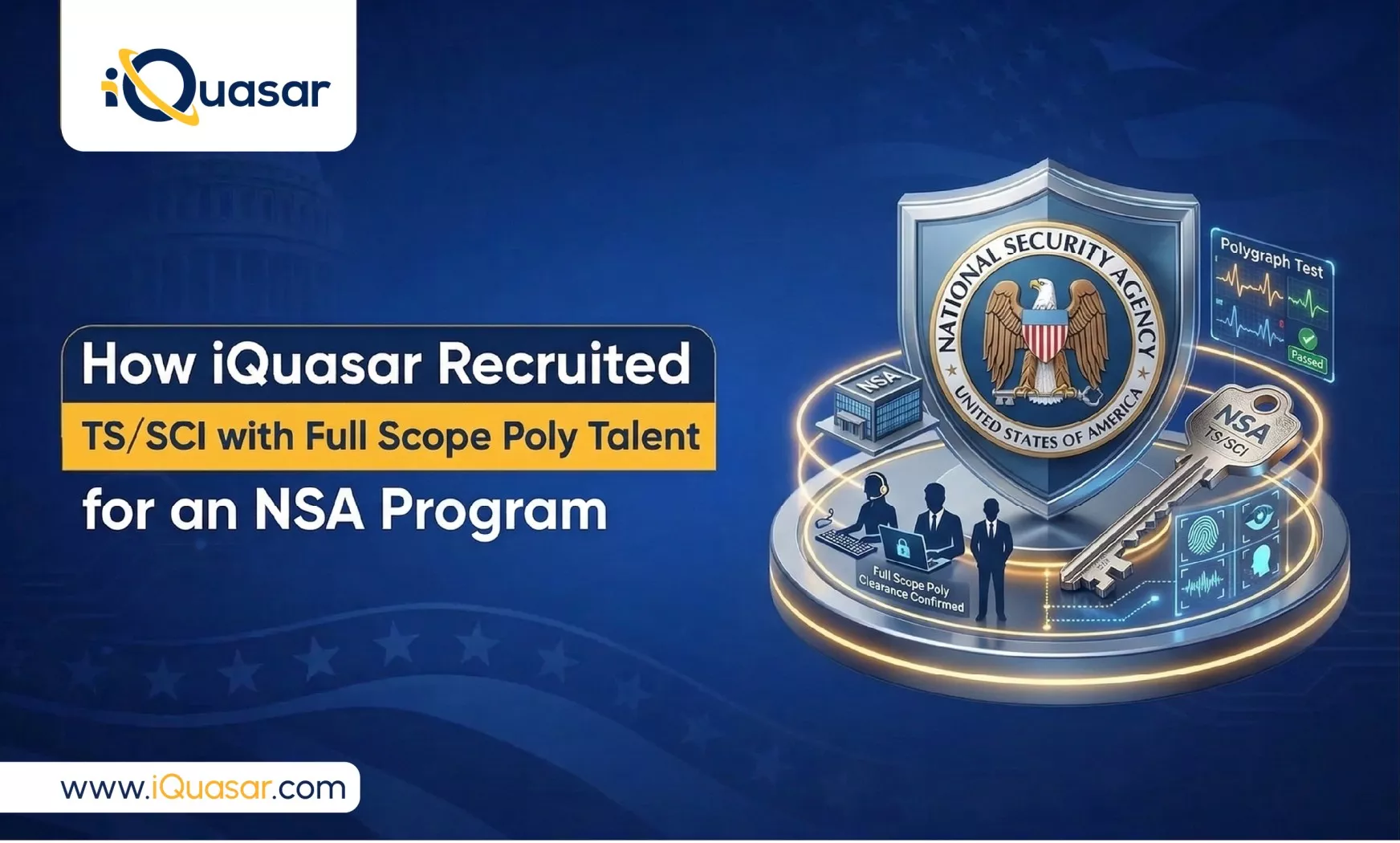
Recruiting professionals with TS/SCI clearance and Full Scope Polygraph credentials is one of the most complex staffing challenges in the government contracting and intelligence community. When a contractor supporting an NSA program needed to staff highly specialized systems engineering roles under the OASIS+ 8(a) contract vehicle, the combination of clearance requirements, niche technical expertise, and strict budget constraints created a hiring environment where traditional recruiting methods were ineffective. Through its Cleared Recruitment Service, iQuasar implemented a targeted recruiting strategy that enabled the contractor to build and sustain a disciplined pipeline of qualified candidates.
The Client
The client is a government contractor supporting highly classified systems engineering and mission-support programs for the National Security Agency (NSA). Operating under the OASIS+ 8(a) contract vehicle, the organization delivers advanced technical expertise in systems integration, cybersecurity, and intelligence support.
Because these programs operate inside secure facilities and directly support national security missions, the client relies heavily on professionals who hold TS/SCI clearance with an active Full Scope Polygraph (FSP). These individuals must not only possess advanced technical skills but also understand the operational discipline required to work within NSA environments. Ensuring a consistent pipeline of such talent is critical to maintaining program continuity and meeting contract deliverables.
The Problem/Opportunity

Traditional recruiting methods proved ineffective, requiring a targeted, intelligence-community-focused hiring strategy.
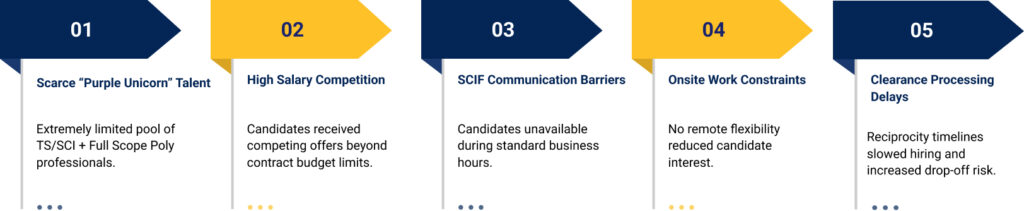
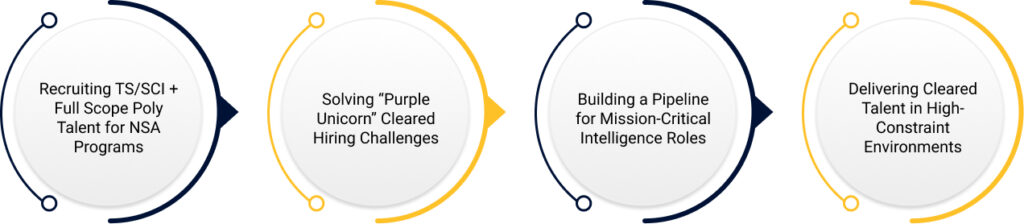
Recruiting TS/SCI with Full Scope Poly Talent presents unique challenges that go far beyond standard cleared recruiting. In this case, the contractor faced a combination of talent scarcity, competitive compensation pressures, communication barriers, and strict security requirements that significantly slowed the hiring process.
1. Purple Unicorn Talent Pool
Professionals who hold TS/SCI clearance with an active Full Scope Polygraph represent one of the smallest talent pools in the cleared workforce. While millions of individuals hold some level of security clearance in the United States, only a tiny percentage possess the combination of TS/SCI clearance, Full Scope Polygraph, and advanced technical experience required for NSA programs.
The difficulty increases further when additional requirements are added. In this case, candidates also needed specialized experience in systems engineering and intelligence-focused technologies. Each additional qualification further reduced the candidate pool, creating what industry recruiters commonly refer to as a “purple unicorn” hiring scenario. In this role, only a handful of professionals nationwide may qualify.
2. Intense Salary Competition
Candidates with TS/SCI and FSP credentials are highly aware of their value in the market. Many receive multiple offers simultaneously from contractors supporting NSA, CIA, and other intelligence agencies. In this environment, compensation expectations are typically high, especially for positions located near Ft. Meade, Maryland, where the cost of living continues to rise.
For this particular program, the contractor needed to hire within defined contract labor rate ceilings, limiting their ability to offer aggressive salaries or sign-on bonuses. As a result, qualified candidates often declined offers in favor of positions that provided higher compensation or additional incentives.
Balancing budget discipline with candidate expectations became a central challenge in maintaining a viable hiring pipeline.
3. SCIF Communication Barriers
Most professionals working on NSA programs spend their days inside Sensitive Compartmented Information Facilities (SCIFs). Within these environments, personal mobile phones, internet access, and external communication tools are typically prohibited.
This creates a unique recruiting barrier: many qualified candidates are simply unreachable during normal business hours. Traditional recruiting tactics such as daytime calls, LinkedIn messages, or email outreach often go unanswered until late evening or on weekends.
Without a recruiting strategy designed around SCIF work patterns, communication delays can significantly slow the hiring process and increase the risk of losing candidates to faster-moving competitors.
4. Lack of Work Flexibility
Unlike many commercial technology roles, positions supporting NSA programs require employees to work fully onsite within secure facilities. Remote or hybrid work arrangements are generally not possible due to security restrictions.
In today’s workforce environment, many technology professionals prioritize flexibility. Candidates who possess both strong technical skills and high-level clearances frequently receive offers from private-sector organizations that provide remote work options.
For contractors supporting NSA programs, this creates an additional recruiting hurdle: attracting candidates who are willing to work full-time onsite in classified environments despite alternative opportunities offering greater flexibility.
5. Lengthy Onboarding and Clearance Reciprocity
Even when a candidate already holds a Full Scope Polygraph, transferring that clearance between agencies is not always immediate. Reciprocity processes, verification checks, and administrative reviews can add weeks, or sometimes months, to the hiring timeline.
These delays create risk for both the contractor and the candidate. Candidates may accept other offers while waiting for clearance verification, while the contractor must continue searching for qualified professionals to avoid program delays.
Managing these uncertainties required a recruitment strategy that balanced candidate engagement, clearance verification coordination, and pipeline continuity.
Also Read: Why Your Internal HR Team Struggles to Fill TS/SCI Roles, And How to Fix It
The iQuasar Solution
To address these challenges, iQuasar implemented a targeted cleared recruitment strategy specifically designed for intelligence community hiring environments. Rather than relying on traditional recruiting methods, the team focused on building a disciplined pipeline of qualified candidates through specialized sourcing, strategic outreach, and proactive verification of clearances.
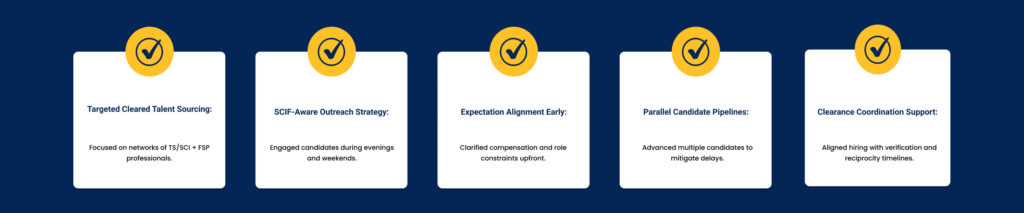
- First, iQuasar concentrated its sourcing efforts within established, cleared professional networks, identifying individuals who already possessed TS/SCI clearance and Full Scope Polygraph credentials. By focusing on communities where cleared professionals actively collaborate, such as specialized technical forums and referral networks, the recruiting team identified candidates not visible on traditional recruiting platforms.
- Second, iQuasar adapted its outreach strategy to account for SCIF communication constraints. Recruiters scheduled candidate outreach during early mornings, evenings, and weekends, times when cleared professionals were more likely to have access to personal communication devices. This approach significantly improved response rates and enabled more meaningful candidate conversations.
- The recruitment strategy also included clear expectation management regarding compensation and program requirements. By communicating budget constraints early in the process, iQuasar ensured that only candidates aligned with the contractor’s compensation structure progressed. This reduced late-stage offer declines and improved hiring efficiency.
- Finally, iQuasar coordinated closely with the contractor to monitor clearance verification timelines and maintain pipeline continuity. Rather than waiting for a single candidate to progress through the process, multiple qualified candidates were advanced simultaneously. This ensured that program staffing remained on track even if individual candidates encountered reciprocity delays.
How iQuasar Created Value
Through its disciplined, cleared recruitment strategy, iQuasar helped the contractor maintain staffing continuity for a highly sensitive NSA program despite the constraints of the cleared talent market. By focusing on qualified professionals who already held TS/SCI clearance with Full Scope Polygraph credentials, the recruitment process eliminated many of the delays associated with new clearance investigations.

The structured outreach and expectation management approach also reduced candidate disengagement during the hiring process. Candidates entered discussions with a clear understanding of the program requirements, onsite work expectations, and compensation structure, which helped maintain momentum from initial contact through final onboarding.
Most importantly, iQuasar’s pipeline-driven recruitment model ensured that the contractor could continue supporting mission-critical NSA work without extended staffing gaps. The result was a more predictable hiring process that balanced security compliance, budget discipline, and program readiness.
Recruiting professionals with TS/SCI clearance and Full Scope Polygraph credentials requires specialized sourcing strategies, disciplined candidate engagement, and deep familiarity with the intelligence community’s hiring environment. By combining targeted sourcing with proactive candidate engagement and coordination of clearance verification, iQuasar helped the contractor overcome one of the most difficult staffing challenges in government contracting.
iQuasar Cleared Recruitment Service
iQuasar’s Cleared Recruitment Service helps government contractors recruit highly specialized professionals with security clearances ranging from Public Trust to TS/SCI and polygraph-level credentials. Our recruitment team understands the complexities of classified hiring environments, including SCIF communication barriers, clearance reciprocity processes, and the competitive landscape for cleared talent.
Contact us today to learn more about how iQuasar supports contractors staffing mission-critical programs.