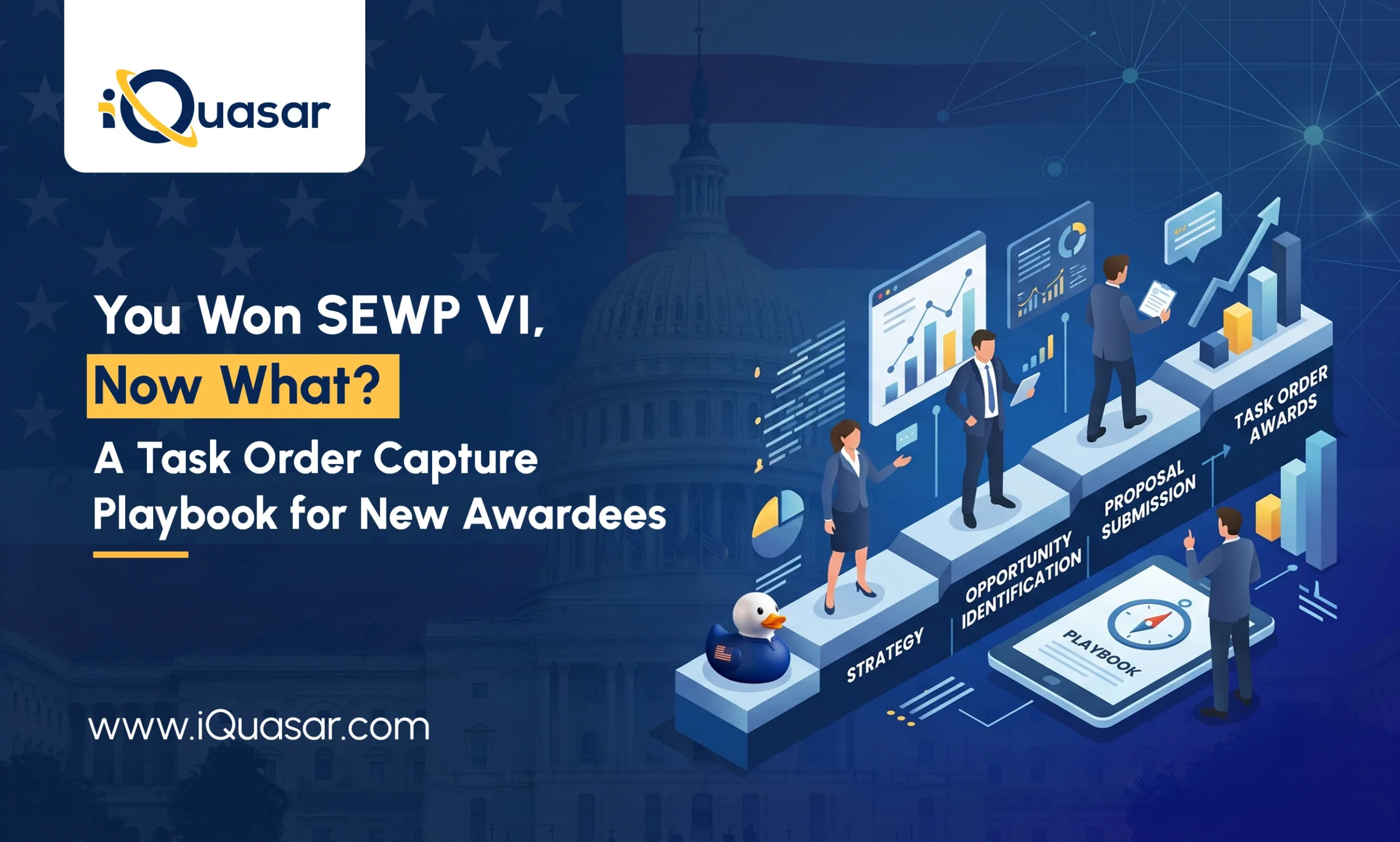
The wait is over. NASA has begun issuing awards for SEWP VI, the sixth generation of its Solutions for Enterprise-Wide Procurement vehicles, with more than 2,100 awards spread across roughly 1,490 vendors. If your company made the list, congratulations, you’ve earned a place on one of the most widely used IT acquisition vehicles in the federal government.
But here’s the part that catches many first-time GWAC holders off guard: winning a seat is not the same as winning work. A SEWP VI award is a license to compete, not a guarantee of revenue. The real competition begins now, at the task order level. This playbook walks through how to turn that hard-won seat into an actual pipeline.
A Seat at the Table Isn’t a Paycheck
It’s worth being clear-eyed about what your award does and doesn’t do. NASA did not evaluate price at the master contract level; pricing is determined order by order, at the task order level. And while the program carries a substantial overall ceiling, the per-awardee ceiling is a cap, not a commitment. Nobody is going to send work your way simply because you’re on the vehicle.
With well over a thousand companies holding seats, every task order you pursue is a competition. The contractors who thrive on SEWP VI are the ones who treat the award as a starting line, not a finish line.
Know Your Category, and Your Competition
SEWP VI organized its awards into three categories, and where you landed has real implications for your capture strategy.
Category A covers IT solutions (364 awards) — hardware, software, and associated services. Category B covers enterprise-wide solutions (692 awards), typically larger-scale IT implementations and managed services. The third category, program and mission-level services, drew the largest pool of winners at over a thousand awardees and covers more complex, agency-specific IT support.
Each category carries different competitive dynamics. Category A tends to attract high-volume, transactional orders where price is the dominant factor. Category B and mission-level services often reward past performance depth and technical differentiation more heavily. Knowing which levers matter in your category shapes how you price, how you position, and which task orders are actually worth pursuing.
Task orders are competing under Fair Opportunity rules, meaning every contract holder in a grouping must be given a reasonable chance to be considered. That’s good and bad: you’ll see opportunities others might miss through sole-source vehicles, but so will every competitor in your pool. The practical implication is that blanket pursuit doesn’t work. You need a filtered, intelligence-driven target list — not a response to every RFQ that crosses your inbox.
Build Your Pipeline Before the Orders Drop
The SEWP VI ordering period is open, and the contractors winning early task orders are the ones who started preparing before the first RFQ hit the street. Pipeline-building isn’t a post-award activity — it should already be underway.
1. Target the right agencies
Start with data, not instinct. Pull historical SEWP V spending from USASpending.gov and FPDS to identify which agencies bought what, in what volumes, and from which vendor profiles. Cross-reference that against your own solution areas to build a shortlist of realistic targets. Ten agencies you understand deeply will outperform a hundred you’ve only glanced at.
Also pay attention to the SEWP Program Office itself. NASA’s SEWP team is unusually accessible compared to other GWAC program offices, and staying visible to them — through check-ins, capability briefings, and responsiveness — can surface opportunities before they’re formally posted.
2. Line up teaming partners
Many task orders, especially at the program and mission-services level, are won by teams rather than solo bidders. The time to identify complementary partners is now, not when an RFQ drops with a ten-day response window. Look for partners who fill gaps in your past performance, hold clearances you don’t, or bring agency relationships you lack. Get teaming agreements in place early so you can move fast.
3. Invest in capture intelligence
Tracking SAM.gov for posted requirements is table stakes. Real capture intelligence means monitoring agency budget justifications, talking to contracting officers before requirements are finalized, and understanding who the incumbent is on every opportunity you’re considering. Win probability is largely set during the capture phase — by the time an RFQ is released, the best-positioned vendors already have an advantage. The goal is to be one of them.
Position to Win Each RFQ
When task order requests start flowing, execution quality is what separates winners from also-rans.
The basics matter more than contractors expect. Submissions must be fully compliant; missing a required section or misreading an evaluation factor is an unforced error that eliminates you regardless of your technical merit. Read the RFQ twice before writing a word.
Pricing on SEWP VI requires discipline. Your price must fall at or below your awarded ceiling rates, but “compliant” isn’t the same as “competitive.” Study the requirement carefully: agencies often signal their budget constraints in the SOW or evaluation criteria. Pricing too high relative to the competitive range is one of the most common reasons strong technical submissions are lost. Build a pricing process that’s fast and defensible, not just a formula applied uniformly.
Past performance documentation is where many awardees leave points on the table. Vague references to prior work don’t score well. Relevant, specific, well-documented examples with measurable outcomes and clear parallels to the requirement at hand are what evaluators are looking for. If your past performance library isn’t organized and ready to pull from, build it now, before you’re operating under deadline pressure.
Finally, speed is a real differentiator on SEWP. Task order timelines are often tight, and a clean, fully responsive submission delivered early frequently beats a more polished one that arrives late or requires clarification. The infrastructure to respond quickly to templates, a cleared teaming bench, an organized past performance library is worth building before you need it.
Also Read: A Task Order Capture Playbook for New Awardees
Turn Your Award Into Revenue
A SEWP VI award opens the door, but walking through it takes a deliberate capture strategy, a real pipeline, and disciplined execution on every task order. The contractors who treat day one of their awards as day one of the competition are the ones who will see returns.
If you’ve just received your award and want to build a real capture engine around it, here’s where to start this week: pull your SEWP V historical spend data, identify your top ten agency targets, and audit your past performance library for gaps.
If you want support doing that or want a team that’s done it before; our Capture Management and Contract Vehicle Support practices help GWAC holders build pipelines, shape opportunities, and convert awards into task order revenue. We also support teams already eyeing their next vehicle through BD strategy and proposal development.