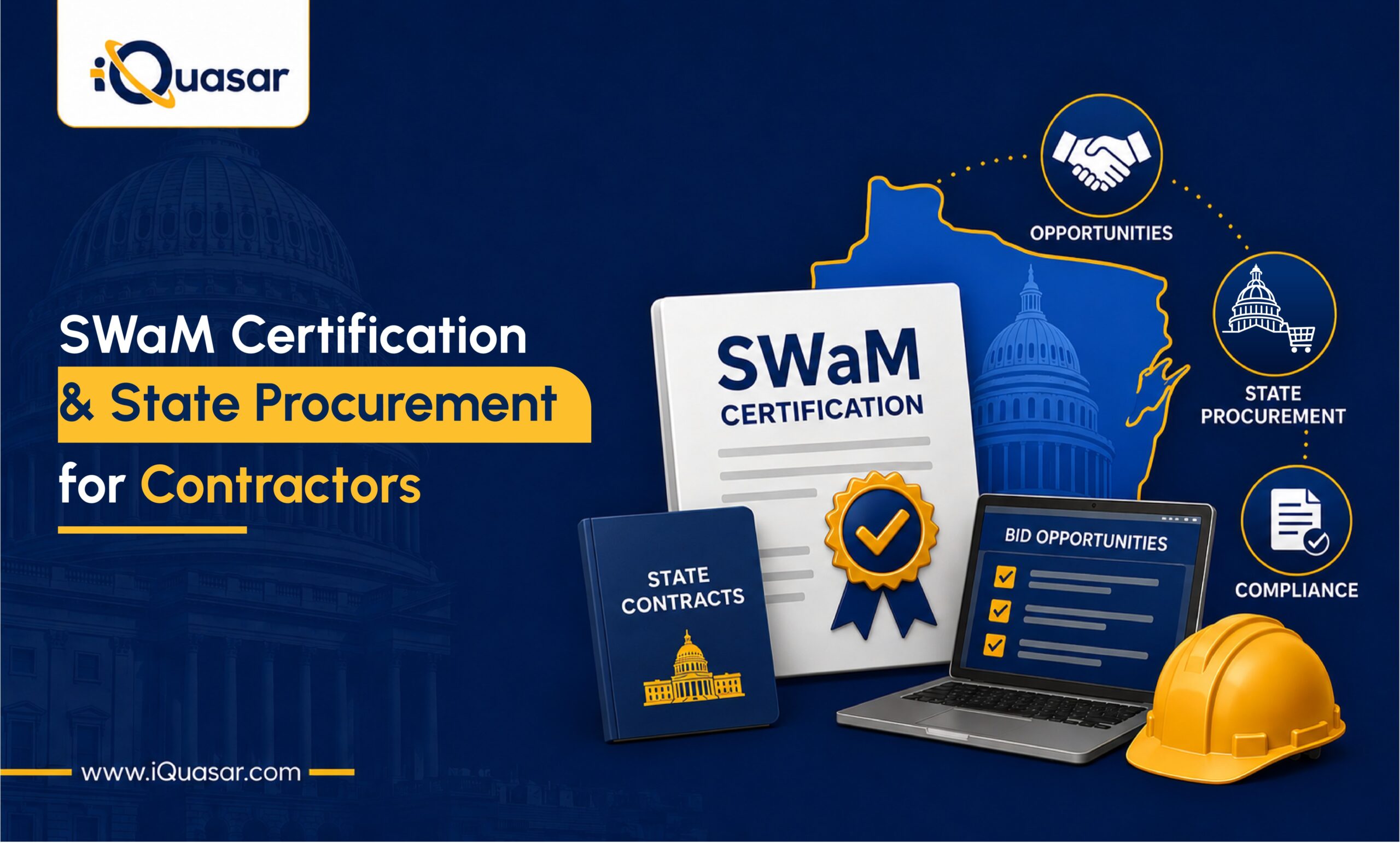
Most contractors think about certification once at the start. The ones who build lasting state contract portfolios think about it continuously. Small, Women-owned, and Minority-owned (SWaM) certification in Virginia is not a one-time credential. It is an active market positioning tool, and understanding how to use it across every phase of the procurement lifecycle separates contractors who win state work from those who simply qualify for it.
What SWaM Is, and Why It Carries Weight
The SWaM program, administered by Virginia’s Department of Small Business and Supplier Diversity (SBSD), establishes formal designations for businesses that meet specific ownership, control, and size criteria. There are five distinct designations, and each one unlocks a different layer of procurement access:
- Small Business — independently owned and operated, with annual revenue under state-defined thresholds
- Women-owned Business (WBE) — 51% or more owned and controlled by women
- Minority-owned Business (MBE) — 51% or more owned and controlled by a minority individual
- Micro-business — a small business with annual revenue under $500,000, carrying enhanced set-aside preferences
- Service-Disabled Veteran-owned (SDVOSB) — 51% owned and controlled by a service-disabled veteran
Each designation is pursued and maintained separately, meaning a firm owned by a minority woman may hold both MBE and WBE status and should, to maximize competitive access across agency solicitations.
The Micro-Business Set-Aside is worth particular attention. Virginia procurement policy allows agencies to restrict competition exclusively to certified micro-businesses for purchases up to a defined threshold. For small firms that qualify, this creates a competitive environment dramatically smaller than an open solicitation and for those that do not pursue the designation, it represents a category of state spending they are entirely locked out of.
The Certification Process Is a Gate, Not a Formality
SBSD certification requires more than a self-attestation. Applicants must provide documentation establishing ownership percentage, operational control, and revenue and the agency reviews submissions with a level of scrutiny designed to prevent misrepresentation. Business licenses, tax returns, operating agreements, and proof of active management by the qualifying owner are standard requirements.
Certification must be renewed annually, and changes in ownership structure, revenue levels, or management responsibilities can affect eligibility. Contractors who allow their certification to lapse or who experience business changes without notifying SBSD risk losing their certified status mid-contract. The consequences of that loss are not administrative inconveniences. They include potential contract termination, debarment from future state procurement, and liability for misrepresentation if certified status was claimed after eligibility was lost.
Active calendar management of renewal deadlines is not optional — it is risk management.
Prime and Subcontractor Synergy: Where the Real Value Multiplies
SWaM’s impact extends well beyond the firms that hold the certification directly. Virginia state agencies set annual SWaM participation goals, and prime contractors on larger state contracts are typically required to demonstrate good-faith efforts to include SWaM subcontractors in their delivery teams.
This creates a structural demand for certified SWaM firms at the subcontractor level one that operates independently of whether a small firm is pursuing prime contracts at all. A certified minority-owned engineering firm, for example, may find that its certification is the precise credential a large prime needs to meet its diversity participation goal on a major infrastructure award.
The “flow-down” dynamic works in both directions. Primes benefit from SWaM subcontractor relationships that satisfy agency diversity goals and strengthen proposal evaluations. SWaM firms benefit from subcontracting opportunities that build past performance, generate consistent revenue, and create the agency relationships that support future prime pursuits. Intentional teaming not opportunistic matching is what makes this dynamic work.
Maintaining Status Is the Work That Never Stops
The most common SWaM compliance failures are not fraud. They are inattention. Firms grow past size thresholds without reassessing eligibility. Ownership structures change without SBSD notification. Renewal deadlines pass during busy execution periods. Subcontractor oversight processes that looked adequate at contract award fail under the documentation scrutiny of a post-award audit.
Best practices for sustained SWaM compliance include annual eligibility self-assessments before renewal, documented subcontractor monitoring processes for prime contractors managing participation commitments, and clear internal ownership of certification management separate from business development and operations functions.
Also Read: WOSB & EDWOSB Certification Assistance
Certification Is an Asset. Treat It Like One.
SWaM certification opens doors at the state level that remain closed to uncertified firms — in set-aside competitions, in prime contractor teaming, and in agency relationships built around supplier diversity goals. But the certification itself is only as valuable as the strategy behind it and the diligence that sustains it.
If your business is pursuing SWaM certification for the first time, navigating a renewal, or managing SWaM subcontractor obligations as a prime, iQuasar’s SWaM Certification Services provide guidance through every stage of the process. Reach out to our team to discuss where your firm stands and what the right next step looks like.