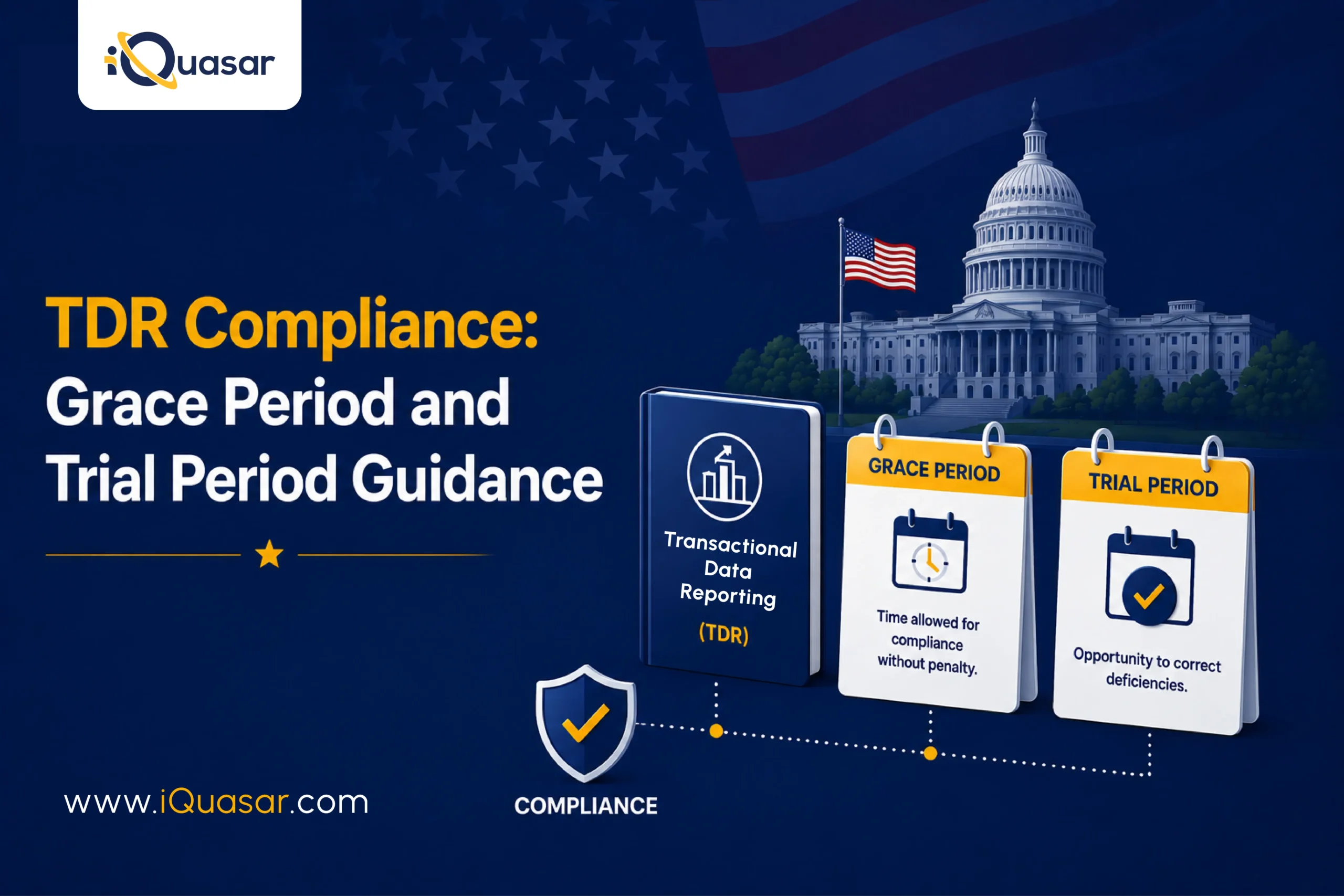
The General Services Administration (GSA) has released important guidance regarding Transactional Data Reporting (TDR) compliance grace periods and trial periods for Multiple Award Schedule (MAS) contractors. The guidance provides additional clarity on compliance expectations as GSA continues the expansion of the TDR Program and introduces new reporting requirements.
The update addresses four key areas: contracts transitioning into TDR, contractors that do not accept Mass Modification A909 by the required deadline, trial period requirements for existing TDR contractors, and trial period guidance for new reporting fields that are not yet available within the FAS Sales Reporting Portal (SRP).
In this blog, we break down each of the four areas in plain terms what the guidance says, what it means for your contract, and what actions you need to take before enforcement begins on January 1, 2027. Whether you are a first-time TDR reporter, a long-standing TDR participant, or a contractor still weighing your modification options, the compliance clock is running and the consequences of inaction are material.
Contracts Transitioning to TDR Effective October 1, 2025, Through July 1, 2026
For MAS contracts entering the TDR Program with effective dates between October 1, 2025, and July 1, 2026, GSA will extend or implement a temporary Grace Period to assist contractors during the transition to monthly TDR reporting requirements. This provision also applies to contracts entering TDR after July 1, 2026.
The Grace Period framework is structured as follows:
- Duration: The Grace Period remains in effect through the reporting period ending December 31, 2026.
- No Penalties During the Period: Contractors will not be penalized for non-compliance during the Grace Period. However, compliance reports and contractor accountability remain active.
- Soft Flags Apply: Contractors may receive “soft flags” identifying reporting discrepancies or instances where reported data does not match expected reporting requirements. These are advisory, not punitive.
- Reporting Obligations Continue: Contractors remain responsible for ensuring that all applicable sales are reported throughout the Grace Period. The period does not suspend the reporting obligation itself.
- Enforcement Begins January 1, 2027: Beginning with the reporting period effective January 1, 2027, compliance will become subject to enforcement action by the Contracting Officer.
The stated purpose of the Grace Period, per GSA, is to provide contractors with sufficient time to become familiar with TDR reporting requirements, identify reporting issues, and make necessary corrections before compliance requirements become fully enforceable. It is expressly intended to support contractors as they adjust internal processes, reporting systems, and data collection practices associated with TDR reporting not to defer those adjustments indefinitely.
Contractors Who Do Not Accept A909 by June 2, 2026
GSA also provided guidance for contractors that do not accept Mass Modification A909 by the required acceptance deadline of June 2, 2026. The consequences are significant and will not be mitigated by a later acceptance date.
Key points contractors must understand:
- Contract Cancellation Risk: For MAS contractors that do not accept A909 by June 30, 2026 (with the acceptance due date of June 2, 2026), a contractor’s MAS contract may be cancelled at the discretion of the Contracting Officer.
- Delayed Start Date, Same Grace Period End: For contractors whose contracts are not cancelled and who accept A909 after July 1, 2026, the resulting delayed TDR start date of October 1, 2026 or later does not extend the Grace Period. The Grace Period still concludes on December 31, 2026, regardless of when acceptance occurred.
- No Grace Period Extension for Late Acceptance: GSA has explicitly clarified that the Grace Period will not be extended because of delayed acceptance of A909. Late-accepting contractors receive less transition time, not more.
- Enforcement Date Is Fixed: As with all other transitioning contracts, Contracting Officer enforcement begins on January 1, 2027, regardless of acceptance timing.
- Recommended Action: Contractors should immediately review their modification status in eMod and ensure timely acceptance of A909 to avoid contract cancellation risk and unnecessary compression of their transition window. Technical issues should be escalated to the Vendor Support Center at [email protected] without delay.
The practical implication is straightforward: every week of delayed acceptance is a week of transition time lost, with the enforcement deadline fixed and immovable. Contractors who postpone acceptance gain no additional compliance runway and take on material contract risk in the interim. iQuasar’s Contract Management team can confirm your modification status and guide you through both acceptance steps—Refresh 31 and the separate TDR participation modification—in the correct sequence.
Trial Period for Existing TDR Contracts Effective Prior to October 1, 2025
For contracts already participating in the TDR Program prior to October 1, 2025, GSA will implement a temporary Trial Period for several newly required data elements.
The new mandatory reporting fields include:
- Ship Date (all product offerings only)
- Order Date (all product offerings only)
- Zip Code Ship To (all product offerings only)
- Federal Customer (all offering types)
- UCID (for contractors that do not list items for click-and-buy on GSA Advantage, such as those using the Services Plus File in FCP)
- Cloud Service Type (for SINs matching or beginning with 518210C only)
GSA noted that this approach is consistent with its prior commitment to provide industry sufficient time to implement new reporting requirements. Several of these fields have previously been optional, and GSA had previously indicated its intention to make them mandatory in the future.
Effective July 1, 2026, contractors will be required to report these data elements. GSA also noted that Order Type, Order Discount, and Worksite are not currently available in the Sales Reporting Portal but will become mandatory once implemented and announced through Interact. The Trial Period will last six months, which is equivalent to two reporting quarters.
During the Trial Period, contractors will not be penalized for non-compliance related to these new data elements. Contractors may, however, receive soft flags identifying missing or invalid data and are expected to continue reporting all applicable sales.
The Trial Period is intended to provide contractors adequate time to modify internal systems, update reporting processes, and adapt their reporting practices to accommodate the new requirements.
Once the Trial Period concludes, compliance with these mandatory reporting fields will become enforceable by the Contracting Officer.
Trial Period for New Fields Not Yet Incorporated in FAS SRP
GSA also addressed new required reporting fields that are not yet available within the FAS Sales Reporting Portal through either upload functionality or manual form entry.
For these reporting elements, all contracts will receive a six-month Trial Period to implement the required data fields once they become available.
The affected fields include:
- Order Type (all offering types)
- Order Discount (Highly Configurable Products (HCP) and Configurable Services (CS) only)
- Worksite (for required labor hour rate breakdown reporting only)
Because these fields are not currently available for reporting within SRP, contractors cannot yet provide the required information. GSA’s Trial Period approach is intended to ensure contractors have adequate time to incorporate these reporting elements into their internal systems and processes once SRP functionality becomes available.
After implementation and completion of the six-month Trial Period, compliance with these mandatory fields will become subject to enforcement by the Contracting Officer.
Key Takeaways for MAS Contractors
GSA’s latest guidance provides additional flexibility for contractors as the agency continues expanding Transactional Data Reporting requirements and introducing new reporting elements. While Grace Periods and Trial Periods offer temporary relief from compliance enforcement, contractors should not view these periods as delays in preparation.
Contractors should use this time to review reporting processes, evaluate data collection capabilities, update internal systems, and prepare for future compliance requirements. Particular attention should be given to the acceptance of Mass Modification A909, implementation of newly required reporting fields, and readiness for monthly TDR reporting obligations.
Although compliance enforcement may be temporarily deferred during applicable Grace Periods and Trial Periods, contractors remain responsible for reporting all sales and addressing any reporting discrepancies identified through GSA’s soft flag process.
Beginning January 1, 2027, and following the conclusion of applicable Trial Periods, Contracting Officers will have the authority to enforce compliance requirements associated with these reporting obligations. Contractors that prepare early will be better positioned to meet these requirements and avoid future compliance challenges.
Also Read:The Real Impact of TDR on GSA Pricing — iQuasar
The TDR mandate under Refresh 31 is active, and the timelines attached to each of the four scenarios are fixed. GSA has built structured tolerance into this transition in the form of grace periods and trial periods, but that tolerance has a defined endpoint. Contractors who use the grace period as intended to build durable reporting processes, not to delay will emerge from this transition with a MAS contract that is administratively cleaner and operationally more competitive. For contractors who need help navigating which scenario applies to their contract and what actions are required, iQuasar’s GovCon 360° team is ready to provide a structured compliance assessment and transition support.