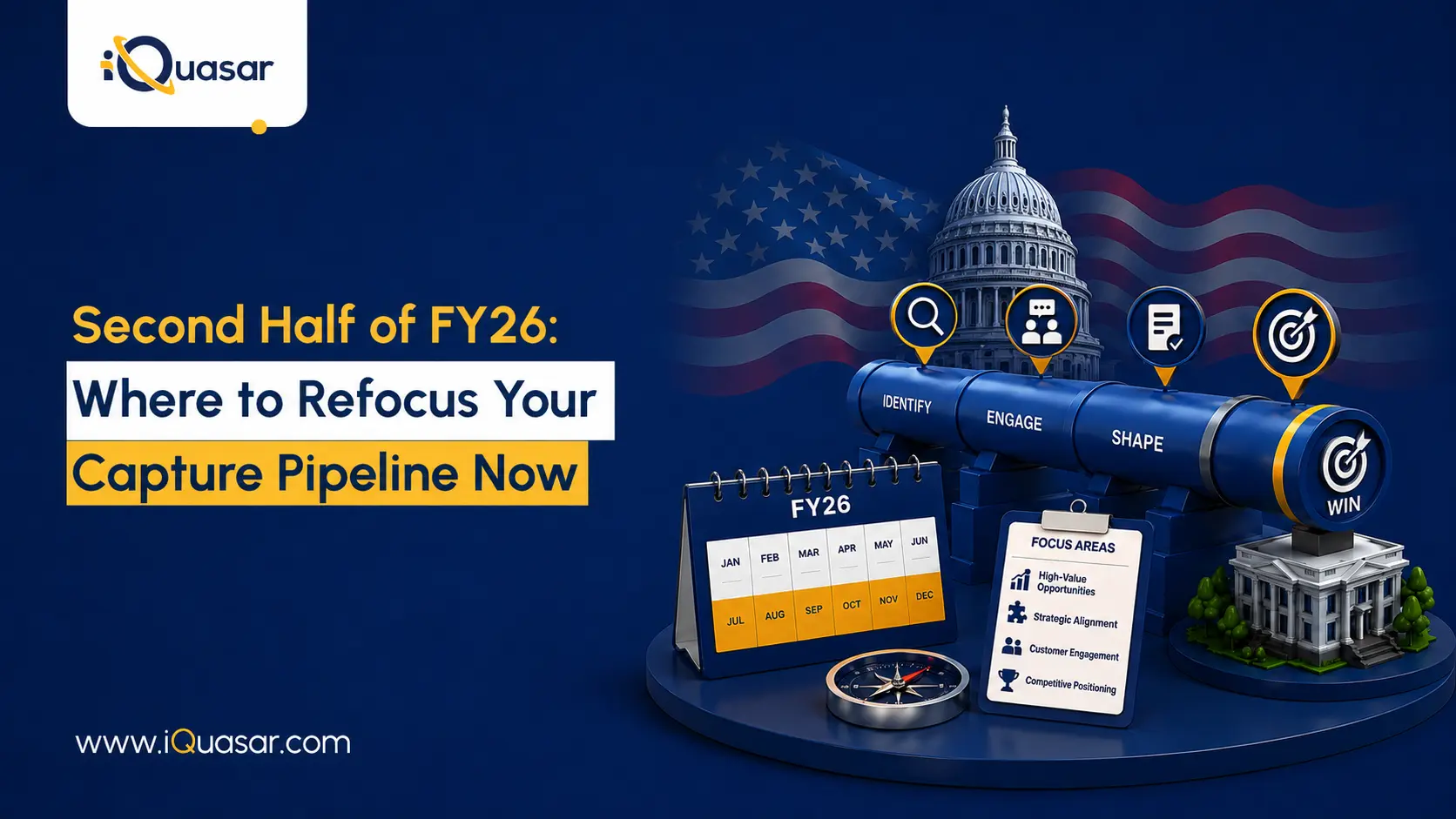
The federal contracting pipeline in FY26 has not unfolded the way most firms planned. Solicitations expected in Q1 and Q2 have shifted. Timelines have compressed. Several high-value vehicles that firms had penciled in for early capture are now landing in Q3 and Q4, concentrated into a shorter window, with more competition and less preparation time.
For executive leadership and business development teams at small and mid-tier contractors, the right response isn’t to work harder on the same plan. It’s to reassess entirely and realign capture resources around where the real opportunity sits right now.
Why Mid-Year Recalibration Is a Strength, Not a Failure
Mid-year recalibration is not a sign that earlier planning failed; it’s the discipline that separates firms that win consistently from those that pursue reactively. The FY26 market has moved in ways that make earlier capture timelines unreliable for a significant portion of the pipeline. Delayed solicitations mean compressed preparation windows, and compressed windows mean firms that started early hold a structural advantage.
A 3-question audit to start with
Run your current capture portfolio through these questions:
- Which opportunities have shifted outside your original timeline?
- Which ones have changed in scope, structure, or competitive dynamics since your first assessment?
- Which pursuits are consuming resources without producing intelligence that meaningfully improves your win probability?
Answering these honestly turns reallocation of capture investment into a purposeful decision rather than a reactive scramble.
iQuasar’s capture management services support firms through exactly this kind of mid-cycle reassessment helping business development teams prioritize with precision rather than spread resources across a pipeline that no longer reflects current market conditions.
The 4 High-Impact Vehicles Defining H2 FY26
These four vehicles define the high-impact tier of the second half of FY26 and deserve priority attention from firms with the capability and past performance to compete.
| Vehicle | Issuing Agency / Focus | What It Means for Your Firm |
| UMCS VI | U.S. Army Corps of Engineers — utility monitoring & control systems, DoD installations worldwide | $5B+ ceiling, multi-award, long-term task order potential for facility systems and infrastructure integration firms. Solicitation expected soon — firms not yet in capture are already behind. |
| OMNIBUS IV On-Ramp | Research and development contracting | A structured entry point for firms that missed the original award. Competitive positioning demands the same discipline as a full and open competition. |
| GEN VI Human Resource Solutions | Federal HR services | Next-generation vehicle covering workforce management, HR transformation, and talent operations — substantial long-term value. |
| CIO-CS Follow-On | IT services | Continues an established IT vehicle — a recompete for incumbents, an entry opportunity for challengers. Predecessor award data on USASpending.gov shows where task order volume has historically concentrated. |
The Market Is Expanding Beyond Traditional IT
One of the defining characteristics of H2 FY26 is how far the high-value pipeline now extends beyond traditional IT contracting. Firms that have historically focused on IT services vehicles are now competing in the same market cycle as infrastructure integrators, healthcare program managers, and HR transformation specialists.
- UMCS VI pulls facility systems and installation infrastructure firms into the strategic planning window.
- OMNIBUS IV draws research and development organizations into near-term capture competition.
- GEN VI positions workforce services firms alongside management consulting primes that have traditionally dominated HR vehicle competitions.
Together, these vehicles reflect a broader shift in federal acquisition toward multi-domain contracting bundling mission support functions rather than procuring them separately.
What this means if your firm sits in one domain
This shift creates both a teaming imperative and a positioning opportunity. For example, a firm with deep SCADA and building automation experience, paired with a strong cybersecurity partner, is better positioned on UMCS VI than either firm would be on its own.
iQuasar’s Teaming Portal helps firms identify and formalize those partnerships before solicitation release when teaming arrangements carry the most evaluative weight.
Fewer Vehicles, Higher Stakes: Navigating a Consolidated Market
Fewer vehicles carrying larger ceilings is the defining structural feature of the current federal market. Budget pressures, acquisition reform, and agency consolidation have produced a landscape where entry points are fewer but the stakes at each one are significantly higher.
When a single vehicle carries a $5 billion ceiling and dozens of capable firms compete for a limited number of seats, the margin between a winning proposal and a losing one narrows sharply. Firms that submit technically compliant proposals without a differentiated narrative, a credible teaming structure, or competitively informed pricing will consistently finish behind firms that invest in those elements.
The takeaway: Broad pursuit strategies that spread capture resources across many opportunities at shallow depth are now actively counterproductive.
The correct response is disciplined pursuit of fewer opportunities, deeper investment in each. That requires:
- Honest capability assessment
- Clear past performance mapping
- A willingness to walk away from pursuits where win probability doesn’t justify the investment
iQuasar’s GovCon360 services provide the market intelligence and competitive analysis needed to make those decisions with confidence.
Also read: Capture Management Strategy: How to Win Before the RFP Drops
Building Early-Stage Readiness (Before the RFP Arrives)
Early-stage readiness is what converts a pursuit decision into a competitive submission. It takes longer to build than most firms budget for once a solicitation actually releases so start with these four pillars now.
1. Capability alignment: Be honest about where your firm’s documented experience matches the requirement and where it falls short. Gaps identified now can be closed through teaming, hiring, or targeted investment. Gaps identified after RFP release become weaknesses evaluators find before you do.
2. Past performance mapping: Identify which completed contracts most closely align with the anticipated scope of each target vehicle. Then brief the contracting officers and program managers tied to those references, and confirm they’re available to respond. A strong reference a reviewer can’t reach is functionally equivalent to no reference at all.
3. Teaming strategy: Finalize your team composition, document each partner’s role, and confirm the flow-down of relevant past performance, all before solicitation release. This directly affects evaluation outcomes.
4. Administrative readiness: Verify SAM.gov and all relevant agency portal registrations are current for every team member before proposal development begins.
Prioritizing for the Rest of FY26
Effective prioritization starts with a clear-eyed view of your firm’s strengths, available capture resources, and realistic win probability on each target opportunity. Not every high-value vehicle in the pipeline is the right pursuit for every firm and selecting the wrong opportunities, even large, well-publicized ones, is a more common and more costly mistake than missing an opportunity entirely.
The firms that finish FY26 strongest will be the ones that:
- Identified their two or three highest-probability targets early
- Allocated capture resources accordingly
- Built readiness before the RFP arrived
- Submitted proposals reflecting genuine preparation, not compressed reaction
That outcome requires a shift from reactive bidding driven by solicitation release dates to deliberate pipeline planning driven by capability alignment and competitive positioning.
The Bottom Line
If your firm is reassessing its FY26 capture priorities and wants support in identifying the right vehicles, building competitive intelligence, and structuring proposal readiness, iQuasar’s proposal development and capture management teams work with small and mid-tier contractors at every stage of this process. Contact us today to make the second half of FY26 your strongest competitive window yet.