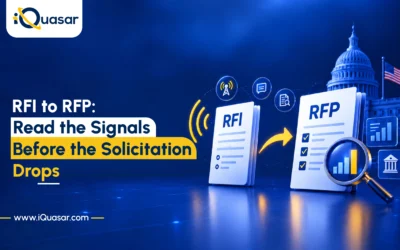
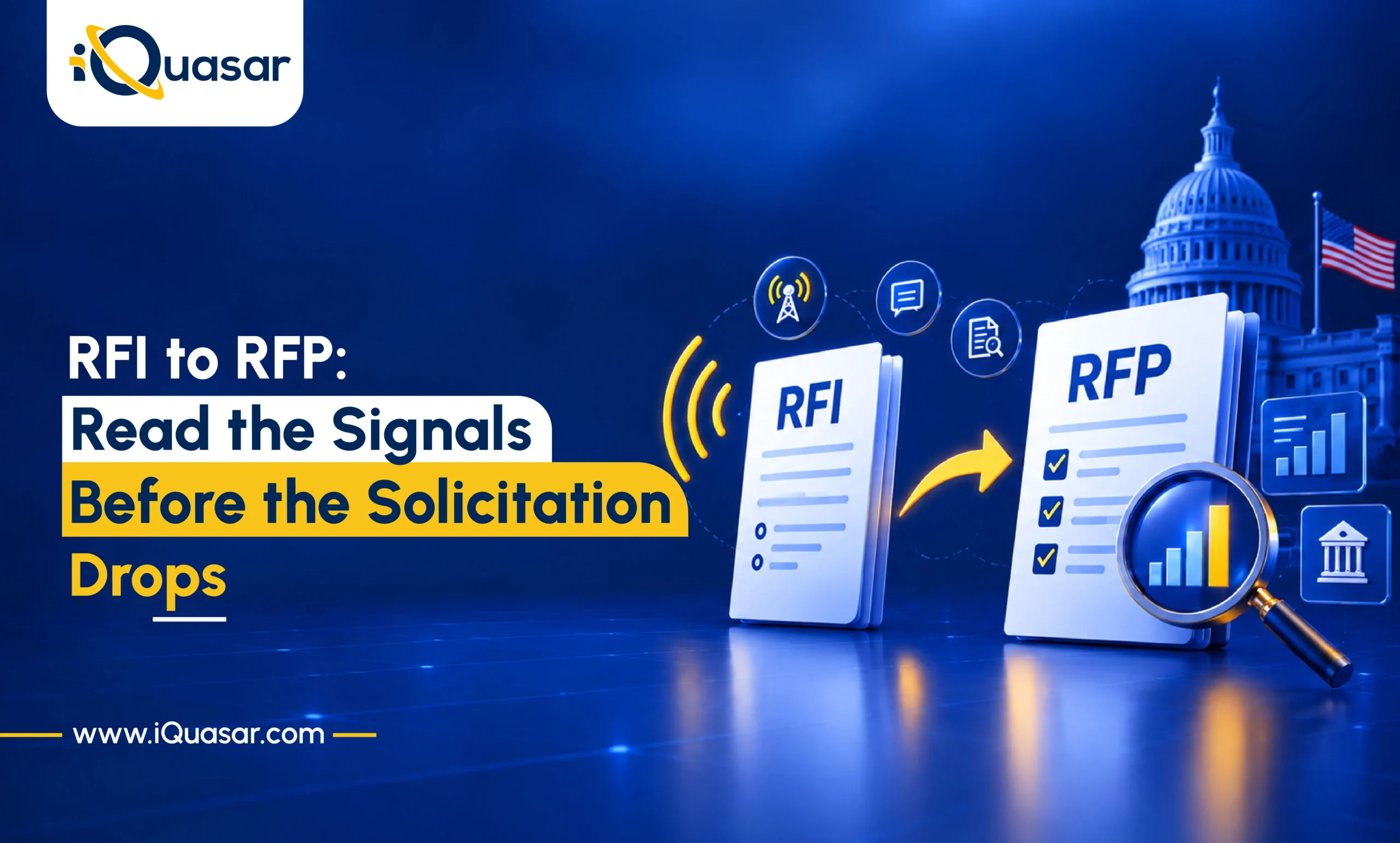
RFI to RFP: How Small Contractors Can Use Early Acquisition Signals
Most small contractors treat the RFP as the starting gun. The solicitation drops on SAM.gov, they download the documents, assess the requirements, and begin writing. By that point, they are already behind. The contractors who win consistently do not start at the RFP. They start at the RFI, the forecast, the sources sought, and the draft solicitation – sometimes months before the final requirement ever publishes. Early acquisition signals contain specific, actionable intelligence that shapes capture strategy, teaming decisions, and proposal positioning long before there is anything to submit. For small contractors learning how to bid on government contracts more effectively, reading those signals is the single highest-leverage skill in the business development toolkit. In this blog, we break down each pre-solicitation signal type, what it tells you, and exactly what to do with it.
What an RFI Actually Tells Contractors
More Than a Market Survey
A Request for Information (RFI) is an official pre-solicitation notice that agencies issue to collect market intelligence prior to finalizing a requirement. Per FAR 15.201, RFIs create no legal obligation, and agencies do not have to take action, launch a solicitation, or evaluate responses formally. Because of this disclaimer, many small contractors ignore RFIs completely which is a major strategic mistake.
What to Extract from Every RFI?
An RFI signals that an agency is actively thinking about a requirement. Beyond that, it reveals:
- Requirement scope and complexity. The RFI describes what the agency thinks it needs. That description tells you whether your capabilities align, where the gaps are, and whether the eventual solicitation will favor generalists or specialists.
- Evaluation priorities. The questions an agency asks in an RFI reveal what concerns them most. A question about transition risk signals that the agency has had a difficult transition before. A question about small business capacity signals that they are considering a set-aside. Read the questions as carefully as the description.
- Timeline signals. RFI language about anticipated award dates and period of performance gives you a forward-planning horizon. That horizon tells you how much time you have to build teaming relationships, close capability gaps, and prepare your past performance portfolio.
- Competition structure. If the RFI specifies NAICS codes, small business set-aside intent, or contract vehicle preferences, those signals tell you which competitive pool you are likely entering and who your competitors will be.
Respond to every RFI where you have relevant capability or can contribute strategic inputs. Your response goes into the contracting officer’s file. When the RFP releases, the contracting officer already knows your name. That is not a trivial advantage.
What Procurement Forecasts Reveal
The Forecast Is a Pipeline, not a Calendar
Federal agencies publish procurement forecasts forward-looking lists of anticipated contract actions via agency-specific portals and USASpending.gov. While most small contractors check these lists infrequently, sophisticated contractors establish systematic processes to track them. A procurement forecast entry tells you the agency expects to award a contract in a specific category, at an approximate value, within a defined timeframe. That entry also tells you what the agency currently does not have under contract which means they will need it from someone. Your job is to be that someone, positioned before the solicitation releases.
What to Do with Forecast Data
- Cross-reference forecast entries against your NAICS codes and service categories. Build a shortlist of forecast entries that align with your capabilities.
- Monitor forecast entries across multiple quarters. An entry that remains listed without advancing to a solicitation points to internal budget or requirements instability, providing valuable insight into whether and when to invest resources in that opportunity.
- Use FPDS-NG (now merged into SAM.gov) to research the award history in the same category. If the requirement has been awarded before, FPDS shows you the incumbent, the contract value, the performance period, and the contract vehicle. That data is the foundation of your competitive analysis.
Reading NAICS and Set-Aside Signals
NAICS Codes Define the Competition
The NAICS code assigned to a solicitation determines size standards, sets eligibility for small business set-asides, and shapes who can compete. When a pre-solicitation notice or draft RFP assigns a NAICS code, it also implicitly defines the competitive landscape including which firms qualify as small, which socioeconomic set-aside programs might apply, and which contract vehicles typically carry that code.
A NAICS code mismatch between a pre-solicitation notice and the final RFP is a meaningful signal. It often means the agency changed its definition of the requirement between market research and solicitation. Understanding what drove that change and whether it favors or disadvantages your firm, is core pre-solicitation intelligence.
Set-Aside Intent as an Early Signal
When an agency issues an RFI or sources sought with a set-aside notation, they are telling you they believe the small business market can support the requirement. That signal has direct implications:
- If you hold a qualifying certification 8(a), WOSB, SDVOSB, or HUBZone a set-aside signal dramatically improves your competitive position and justifies deeper investment in capture.
- If you do not hold a qualifying certification, a set-aside signal tells you that your best path to this contract runs through a teaming arrangement with a firm that does.
Analyzing Incumbent Information
The Incumbent Advantage Is Real and Defeatable
When a requirement has an incumbent contractor, the incumbent enters the recompete with structural advantages: existing relationships with the program office, detailed knowledge of the work, and a lower perceived transition risk. Overcoming the incumbent advantage requires understanding it precisely — and exploiting the specific places where incumbents are most vulnerable.
Use FPDS-NG and USASpending.gov to research the incumbent’s contract history on this requirement. Look for:
- CPARS performance ratings, where accessible, to assess whether the incumbent has any documented performance issues
- Modification history to identify contract growth, scope changes, or funding anomalies that signal problems during performance
- Personnel turnover signals in industry news, LinkedIn activity, or agency communications that suggest staffing instability on the incumbent team
An incumbent with documented performance concerns, high staff turnover, or a history of cost growth is a defeatable position. Your proposal needs to name those specific risks without explicitly identifying the incumbent and explain precisely how your approach eliminates them.
Understanding Draft Requirements
The Draft RFP Is a Gift Most Contractors Ignore
When agencies release draft solicitations or Requests for Comment, they invite industry to shape the final requirement. Most small contractors treat draft solicitations as preview documents rather than influence opportunities.
Sophisticated contractors treat every draft as a negotiation. They read the draft statement of work against their own capabilities, identify language that disadvantages them or advantages the incumbent, and submit specific, reasoned comments through the formal response process. Agencies do not accept every comment, but they read them. Comments that are specific, data-supported, and genuinely responsive to acquisition objectives influence final solicitation language more often than most contractors assume.
When the final RFP releases, compare it carefully against the draft. Changes between the draft and the final solicitation reveal the agency’s response to industry feedback. A change that moved in a direction you advocated for is a signal that your relationship with the contracting office is productive. A change that moved against your position tells you the agency has a different priority than you assumed.
Using Government Responses to Industry Questions
The Q&A File Is Pre-Proposal Intelligence
Every solicitation that runs a question-and-answer period produces a public record of what competitors asked and what the agency answered. That record is a direct window into what the competition is concerned about, where the solicitation language is ambiguous, and where the agency has strong preferences it did not state directly in the solicitation.
Read the Q&A file before writing your technical approach. Answers that clarify evaluation criteria, define ambiguous terms, or specify agency preferences belong in your proposal response not as quoted language, but as evidence that your approach reflects a precise understanding of what the agency actually wants.
What This Means for Contractors: Building an Opportunity Intelligence Process
Start Capture Before the Solicitation
The intelligence described above is only useful if the organization has a process to gather, organize, and act on it continuously not reactively when a specific solicitation appears. Small contractors that build even a lightweight opportunity intelligence process consistently outperform those that rely on SAM.gov alerts alone.
A basic process includes:
- Weekly forecast review across target agencies and NAICS codes using SAM.gov and agency-specific procurement portals
- FPDS research on every high-priority opportunity to understand award history, incumbent identity, and contract vehicle preferences
- RFI response discipline – responding to every relevant RFI with a capability statement calibrated to the specific questions the agency asked
- Draft solicitation tracking to catch opportunities for pre-RFP influence and to monitor changes between draft and final requirements
Use Early Signals to Assess PWin
Probability of win assessment commonly called PWin should happen before significant proposal resources are invested, not after the RFP drops. Early acquisition signals give you the data to make that assessment honestly.
Assess PWin across five dimensions before committing to a pursuit:
- Capability fit: Does your past performance map to the requirement’s scope, scale, and technical complexity?
- Competitive position: Do you have a specific advantage over the incumbent and the likely competitive field?
- Relationship depth: Has your firm engaged with this agency, this program office, or this contracting officer before?
- Set-aside alignment: Does your socioeconomic certification status match the likely competition structure?
- Teaming readiness: Can you close any capability or past performance gaps through a teaming arrangement that can be formalized before the RFP releases?
A pursuit with low scores across three or more of these dimensions is a pursuit that will consume proposal resources without producing a realistic chance of award.
Identify Teaming Partners Sooner
Teaming decisions made before the RFP releases produce better outcomes than those made after. A teaming partner identified from the competitive landscape analysis because they hold complementary past performance, a qualifying socioeconomic certification, or relationships with the program office your firm lacks enters the proposal process as a genuine capability contributor rather than a last-minute addition.
iQuasar’s Teaming Portal connects small businesses with qualified partners across federal domains. For firms that identify a teaming gap during pre-solicitation research, formalizing that relationship early is one of the highest-leverage steps in the capture process.
Prepare Past Performance and Technical Content Now
Every high-priority opportunity on your pipeline should have a draft past performance write-up and a preliminary technical approach framework before the RFP releases. Those documents do not need to be final they need to exist as working drafts that the proposal team can rapidly refine against the final solicitation requirements. Teams that start from a blank page after the RFP drops consistently produce weaker proposals than those that start from a 60-percent-complete draft developed during the pre-solicitation period. The RFP then becomes a calibration tool rather than a starting signal.
Also Read: 8 Proposal Mistakes That Could Cost You the Contract
Key Takeaways
- RFIs reveal requirement scope, evaluation priorities, timeline signals, and competition structure. Respond to every relevant one. Your response builds name recognition with the contracting office before the competitive evaluation begins.
- Procurement forecasts identify requirements before they become solicitations. FPDS research on forecast entries surfaces incumbents, award histories, and contract vehicle preferences.
- NAICS and set-aside signals define which competitive pool you are entering and whether teaming is required to access the opportunity.
- Incumbent analysis using FPDS and USASpending data identifies specific vulnerabilities your proposal can address directly.
- Draft solicitation comments influence final requirements. Changes between draft and final RFP reveal the agency’s actual priorities.
- Q&A file review surfaces competitor concerns and agency preferences that belong in your technical approach.
- PWin assessment using early signals should precede proposal investment, not follow it.
- Teaming decisions made before the RFP release produce stronger, more integrated proposals than those assembled under deadline pressure.
For small contractors building an opportunity intelligence process, strengthening capture strategy, or developing the proposal infrastructure that turns early acquisition signals into winning submissions, iQuasar’s GovCon360 and proposal development teams provide end-to-end support across every stage of the pursuit cycle. Contact us today to build a capture process that starts earlier and wins more.