The federal contracting landscape is undergoing seismic changes. At the heart of the disruption lies the Department of Government Efficiency (DOGE), which was created to cut government waste and reduce spending. In the months since its formation, DOGE has overseen a wave of contract cancellations, unsettling federal contractors across sectors. This blog explores recent contract cancellations spearheaded by DOGE, and how government contractors can navigate the current scenario.
Understanding DOGE-Cancelled Contracts: Who’s Affected, What They Reveal, and How to Adapt
DOGE Cancelled Contracts span multiple agencies and contract types—ranging from research and advisory services to IT modernization and consulting. While the stated aim is efficiency, these actions have triggered uncertainty in the government contracting community. The bulk of DOGE Cancelled Contracts fall into a few key categories:
- Consulting and Advisory Services – Especially in strategic planning, management reform, and transformation support.
- Independent Research and Program Evaluations – Contracts without a clear, data-driven impact have been scaled back.
- Legacy IT and Business Systems – Projects lacking a modernization focus or ROI clarity face higher cancellation rates.
- Training and Capacity Building – Leadership and soft-skills programs are being reevaluated for mission alignment.
- Contracts that are based around DEI and environmental justice-related offices, positions, programs, initiatives, and contracts.
Agency-wise patterns reflect this targeting:
- Department of Education canceled $900M in research contracts.
- DoD ended several consulting agreements, shifting toward internal capabilities.
- USAID rolled back capacity-building efforts in favor of more direct-impact programming.
DOGE’s strategy is clear: prioritize efficiency, eliminate overlap, and push funding into areas aligned with the administration’s 2025 priorities—national defense, cybersecurity, AI, and border security.
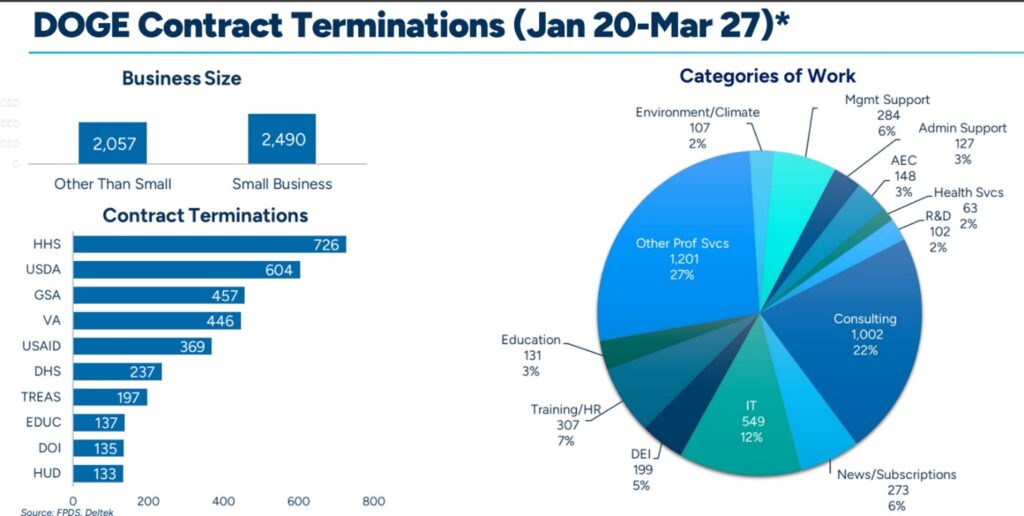
DOGE Contract Terminations Jan 20 – March 27 *data from GovWin
Download Whitepaper: Navigating the Current US Economy – Insider Tips for Federal Contractors
Why Federal Contractors Are Vulnerable to DOGE Cancelled Contracts
Federal contractors are inherently exposed to shifts in political and administrative priorities. The current wave of DOGE Cancelled Contracts has highlighted these vulnerabilities:
- Overreliance on Multi-Year Contracts: Many firms structure budgets, teams, and forecasts around long-term awards—making early terminations financially disruptive.
- Minimal Advance Warning: DOGE’s approach has been swift. In many cases, contractors receive short notice, with limited transparency around cancellation rationale.
- Policy Overhaul: Cost-cutting and mission alignment now trump relationship history or past performance.
However, it’s essential to understand that DOGE does not act alone. The cancellation process starts within agencies. Agencies conduct audits of active contracts to identify those that do not directly support mission-critical needs. Findings are shared with DOGE for validation under government-wide efficiency guidelines. Agencies, not DOGE, terminate contracts. Contracting Officers initiate formal actions and notify vendors.
How to Protect Your Federal Contracting Business From DOGE Cancelled Contracts
Inclusion on the DOGE “contract termination” list does not mean the contract (or task, BPA, BPA call, OTA, etc.) was actually terminated. Observed actions:
- Full termination – the work falls under targeted areas, such as DEI, consulting, climate, etc.
- Partial termination – some of the work or language is associated with an EO (e.g., removing DEI language from a contract).
- Close out – the item already expired/ordering period ended.
- Unknown – there is no modification item that ties back to reasoning from the DOGE list.
These adjustments may still impact revenue and staffing, but they also offer a chance to remain engaged with the agency while demonstrating flexibility and value.
Utilize Force Majeure and Termination Clauses:
Now is the time to revisit the fine print of your federal contracts. Force Majeure clauses—typically reserved for natural disasters or unforeseen circumstances—may provide room for negotiation or relief, especially if changes stem from government-wide policy shifts. Also, understand your rights under FAR clauses related to Termination for Convenience or Termination for Default.
Monitor Legal Challenges and Policy Pushback:
Some of DOGE’s more aggressive measures are being met with legal challenges from industry groups and congressional oversight. While not all will result in reversals, they may delay enforcement or soften implementation, especially for smaller firms and essential service providers.
Also Read: DOGE and Government Contracting: What Contractors Need to Know
5 Tips to Navigate the Current Scenario of DOGE Cancelled Contracts
The DOGE-driven contracting environment may be unpredictable—but with the right positioning, contractors can stay protected and even find new paths to growth.
Understand Termination Legal Frameworks & Maintain Communication:
Proactively engage with Contracting Officers to negotiate modified scopes or delivery models after contract cancellations, leveraging legal knowledge to preserve work opportunities. Collaborate with legal counsel to identify contracts eligible for compensation or protection under DOGE-related termination clauses. Clarify project relevance to agency priorities during discussions, propose cost-effective alternatives, and emphasize deliverables aligned with current missions.
Diversify into Resilient Sectors:
Prioritize growth in defense, cybersecurity, AI, IT modernization, and border security—areas aligned with current administration priorities and less vulnerable to budget cuts.
Leverage Agile Acquisition Pathways:
Pursue innovation-focused mechanisms like Other Transaction Authorities (OTAs), Commercial Solutions Openings (CSOs), and SBIR/STTR programs to bypass bureaucratic delays and access emerging opportunities.
Strengthen Financial & Proposal Strategies:
Reassess financial resilience, invest in compliance infrastructure, and emphasize cost-efficiency narratives in proposals to align with federal budgetary constraints.
Adopt Technology for Risk & Opportunity Forecasting:
Implement tools to track contractual risks, monitor market shifts, and predict emerging demand, enabling proactive adjustments to dynamic contracting environments. Stay informed through credible sources (e.g., G2Xchange’s DOGE Tracker, Fed Gov Today) to anticipate policy changes and strategically pivot.
Preparing for What’s Next in Federal Contracting
As DOGE Cancelled Contracts continue reshaping the federal landscape, the most resilient contractors will be those that balance situational awareness with forward-thinking strategy.
First, understand the legal boundaries—know what your contracts allow under FAR and how terminations are processed. Stay in close, proactive communication with your Contracting Officers; many contracts may see scope adjustments instead of outright termination. Strengthen internal processes for compliance and reporting and emphasize cost-efficiency and performance in every proposal.
To stay competitive long-term, diversify your customer base and consider expanding into high-priority domains aligned with the Trump 2025 agenda—such as defense, cybersecurity, AI, and border security. Leverage flexible acquisition pathways like OTAs, CSOs, and SBIR/STTR programs to reduce dependence on traditional contract vehicles. In addition, digital tools for real-time risk assessment, opportunity tracking, and performance monitoring should be adopted.
DOGE has made one thing clear: the future of government contracting will reward agility, transparency, and alignment with mission outcomes. By preparing now, contractors can not only survive this shift—but lead through it.
At iQuasar, we help federal contractors adapt to change with confidence. From identifying stable opportunity pipelines to developing winning proposals, refining compliance strategies, and building resilient business models—we partner with you through every step of the government procurement lifecycle.