New York has never treated its MWBE program as a soft commitment. Article 15-A of the Executive Law has always carried real enforcement weight binding on state agencies, public authorities, and every entity touching public procurement dollars. The most recent legislative budget made one thing unmistakably clear: this framework is not winding down. New York has extended Article 15-A through July 1, 2028, locking MWBE utilization in as a permanent feature of state contracting. For certified firms and their partners, that stability matters. The rules are set. The question is whether your firm is ready to compete in the space the legislature has created.
What the $1.5 Million Threshold Actually Changes
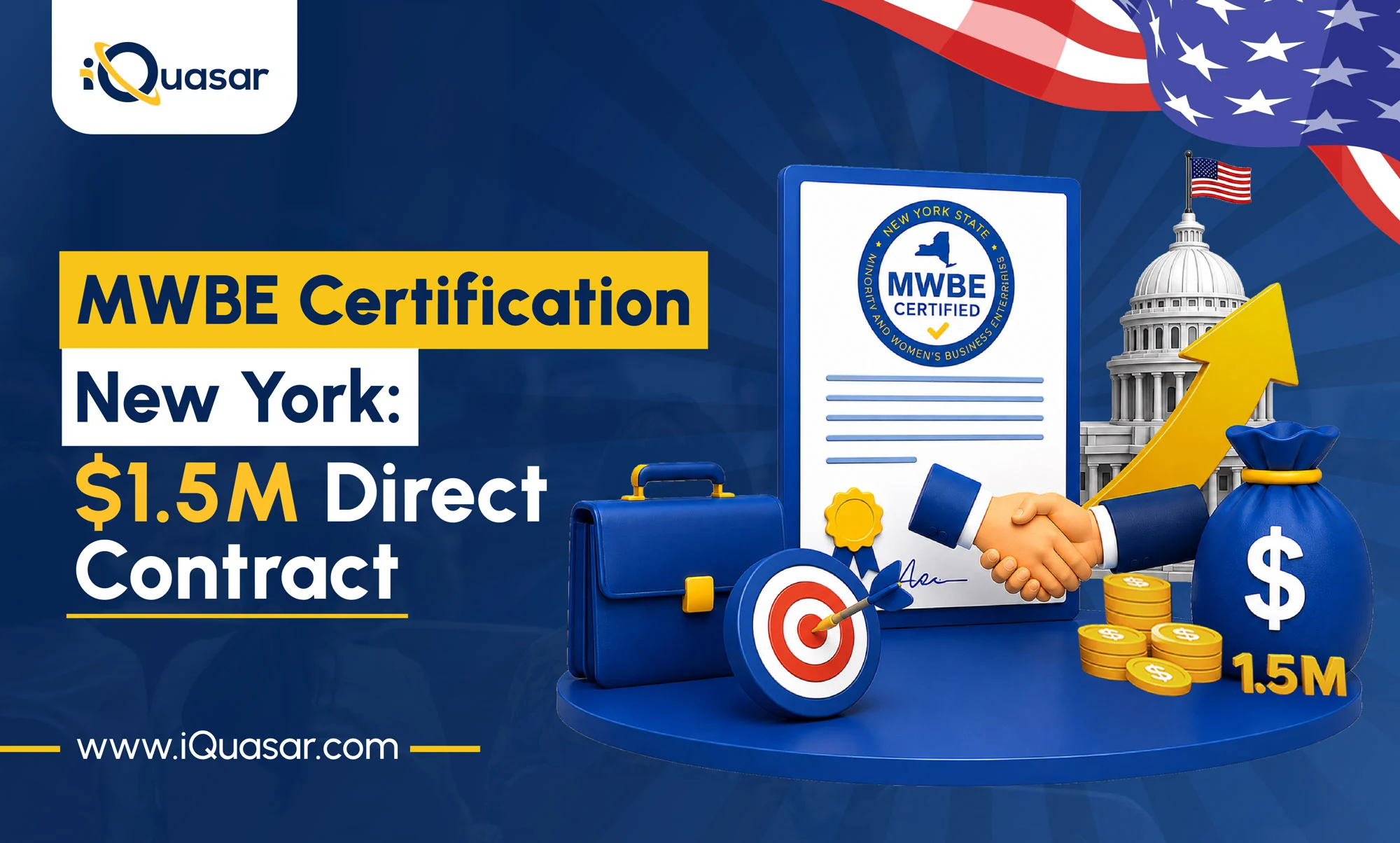
The most significant shift in this legislative cycle is the doubling of the statewide discretionary purchasing threshold from $750,000 to $1.5 million. State agencies and public authorities can now award contracts directly to certified MWBEs up to that ceiling, without running a formal competitive bid.
Think about what competitive bidding demands: public advertisement, submission windows, evaluation panels, protest periods, and timelines that routinely run several months. That process creates structural friction that puts smaller certified firms at a disadvantage. The discretionary lane removes that friction entirely.
An agency with a utilization gap can now route up to $1.5 million directly to a certified firm. No public solicitation required. No open competition. For firms with the right positioning, this opens a contract channel that simply did not exist at scale under the old threshold.
The New York State Office of General Services maintains the certified business directory and discretionary purchasing guidance for firms in this space.
The Eligibility Standards Are Rigorous and Continuous
Certification unlocks this market — but keeping it requires ongoing work. New York’s eligibility framework is not a one-time screen. The state monitors compliance through reporting cycles and periodic audits.
Firms must average fewer than 300 employees across four consecutive quarters. That figure must stay accurate well beyond the application date. The business must also show at least one full year of continuous operations before certifying. This requirement exists to screen out vehicles created solely to capture procurement preferences.
The personal net worth cap on the diverse owner sits at $15 million. The state excludes the owner’s home equity and the value of the certified business from that calculation. The intent is clear: the program targets genuinely disadvantaged owners, not wealthy individuals using diverse structures as a pass-through.
New York State Executive Law Article 15-A gives the Division of Minority and Women’s Business Development authority to investigate, audit, and decertify firms that fall out of compliance. Certification is an active status. It requires accurate disclosures, current filings, and real adherence to ownership and control standards at all times.
Enforcement Is Forensic, Not Procedural
New York’s compliance environment has become significantly more rigorous. State and municipal buyers now face strict reporting rules on MWBE participation rates. That pressure has driven deeper, more technical audits of corporate structures across the state.
Regulators are actively targeting front companies. These are arrangements where a certified firm appears on a contract but exercises no real control, performs no substantive work, and carries no financial risk. The state does not treat these as paperwork errors. It treats them as fraud.
The consequences are serious. Firms that misuse certification face contract termination, permanent debarment, civil penalties, and in cases of deliberate misrepresentation, criminal prosecution.
The Commercially Useful Function standard sits at the center of this enforcement push. A certified MWBE must perform a real, defined role in every contract that credits its participation. That means managing staff, directing scope, making procurement decisions, and carrying financial accountability for its portion of the work. Lending a certification while a non-certified prime does the actual work does not meet the CUF standard regardless of what the subcontract document says.
Prime contractors share this risk. The state does not cleanly separate a fraudulent subcontractor from the prime that created the arrangement. Both parties face exposure, and current audits are built to find exactly these structures.
Intelligence-Driven Positioning Is the Competitive Differentiator
Compliance is the floor, not the strategy. The firms that win consistently in New York’s MWBE discretionary market treat procurement as an intelligence discipline. They know which agencies are spending, which offices face utilization pressure, and which NAICS or NIGP codes are underserved in the current cycle.
That intelligence is publicly available. NYS Contract Reporter and the Office of the State Comptroller’s statewide financial data both publish award histories, spending volumes, and agency-level procurement patterns. Firms that study this data before reaching out to an agency arrive with real context. They are not asking for a chance. They are bringing a specific capability to a documented need and agencies under utilization pressure respond to that very differently than they respond to cold outreach.
If your firm wants to build that kind of intelligence foundation, iQuasar’s GovCon360 services support market mapping, capture strategy, and agency engagement across state and local procurement environments. Contact us today to put your certification to work strategically.
Also Read: New York MWBE Certification: Everything You Need to Know
Documentation, Governance, and Sub-Tier Oversight Are Non-Negotiable
Sustaining certification under New York’s current enforcement climate is an operational discipline, not an administrative task. Firms need to treat documentation as a continuous audit-readiness function.
Ownership and control records, operating agreements, bank account authorities, and payroll files must stay current and consistent with what the Division of MWBE has on file. The state’s forensic review process looks specifically for gaps between what a certification filing claims and what internal records actually show. Any discrepancy creates liability the moment an auditor requests documents.
Corporate governance records deserve the same attention. Firms that update these records regularly not just at renewal carry significantly less risk than those whose filings have drifted from operational reality.
Sub-tier compliance requires equal discipline. In teaming or subcontracting arrangements, all parties must document scope delineation, payment flows, and performance accountability clearly. Internal review cycles should catch compliance gaps before an agency audit does. New York’s enforcement apparatus rewards firms that can respond to scrutiny on short notice.
Practical Guidance for Entering the $1.5 Million Direct-Buy Pool
Start by confirming that your certification is current and fully aligned with your internal governance records. Then build a procurement intelligence baseline. Identify which agencies match your service categories, review their utilization histories, and find which offices are actively using discretionary purchasing authority.
When you reach out, lead with specific capability and relevant experience — not just certification status. Certification opens the door. Demonstrated fit wins the contract. Establish a sub-tier compliance tracking process before you need it, so every engagement is audit-ready from day one.
New York’s MWBE framework is one of the most substantive state procurement programs in the country. The extension through 2028 and the new $1.5 million threshold create a real market opportunity. But it rewards firms that prepare early, position strategically, and operate with clean governance.
If your firm is working through New York’s MWBE certification process or wants to compete more effectively in the discretionary market, iQuasar’s certification services team offers end-to-end support — from eligibility and documentation through compliance and contract pursuit. Contact us today to build a certification strategy that holds up under scrutiny and opens the right doors.