The Marketplace for the Acquisition of Professional Services (MAPS) IDIQ is a game-changing contract vehicle that will make professional services more accessible to the United States Army and other government agencies. MAPS is a massive opportunity for companies in the professional services and IT industries, with an estimated contract ceiling of $50 billion. With the goal of increasing efficiency and minimizing effort duplication, this contract combines the advantages of the Responsive Strategic Sourcing for Services (RS3) and Information Technology Enterprise Solutions 3 Services (ITES-3S) contracts. When ITES-3S and RS3 expire in 2027, the U.S. Army will replace them with MAPS, a ten-year acquisition vehicle, as detailed in the U.S. Army’s official announcement.
MAPS is essential because it supports the Army’s continuous digital transformation and Agile acquisition process implementation initiatives. MAPS helps the Army achieve its strategic goals by providing a broad range of services in several areas, such as engineering, cybersecurity, and research & development. This consolidation is a crucial deal for companies looking to contribute to federal projects because it is anticipated to streamline procurement procedures for federal agencies.
Overview of the Latest Amendment
In draft 3 of the Marketplace for the Acquisition of Professional Services (MAPS) RFP, the Army Contracting Command – Aberdeen Proving Ground (ACC-APG) and the Program Executive Office (PEO) Enterprise, Computer Hardware, Enterprise Software, and Solutions (CHESS) program have made substantial modifications to Section L (Instructions, Conditions, and Notices to Offerors) and Section M (Evaluation Factors for Award).
Clarity, evaluation equity, and adherence to changing federal acquisition criteria are the goals of these modifications. To ensure that only eligible offerors move forward in the procurement process, the revisions improve the structure for submitting proposals, modify the evaluation standards, and impose more stringent compliance requirements. The agency aims to remove redundancy, expedite the purchase process, and foster a more transparent and competitive selection framework by putting these changes into practice.
Below, we detail the key modifications the agency has made in draft 3.
Download Now: Understanding Document MAPS Draft RFP 3
Key Changes in the Amendment
1. Revised Proposal Submission and Formatting Guidelines
- New submission and formatting guidelines: To assure uniformity across all proposals, the agency has implemented new formatting and submission criteria. One of the most noticeable improvements is the standardization of file naming rules, which mandates that offerors use specific labels for every document type and attachment. This streamlines the evaluation process and guarantees consistency in submissions.
- Modified the maximum page limits for proposal volumes: The agency has changed the maximum page restrictions for proposal volumes, especially for the technical response sections. This modification encourages offerors to submit well-organized, succinct, and unambiguous proposals free of superfluous material that could impair the effectiveness of the evaluation process. In order to give the required information within the allotted restrictions, offerors must now carefully monitor how many pages they use.
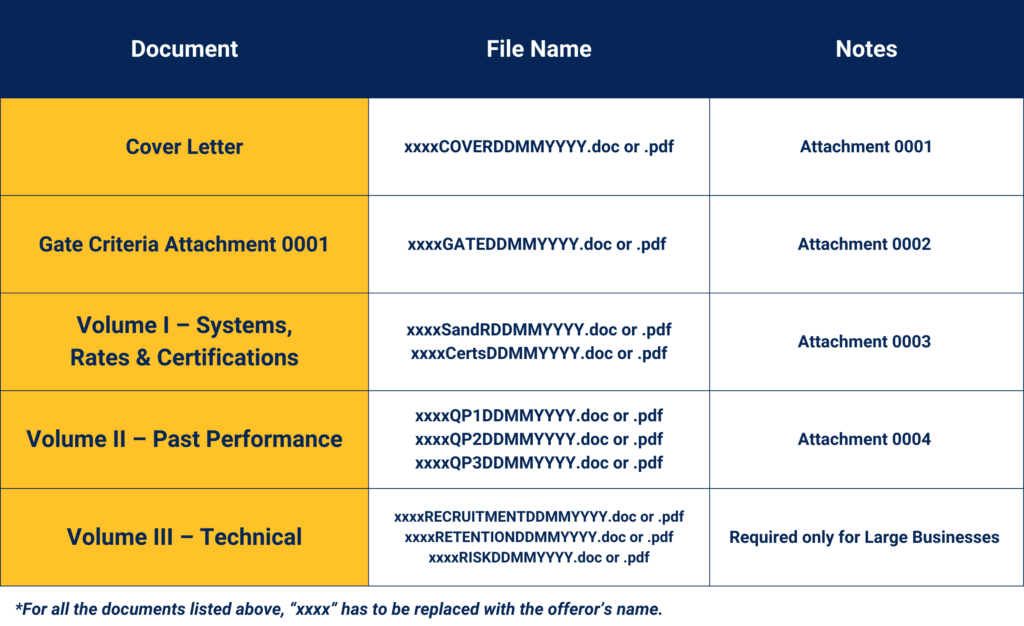
- Proposal Submission: The requirement that offerors register on the CHESS Portal prior to submitting offers is another crucial procedural reform. This step ensures that only verified vendors take part in the solicitation process, improves traceability, and strengthens security. In order to further demonstrate the agency’s dedication to stable contracts and vendor responsibility, proposals must also be valid for at least 180 calendar days after the date of submission.
2. Updates to Domain Classification and NAICS Codes
- NAICS Classification: Under the MAPS contract, the agency updated the NAICS code classification to reflect service categories and industry norms better. These changes impact offerors applying in the domains of Research, Development, Testing, and Evaluation (RDT&E) and Management and Advisory Services.

These modifications ensure that vendors applying under each domain meet the necessary requirements and that offerors are assessed in accordance with the most current industry standards. Offerors should thoroughly review these modifications to ensure that their prior performance and skills match the revised classifications.
3. Strengthened Gate Criteria for Offeror Eligibility
- Facility Clearance: To improve compliance so that only eligible vendors advance in the review process, the agency has strengthened the Gate Criteria. Offerors are required to submit more thorough evidence proving their facility clearance status under draft 3. The revised criteria enforce more stringent verification procedures, ensuring that only vendors with legitimate, active clearances are taken into consideration, even though a Secret-level clearance was previously necessary as well.
- Small Business Certifications: The agency has clarified the requirements for Small Business Certification, especially for socioeconomic groups like Woman-Owned Small Businesses (WOSB), HUBZone, and 8(a). To confirm their status and eligibility for these set-aside possibilities, offerors are now required to provide particular supporting paperwork.
- ISO and Cybersecurity Certifications: ISO and cybersecurity certifications represent yet another significant improvement. Although CMMC Level 2 or higher and ISO 9001:2013 or ISO 9001:2015 are still required, the verification procedure has been improved to call for more evidence of conformity. The agency has explicitly included ISO/IEC 27001:2022 as a key compliance benchmark, further reinforcing cybersecurity and data protection standards. To attest to their compliance with these requirements, offerors must provide documentation from an authorized certifying organization.
4. Adjustments to Proposal Evaluation Factors
- CPARS Ratings: To ensure a more organized and open evaluation process, the agency has improved the standards by which proposals are evaluated. The increased focus on CPARS ratings from the previous three years, which enables evaluators to evaluate each offeror’s current and pertinent performance, is among the most significant changes. This ensures that suppliers with proven track records of winning government contracts are given precedence over those with weak or out-of-date performance histories.
- Scoring Model: For rewarding vendors that have completed high-value contracts, the agency has modified the scoring model to account for prior performance. The agency’s emphasis on experience managing large-scale government contracts will be strengthened by awarding extra points to offerors who submit eligible projects with contract values above $50 million.
- Evaluation Process: The agency has implemented new standards for evaluating recruitment and retention tactics. Now, offerors have to show that they can keep a steady workforce for the duration of the contract. The ability of an offeror to effectively acquire, train, and retain staff in order to satisfy performance standards will be given more weight during the evaluation process.
5. Enhanced Past Performance and Tie-Breaking Rules
- Past Performance: With tighter rules on how qualifying projects (QPs) are judged, past performance is now given more weight when awarding contracts. To be considered, offerors must submit a minimum of one project with a contract value of $2 million or more; projects that surpass this amount will receive extra points.
To ensure impartial and equitable selection in the event of a tie between offerors, the agency has developed a three-tiered tie-breaking procedure. Priorities under the new tie-breaking regulations are:
- Offerors with the highest percentage of “Exceptional” CPARS ratings over the past three years.
- Offerors with the highest percentage of “Very Good” CPARS ratings over the same period.
- Small businesses over large businesses, to promote small business participation and compliance with federal set-aside goals.
These refinements ensure that contract awards are based on proven performance, reliability, and alignment with government priorities.
6. More Stringent Risk Management and Compliance Measures
- Risk Management: To reduce the risks related to contract execution, the agency has implemented a more thorough risk management structure. Offerors are now required to present comprehensive risk assessment plans that specify how they will recognize, manage, and minimize risks over the course of the contract.
- Compliance with federal cybersecurity and acquisition risk standards: Organizational Conflict of Interest (OCI) rules are governed by FAR Subpart 9.5, which the agency requires offerors to show compliance with. In order to avoid conflicts of interest and ensure that contract performance is carried out impartially and with integrity, offerors must describe their internal policies and controls.
7. Refinements to Evaluation of Systems and Certifications
- Evaluation Criteria: The agency has expanded the evaluation criteria for offeror systems and certifications, ensuring that vendors possess the necessary infrastructure and compliance mechanisms to support federal contracts. Offerors must now provide:
- Proof of a Government-approved accounting system.
- Verification of an approved purchasing system.
- Demonstration of adherence to property management and earned value management systems.
To encourage high security and performance standards, additional points are awarded to offerors with CMMC Level 3 certification and those compliant with ANSI/EIA-748 Earned Value Management Systems standards.
Offerors preparing their proposals should carefully review these modifications to ensure full compliance with the latest requirements. By understanding these key changes in Sections L & M, vendors can position themselves more competitively and improve their chances of securing a contract under the MAPS program.
Impact on Contractors & Industry
By offering a single platform for obtaining expert services, the MAPS IDIQ will significantly affect contractors and the sector. It also provides chances for small companies to take part in federal initiatives. To be competitive in this market, contractors must make sure they match the gate criteria, which include secure data methods and previous performance documentation. Technical services, RDT&E services, management and consulting services, and high-level IT services are among the many services covered under the contract, as detailed in the latest updates on the MAPS solicitation.
Register for Webinar: Winning with MAPS – The Army’s $50B Professional Services Opportunity
Next Steps: How to Prepare & Stay Updated
To stay informed and well-prepared for the MAPS IDIQ opportunity, contractors should take the following steps:
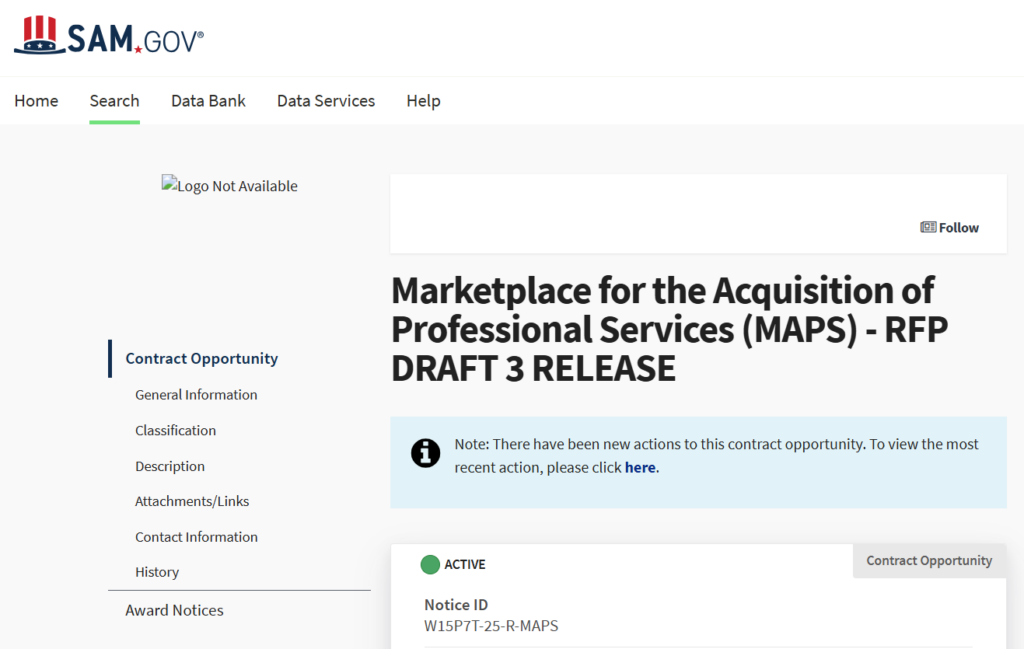
- Monitor SAM.gov & Industry Notices – Regularly check System for Award Management (SAM.gov) for RFP drafts, submission requirements, and updates. Attend industry days and webinars to gain insights into evaluation criteria and acquisition timelines.
- Conduct a Capability Gap Analysis – Assess internal strengths and identify any gaps in capabilities, past performance, or compliance requirements. Develop a strategy to address these gaps before solicitation release.
- Form Strategic Partnerships – Identify and engage potential teaming partners or subcontractors with complementary expertise to strengthen your offering and meet all RFP requirements.
- Prepare Required Documentation & Certifications – Ensure all mandatory registrations (e.g., SAM.gov, CMMC and ISO certifications etc.) and compliance documents (e.g., accounting systems, facility clearances) are up to date and aligned with MAPS IDIQ requirements.
- Develop a Proposal Readiness Plan – Establish a timeline for gathering past performance, key personnel resumes, technical solutions, and pricing strategies to streamline proposal development once the final RFP is released.
- Engage with the Government & Provide Feedback – Participate in government engagement opportunities, respond to draft RFPs, and submit questions or comments through the designated channels to help shape the final solicitation.
Taking these steps will position contractors for a competitive and compliant submission when the MAPS IDIQ solicitation is officially released.
If you’re interested in navigating the complexities of the MAPS IDIQ and ensuring your business is well-positioned to secure this contract, consider reaching out to iQuasar. To increase your chances of winning, our team of professionals can assist you in determining your eligibility, creating a unique proposal approach, and producing a superior response. Get in touch with us right now to find out how we can help you succeed.