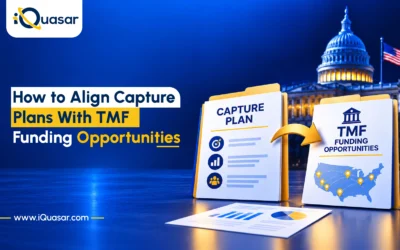
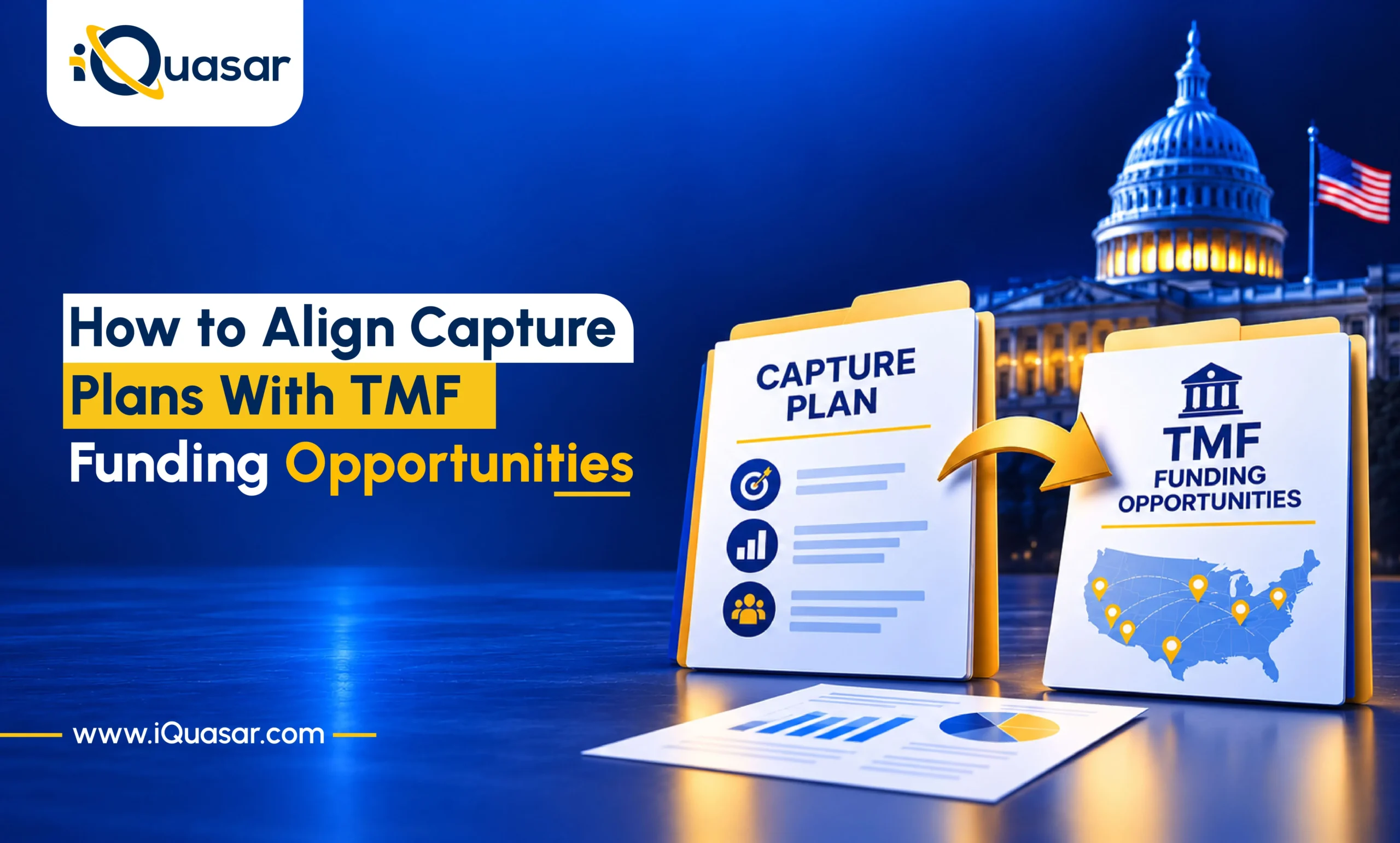
The Technology Modernization Fund (TMF) reports more than $1.1 billion invested across 74 projects at 34 federal agencies as of October 2026. A July 23, 2026, review by the Government Accountability Office (GAO) adds a second signal. Agencies are now expected to show measurable value from these investments. For government contractors, that combination reshapes how federal IT modernization opportunities form.
However, funding does not equal a contract. In this blog, we explore how the TMF funding opportunities can inform a disciplined capture strategy. We also cover what is changing in federal modernization and how to prepare before requirements become solicitations.
What Is Changing in Federal IT Modernization?
Federal IT modernization is shifting toward funded project pipelines, legacy replacement, AI adoption, and measurable results. Each shift affects when and how contractors can engage.
1. Modernization Funding Is Creating New Project Pipelines
The official TMF investment portfolio now spans cloud, cybersecurity, zero trust, data modernization, digital services, and mission applications. Each funded project signals a defined agency need. Further, each one may create supporting work in architecture, integration, data migration, testing, change management, and sustainment.
Execution paths still vary. A TMF-funded initiative may run through an existing contract, an interagency agreement, government personnel, a modification, or a new procurement. GAO’s review points to a competitive environment. It found that 154 of 177 (87%) reviewed TMF-related contract actions were competitively awarded. Those actions represented about $713.1 million, or 96%, of the funding reviewed. That finding applies only to GAO’s review period and is not a forecast. Even so, firms without early positioning should expect to compete rather than inherit work.
2. Agencies Are Targeting Legacy Technology Challenges
Legacy systems remain the core driver. The Department of Agriculture’s payroll modernization effort began in September 2026. It replaces legacy payroll technology with a cloud-based platform that uses automation and AI. Projects like this show that agencies fund replacement and risk reduction, not only new capability.
For contractors, the cause and effect is direct. Aging systems create security exposure, maintenance burden, and mission constraints. Funding aimed at those problems favors suppliers that can show how they retire risk, migrate data safely, and keep operations running during transition. Transition planning and continuity of operations therefore deserve as much attention as the target architecture.
3. Emerging Technologies Are Entering the Modernization Scope
AI is moving from pilot toward program scope. The Department of State’s “Advancing Diplomacy Through Agentic AI” project began in July 2026. It applies secure agentic AI to help desk operations, policy research, and employee-built automated agents under human oversight. Additionally, the 2026 TMF Call for Proposals names AI adoption and permitting technology as priority areas.
The oversight element is notable. Agencies are pairing AI ambition with governance expectations. Contractors should expect evaluators to weigh security controls, data handling, and accountability alongside technical capability. Therefore, “IT modernization” is too broad a label for planning. Each project carries distinct technical, security, and data requirements.
4. Agencies Must Demonstrate Measurable Results
Why does this matter commercially? Because agencies that must prove value will favor contractors who can prove it too.
GAO found that as of June 2025, about $1.03 billion had been invested in 68 unclassified projects. Twenty-four projects are expected to save about $1.06 billion in combined savings. Eleven had realized about $13.5 million. Meanwhile, 37 projects did not expect savings and targeted other benefits, such as reduced security risk. As a result, value now includes risk reduction, compliance, efficiency, and service quality. A proposal that promises only cost savings may miss what the agency is actually measuring.
Adapting Capture Plans to TMF Funding Opportunities
The TMF gives contractors an early view of agency priorities. It rewards teams that qualify signals quickly and prepare evidence before a solicitation exists. A structured capture strategy converts that early view into competitive advantage. The six actions below form its core.
1. Identify Agencies and Programs Likely to Benefit From TMF Funding
Start with the TMF portfolio and the current Call for Proposals. Filter opportunities by agency, mission area, and technology focus, then prioritize organizations where your past performance, contract access, certifications, or clearances already align. Focused targeting helps business development teams concentrate resources on opportunities with the strongest strategic fit.
2. Track TMF Project Announcements Before Requirements Become Solicitations
Continuously monitor new announcements, then validate each signal. Does every funded project lead to a solicitation? No. Compare TMF information with agency strategic plans, budget materials, procurement forecasts, existing vehicles, and SAM.gov notices.
The pathway is a possibility, not a fixed sequence:
Policy direction → Agency Requirement → Modernization Initiative → Potential Funding → Potential Acquisition Activity.
This matters most for small and mid-sized firms. A prime role may be unrealistic on a large initiative. Nevertheless, the same project may offer subcontracting, teaming, or task-order entry points. Early awareness also lets firms respond to sources-sought notices and industry engagement while their input can still shape the requirement.
3. Map TMF Priorities to Your Capabilities
Connect each project’s objective, systems, security needs, and expected outcomes to your solutions. Identify strengths, capability gaps, and areas where teaming partners may be required. Early gap analysis protects bid decisions and strengthens teaming conversations. Partners commit more readily to pursuits with a clear role and a credible timeline. It also avoids the costly pattern of discovering a capability gap after the solicitation is released.
4. Prepare Relevant Past-Performance Examples
Generic IT experience carries limited weight. Select past performance examples that match the agency’s systems, mission, scale, and security environment. Highlight measurable outcomes such as reduced downtime, improved operational efficiency, enhanced cybersecurity, or successful cloud migration. Trace every metric to documented performance. Where your own record is thin, consider whether a teaming partner’s experience closes the gap. Evaluators reward evidence they can verify and discount claims they cannot.
5. Build Proposal Content Around Measurable Modernization Outcomes
Given GAO’s emphasis on demonstrated value, themes should move from “we can modernize the system” to “our approach solves the stated problem and improves mission outcomes.” Build reusable narratives, solution components, résumés, compliance references, and graphics around the areas you pursue. Maintaining tailored narratives, resumes, compliance matrices, graphics, and solution content in advance enables faster and more effective responses to RFIs, sources-sought notices, and solicitations.
Also Read: GSA Procurement Consolidation: Proposal Strategy Under EO 14240
6. Establish a Capture Plan Before Requirements Are Finalized
A capture strategy should exist before the requirement does. Assign an owner, define qualification criteria, and document customer hypotheses. Additionally, set decision gates for pursue, team, or pass. Schedule reviews that align with the agency’s likely acquisition timeline. Leadership should review these gates against bid-and-proposal budgets. A disciplined pass is as valuable as a win because it preserves resources for stronger pursuits.
7. Treat TMF Funding as a Hypothesis
Strong capture teams treat TMF funding as a hypothesis, not a conclusion. They test it against incumbents, budgets, and contract vehicles. This protects bid-and-proposal spend and keeps subject-matter experts on pursuits with a credible path to award.
In practice, this means asking three questions early. Who holds the current work? Has the agency budgeted for sustainment after the TMF investment ends? Which vehicle can carry the award? Clear answers sharpen the bid decision. Unclear answers signal the need for more customer engagement before committing capital to a pursuit.
Turn TMF Intelligence Into Proposal Readiness
The TMF portfolio shows where federal agencies are directing their modernization efforts, while GAO’s July 23, 2026 assessment indicates that agencies are expected to demonstrate value from those investments. That makes early capture discipline increasingly important for contractors that want to compete for modernization work.
The opportunity is not to predict which funded projects will become contracts. It is to identify credible modernization needs, understand the potential acquisition environment, and prepare evidence before the requirement becomes a solicitation.
For contractors that need additional capacity to connect capture intelligence with compliant, outcome-focused proposals, iQuasar’s Proposal Development Services can support opportunity research, capture support, proposal development, compliance analysis, technical writing, reviews, and submission. Contact us today to streamline your capture strategy and build winning proposal submissions.