Latest Update:
September 24, 2026: FAS is revising the MAS Refresh 33 Interact Notice to integrate additional changes to the Information Technology large category, including the introduction of three (3) new subgroups under SIN 517312 Wireless Nobility Solutions.
Information Technology (F)
a. Telecommunications Subcategory (F09)
i. Incorporate the following three new subgroups for SIN 517312 Wireless Mobility Solutions. New offerors or existing FSS Contractors may request placement under any of these new SIN subgroups. Placement is subject to technical review and approval by GSA.
Managed Mobility Services – Provides end-to-end lifecycle management services for enterprise mobile devices and wireless endpoints, including:
● Device procurement, provisioning, activation, suspension, transfer, and deactivation.
● Mobile Device Management (MDM), Mobile Application Management (MAM), Mobile Content Management (MCM), Mobile Threat Protection (MTP) and Unified Endpoint Management (UEM).
● Security policy enforcement, operating system and application updates, compliance monitoring, remote diagnostics, troubleshooting, and remote lock/wipe capabilities.
● Asset inventory, device refresh, logistics, and lifecycle replacement.
● Support for Government-Furnished Equipment (GFE), Corporate-Owned Personally Enabled (COPE), Corporate-Owned Business Only (COBO), and Bring Your Own Device (BYOD), where authorized.
Managed Wireless Service – Provides end-to-end management of commercial wireless connectivity and related services for users, facilities, locations, and connected devices. The service covers cellular, Wi-Fi, Li-Fi, Fixed Wireless Access, private wireless networks, satellite-enabled wireless communications, and other commercially available wireless technologies used for local, wide-area, primary, temporary, supplemental, or backup connectivity. The service includes provisioning, activation, installation, configuration, monitoring, security policy implementation, performance optimization, troubleshooting, reporting, and lifecycle management to support secure, resilient, and scalable wireless communications across ordering activity designated environments. Enterprise Access.
Connectivity, and Transport Services- Provides enterprise-grade WAN, MAN, and LAN environments, enabling secure access to the Internet, cloud environments, and private networks through Carrier Ethernet, broadband, fiber, optical transport, and managed wireless, satellite, or Wi-Fi / Li-Fi services.
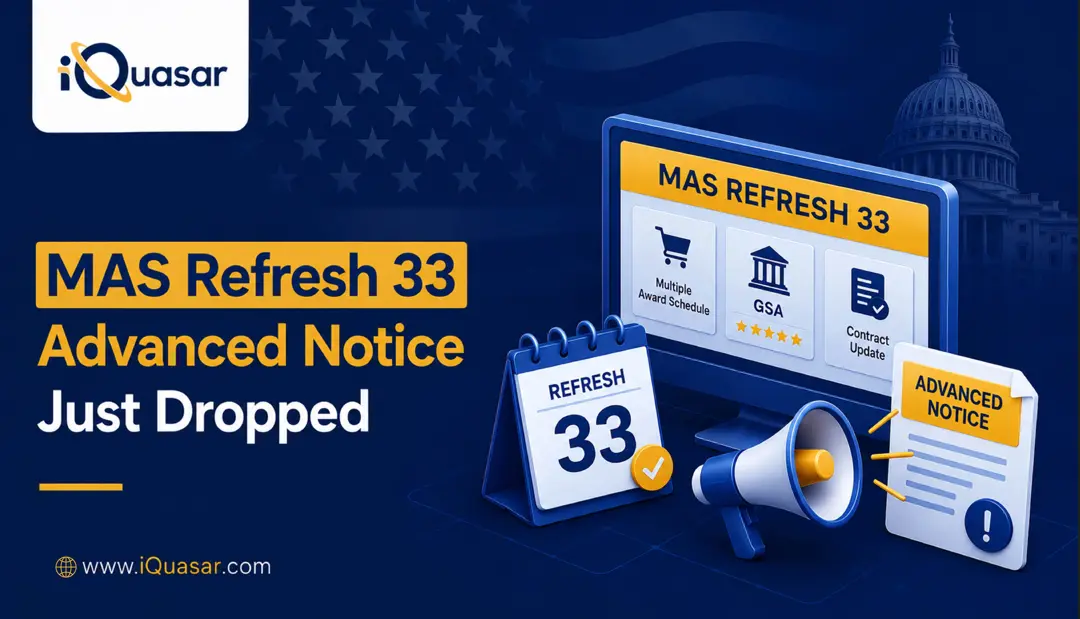
September 11, 2026: The Federal Acquisition Service (FAS) is rescheduling GSA Multiple Award Schedule (MAS) Refresh 33 to October 2026. The delay is intended to ensure that updates are fully and appropriately integrated ahead of release. Contract holders and offerors should continue monitoring GSA’s official channels for the confirmed release date.
August 21, 2026: FAS has updated the Refresh 33 Interact Notice to draw attention to Class Deviation CD-2026-03, which eliminates the Trade Agreements Act (TAA) exemption previously available to Federal Prison Industries, Inc. (FPI) and AbilityOne Participating Nonprofit Agencies. See the new section below for details.
GSA is anticipating MAS Refresh 33 in September 2026, with several updates that will affect both current contractors and new offerors. The upcoming refresh focuses on strengthening supply chain security, expanding FASt Lane eligibility, clarifying product substitution requirements, and making targeted updates across several MAS Large Categories and SINs.
Below is a practical overview of the changes contractors should be aware of.
Key Changes Across the MAS Solicitation
1. New Supply Chain Security Requirements
One of the more significant changes comes through GSA’s Revolutionary GSAR Overhaul (RGO) initiative. GSA is incorporating existing supply chain security requirements into the acquisition framework through a new provision and clause under GSAR Part 540.
The goal is to establish a more consistent approach to supply chain security across GSA acquisitions and strengthen protections against supply chain risks.
For contractors, this means supply chain security requirements will become more formally integrated into the MAS contracting process. Companies should review their current products, services, suppliers, and internal controls to ensure they can meet the applicable requirements.
2. FASt Lane Eligibility Expands to All MAS Large Categories
GSA is expanding FASt Lane eligibility beyond the IT Category.
Under Refresh 33, offerors across any MAS Large Category may be considered for FASt Lane when they can demonstrate a validated federal requirement supported by agency sponsorship or documented customer demand.
However, there is an important distinction:
- For categories outside IT, FASt Lane eligibility will generally apply to offers only.
- FASt Lane modification processes will remain limited to the IT Category and designated FASt Lane initiatives.
- Existing FASt Lane participation requirements will continue to apply.
- Startup Springboard will remain limited to contractors approved for FASt Lane.
In practical terms, this gives contractors in other Large Categories an additional path to pursue accelerated consideration when there is a legitimate and verifiable federal customer need.
3. New Product Substitution Requirement
GSA is also adding a new requirement to the General Information section of each Large Category solicitation.
Contractors may not substitute a product without prior written approval from the buyer. Any approved substitute must already be listed on the MAS contract and generally cannot be priced higher than the original item.
A more expensive alternative may be used only when the customer explicitly approves the higher-priced, MAS-listed product.
Contractors offering products should therefore pay close attention to their product catalogs and substitution practices.
4. Updated SCLS Wage Determinations
The refresh will also incorporate the most recent Service Contract Labor Standards (SCLS) wage determinations.
Contractors with SCLS-covered labor categories should review their applicable wage determinations and ensure their pricing and labor category information remain compliant.
Selected Large Category Updates
Refresh 33 also includes targeted changes to specific Large Categories and SINs. Rather than changing the entire scope of these categories, many of the updates are intended to clarify existing requirements or expand clearly defined areas of coverage.
1. Facilities – Roofing Services
Under the Facilities Large Category, GSA is revising SIN 238160 – Roofing Products and Services Solutions.
The revised description makes it clearer that the SIN can be used for:
- Roofing materials only
- Roofing services/labor only
- A combination of materials and services
An important clarification is that standalone roofing services are within scope.
2. Facilities – Temporary and Prefabricated Structures
GSA is also expanding and clarifying SIN 532490P – Lease/Rental of Pre-Engineered/Prefabricated Buildings and Structures.
The updated scope will cover a broader range of temporary structures and clarify the availability of turnkey temporary facility and base camp solutions.
Integrated support services, such as laundry, housekeeping, and restroom/shower servicing, may also be included if they are directly related to the leased or rented temporary structures.
However, food services and dining operations will generally need to be part of a complete turnkey base camp solution rather than offered independently under this SIN.
3. Miscellaneous – Installation and Site Preparation
For SIN 238910 – Installation and Site Preparation Services, GSA is clarifying the treatment of ancillary products, incidental services, and equipment rentals.
These items must directly support the awarded installation or site preparation services and cannot be used as standalone offerings unrelated to the primary SIN requirement.
4. Travel – Employee Relocation
GSA is proposing updates to the SOW requirements for SIN 531 – Employee Relocation Solution.
The changes are intended to align move management requirements with updated federal audit and payment standards for household goods relocation services.
Contractors providing relocation services should review the revised SOW requirements when the final refresh is released.
5. Travel – Travel Agent Services
GSA is also updating SIN 561510 – Travel Agent Services, including changes to both the Statement of Work and Price Proposal Template.
Among the changes are updates related to Transactional Data Reporting, VIP services, service-level requirements, and explanatory codes. The PPT will also include changes affecting Travel Management Companies (TMCs), including a new tab for eOffers and certain mandatory ancillary CLINs.
What Contractors Should Do Now
Although Refresh 33 is still anticipated for September 2026, contractors can begin preparing now.
A few practical steps include:
- Review your current MAS contract and applicable SINs.
- Check whether your products or services could be affected by the new supply chain security requirements.
- Review product substitution practices and catalog information.
- Review applicable SCLS wage determinations if you have covered labor categories.
- If you are pursuing FASt Lane, determine whether you can document a qualifying federal customer requirement.
- Review any SOW or PPT changes applicable to your specific SIN.
- Monitor the final Refresh 33 solicitation and mass modification once released.
Also Read: GSA MAS Pricing 2.0: Key Changes for Contractors
Key Takeaways
Refresh 33 is not a routine administrative update. The AI safeguarding clause that GSA has been deferring since early 2026 is now the most likely candidate for formal incorporation. Enforcement of TDR compliance is expected to tighten. SIN-level changes will require portfolio review. The mass modification acceptance window may again be as short as 30 days. Contractors that engage with the advanced notice now, reading it, commenting where needed, and preparing their internal compliance infrastructure will move through the modification acceptance period without disruption. Those that wait will not.
GSA program updates are published at vsc.gsa.gov, and questions can be directed to [email protected].
For MAS contractors who need hands-on support reviewing Refresh 33 changes, managing mass modification acceptance, navigating AI clause compliance, or keeping their GSA schedule current through an accelerating reform cycle, iQuasar’s GSA MAS team provides end-to-end contract administration support across every refresh. Contact us today before the mass mod clock starts running.