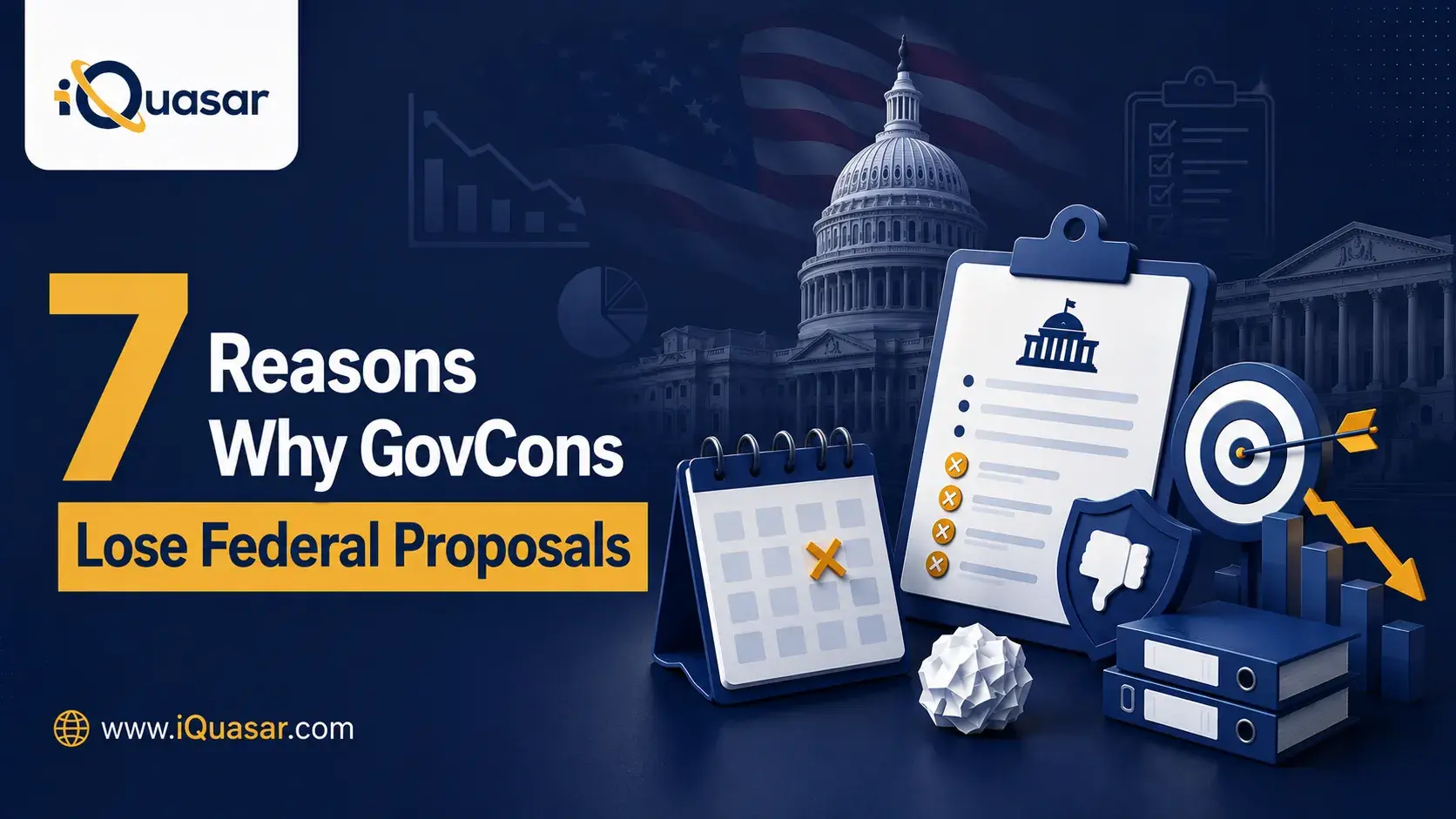
Losing a federal proposal hurts. Losing ten in a row is demoralizing enough to make firms question whether government contracting is worth pursuing at all. The reality is that the majority of the first-time federal contractors do not lose because they lack capability. They lose because they repeatedly make the same avoidable government proposal-writing mistakes mistakes that experienced contractors solved years ago through disciplined processes, early preparation, and honest self-assessment.
Understanding exactly where proposals fail is the first step toward building a submission approach that actually wins.
Reason 1: Poor Opportunity Qualification
Most of the proposals that are lost should never have been submitted in the first place. The decision to pursue an opportunity is the most consequential choice in the entire proposal process, and the majority of first-time contractors make it carelessly. They chase opportunities because the scope sounds familiar, the deadline seems manageable, or someone in leadership saw the solicitation and got excited. None of those are valid qualification criteria.
Winning contractors ask harder questions before committing. Does the NAICS code match our registered capabilities? Do we have an existing relationship with this customer? Does the contract size align with our capacity to perform? Is there an incumbent, and do we have a credible path to displace them? A “no” on any of those questions is a signal to walk away. Pursuing the wrong opportunity wastes resources that could have gone into a pursuit you could actually win. iQuasar’s capture management services help firms build qualification frameworks that filter opportunities before the proposal clock starts running.
Reason 2: No Capture Strategy
A government contract proposal written without prior capture work is a cold letter to a stranger. Agencies award contracts to firms they understand, trust, and believe can perform. That confidence does not develop during the proposal evaluation period. It develops over months of pre-solicitation engagement, customer meetings, industry days, sources-sought responses, and consistent market presence.
Capture strategy is the work that happens before the RFP drops. It includes direct customer engagement to understand mission priorities, incumbent analysis to identify where the current contractor is vulnerable, and positioning work to ensure your firm’s differentiators are visible before the solicitation releases. Firms that skip this step submit proposals that are technically responsive but strategically blind, clearly because they are unaware of what the customer actually values.
Reason 3: The Proposal Starts Too Late
The single most common mechanical failure in government proposal writing is a compressed timeline. The solicitation releases, leadership decides to pursue, and the team scrambles to write, review, and submit a competitive response in a fraction of the time it actually requires. The result is a proposal that is incomplete, inconsistently written, and reviewed under deadline pressure rather than evaluated against a compliance matrix.
Winning contractors operate on a reverse timeline, working backward from the submission deadline to establish when each section must be drafted, reviewed, and finalized. Kickoff happens within 24 hours of RFP release. Writing assignments go out immediately. Color team reviews are scheduled before writing begins, not added to the calendar as an afterthought. Every day lost at the front of the proposal timeline is a day of review time lost at the back.
Reason 4: Weak Win Themes
Review enough unsuccessful federal proposals, and a common pattern quickly emerges. Generic statements such as “We are committed to delivering quality services” or “Our experienced team will exceed your expectations” appear repeatedly. While well-intentioned, these claims offer little value to evaluators because they lack evidence, differentiation, and relevance to the agency’s specific requirements. Experienced evaluators recognize this type of generic language immediately.
Win themes are specific, differentiated, and tied directly to what the agency cares about. They answer one question the evaluator always asks: why this firm and not the others? A strong win theme does not assert quality; it demonstrates it through a specific capability, a relevant outcome, or a named approach that competitors cannot credibly claim. If your government contract proposal sounds like every other proposal in the competitive range, it will be evaluated like every other proposal in the competitive range.
Reason 5: Compliance Errors
Federal proposals clear a compliance check before they reach merit evaluation. A proposal that omits a required section, exceeds a page limit, uses the wrong font size, or omits a mandatory attachment can be eliminated before a single evaluator reads a word of the technical approach. Compliance is not a secondary concern; it is the first gate, and first-time contractors fail it at a startling rate.
The fix requires discipline. Build a compliance matrix from Sections L and M of the solicitation before writing begins. Assign every requirement to a section owner. Check compliance before the first draft is complete, again at the red team, and again before final submission. SAM.gov and agency-specific portals publish all submission requirements in detail. These are entirely preventable errors that can disqualify an otherwise strong proposal.
Reason 6: A Weak Executive Summary
The executive summary is the most important section in a government contract proposal and the one most frequently written last, in the fewest hours available before submission. That is exactly backward. Senior agency leadership reads the executive summary to understand why they should award to your firm. It is not a place for company history, founding dates, or organizational charts.
A strong executive summary leads with the agency’s mission challenge, demonstrates your firm’s understanding of it at a specific, operational level, and articulates clearly what your approach delivers and why it outperforms alternatives. Agencies are less concerned with when your company was founded; what matters for them is whether you can effectively solve their mission challenge. Your executive summary should answer that question clearly within the opening paragraph.
Reason 7: No Proposal Process
First-time contractors treat proposal writing as a writing exercise. Winning contractors treat it as a managed business process with defined roles, scheduled milestones, documented deliverables, and structured reviews. The difference in output quality between those two approaches is not marginal; it is decisive.
A winning proposal process includes a kickoff meeting with all section owners present, a compliance matrix governing the entire effort, color team reviews at defined draft stages, a final compliance check before submission, and a lessons-learned debrief after every award decision. Without that structure, proposal development becomes reactive rather than disciplined. Sections are assigned based on availability instead of expertise, reviews are rushed, and the final submission often falls short of the quality and competitiveness the firms set out to achieve.
How Winning Contractors Operate
The gap between firms that keep losing their initial proposals and those that win consistently is not about capability; it is about process. Winning contractors qualify opportunities before committing resources, and start capture months before the RFP releases. They build compliant proposal architectures before writing begins; they conduct staged reviews early on and often. They write winning themes that differentiate rather than just describe. And treat every submission, win or loss, as data that improves their next pursuit.
Building a winning proposal operation takes time, but strategic firms accelerate the process by adopting proven capture and proposal management practices, establishing disciplined workflows, and leveraging experienced professionals before the next solicitation is released.
iQuasar’s GovCon360 and proposal development teams work with first-time and experienced federal contractors at every stage of the pursuit lifecycle, from opportunity qualification and capture strategy to compliant, compelling proposal development. Whether you’re pursuing your first award or looking to improve win rates, our experts can help you build a proposal process designed for long-term success. Contact us today to build a proposal operation that wins.