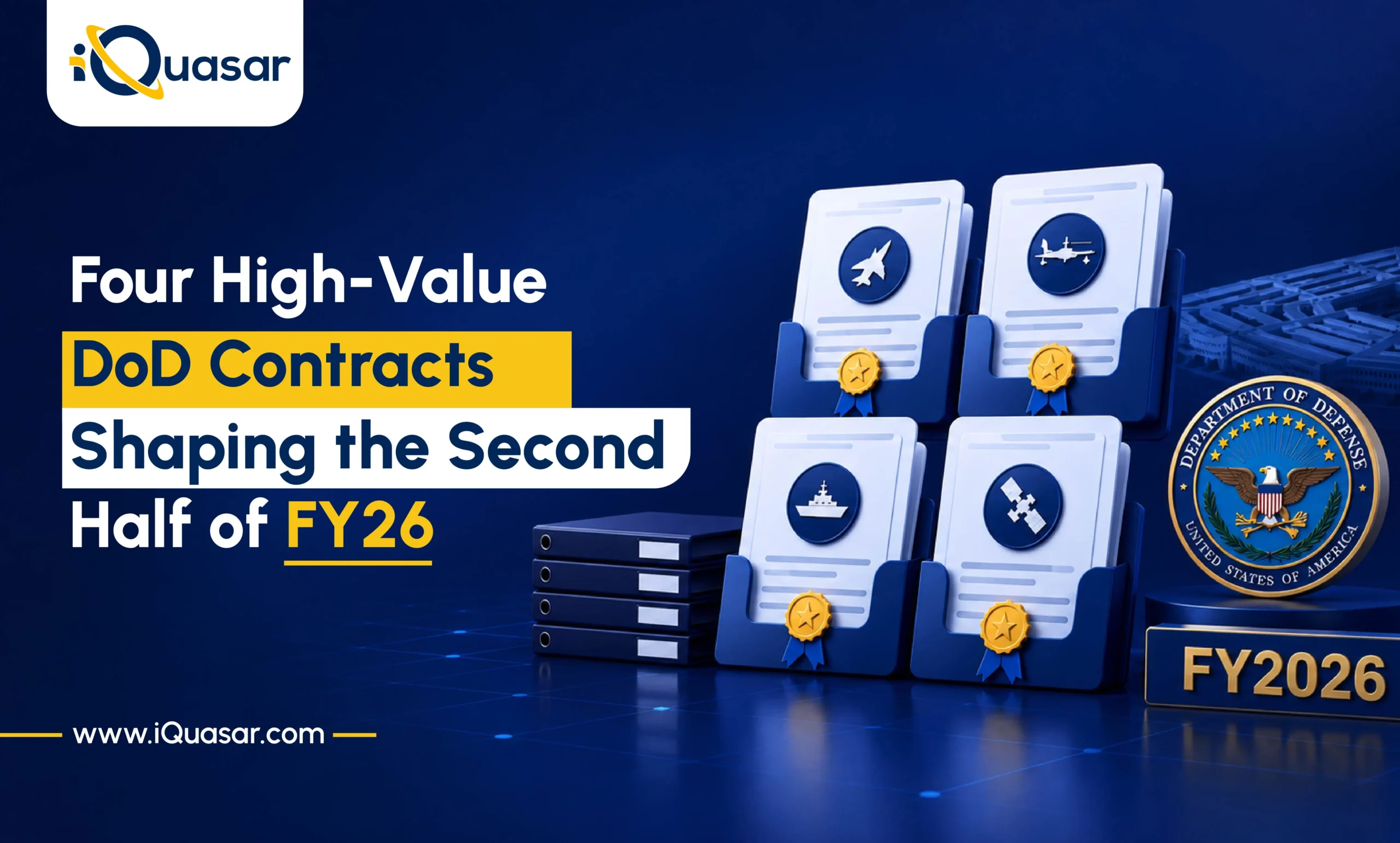
The second half of FY26 is not a typical procurement cycle. Four multi-billion-dollar DoD IDIQ vehicles are converging in the same window Army HR, defense health R&D, Air Force base construction, and utility control systems spanning different agencies, acquisition frameworks, evaluation methodologies, and compliance regimes. Combined ceiling value exceeds $17 billion. Combined performance periods extend a decade or more. For capture managers and BD executives with the right capabilities, this window represents a decade of task order pipeline. For firms that move too slowly or pursue without qualification rigor, it represents a significant resource drain on bids they were never positioned to win. In this blog, we go deep on all four vehicles scope, structure, evaluation mechanics, and the positioning decisions that separate serious competitors from noise in the queue.
The Four Vehicles at a Glance
| Vehicle | Agency | Ceiling | Set-Aside | NAICS | Key Deadline |
|---|---|---|---|---|---|
| Army GEN VI RMAS | ACC-NJ / Army HR Solutions | $1.52B | 100% SB | 541612 | Active pursuit |
| DoD OMNIBUS IV On-Ramp | Defense Health Agency | $10B | 8(a) On-Ramp | 541714 | Active pursuit |
| Tinker AFB MACC | AFSC / Air Force | $950M | Partial SB | 236210 | Sept 11, 2026 |
| USACE UMCS VI | USACE Huntsville | $5.1B | SB Reserve + Unrestricted | 541512 | Sept 17, 2026 |
Each vehicle operates under a distinct acquisition framework. Treating them as interchangeable IDIQ vehicles is the fastest path to a misaligned pursuit strategy.
Vehicle Deep-Dive #1: Army GEN VI RMAS — $1.52B
Scope and Structure
GEN VI RMAS is the Army’s premier HR and recruiting support vehicle. It is a 10-year, 100% Small Business Set-Aside IDIQ managed by the Army Contracting Command New Jersey under Army HR Solutions. Task orders span recruiting and retention support, personnel program management, data analytics, protocol and administrative services, technical writing, event coordination, and public relations support across Army and select DoD components.
This is not an IT vehicle. NAICS 541612 defines the competitive universe Human Resources Consulting Services and firms that attempt to qualify through adjacent IT or professional services experience without documented HR program delivery at comparable scope will face substantive past performance gaps during evaluation.
Critical Compliance Considerations
Two compliance elements require early internal resolution before any Go/No-Go decision:
- Secret Clearance Mandate. Task orders will require cleared personnel at the Secret level. Firms without an existing cleared workforce pipeline face a staffing risk that no proposal narrative can paper over. Clearance transfer timelines and new investigation timelines must be built into every staffing plan.
- FAR 52.219-14 Limitations on Subcontracting. The 50% limitation on subcontracting under this clause means the small business prime must perform at least 50% of the cost of the contract with its own employees. Teaming arrangements that rely on a large subcontractor to deliver the substantive work expose the prime to compliance liability post-award. This is not a theoretical risk it is an active enforcement area.
- On-Ramp/Off-Ramp Structure. The vehicle includes annual off-ramping for underperforming awardees and on-ramping for new entrants. This creates ongoing competitive pressure for base awardees and a recurring entry point for firms that missed the original award window.
Positioning Priority
- Verify that HR program management past performance is documented at federal or large-scale equivalent scope
- Map cleared personnel inventory against anticipated task order requirements before submitting
- Formalize teaming before RFP release the 50% subcontracting rule makes teaming structure a compliance decision, not just a capability decision
Vehicle Deep-Dive #2: DoD OMNIBUS IV 8(a) On-Ramp — $10B
Scope and Structure
OMNIBUS IV is the Defense Health Agency’s flagship medical research and development vehicle. The base vehicle carries a $10 billion ceiling over 10 years. The On-Ramp solicitation targets 8(a)-certified firms, providing a structured entry point for certified small businesses into one of DoD’s highest-value R&D vehicles without competing against the full awardee pool from the original award.
The vehicle is organized around four primary market segments:
- R&D Services – direct research execution across biomedical and military health science domains
- R&D Support Services – program management, data analysis, regulatory coordination, and scientific advisory support
- Regulatory Processes – FDA submission support, human subjects research compliance, vivaria management
- Translational Science – bench-to-bedside research translation, clinical research coordination, and technology transfer
The RFO Regulatory Nuance
This is where the practitioner-level detail matters. Under the Revolutionary FAR Overhaul rules now governing DHA acquisitions, 8(a) graduates firms that have completed or are past their 8(a) program term who are on the unrestricted OMNIBUS IV vehicle may compete for set-aside task orders without order-level size recertification until Year 5 of the contract. For firms approaching 8(a) graduation or recently graduated, this creates a window to pursue On-Ramp access now while the regulatory structure still supports task order eligibility. Missing this window means re-entering through a future on-ramp under potentially different eligibility rules.
Positioning Priority
- Confirm 8(a) certification status and program term timeline relative to the On-Ramp award and Year 5 recertification trigger
- Map R&D capability documentation to the four market segment definitions vague capability statements will not differentiate in a DHA technical evaluation
- Firms with FDA regulatory affairs, IRB coordination, or vivaria management experience should surface those specifically these are differentiating, not generic
Vehicle Deep-Dive #3: Tinker AFB MACC — $950M
Scope and Structure
The Tinker AFB MACC is the Air Force Sustainment Center’s 10-year IDIQ for general construction, repair, renovation, and minor new construction at Tinker Air Force Base, Oklahoma home of the Oklahoma City Air Logistics Complex and more than 18.7 million square feet of facility infrastructure.
Solicitation Number: FA8137-26-R-0040 Proposal Due: September 11, 2026, 4:00 PM CT Submission Platform: PIEE
Two award pools operate independently:
| Pool | MTTR Threshold | Eligible Firms |
|---|---|---|
| Small Business | 8,190 points | SB under $45M NAICS 236210 |
| Full and Open | 7,140 points | All qualified offerors |
Pool Mechanics and Delivery Methods
Task orders are issued under three delivery models:
- Design-Build: contractor holds full design and construction responsibility through 100% IFC; designs must be signed and sealed by Oklahoma-licensed professionals
- Construction with Limited Design: Government provides preliminary documents; contractor completes design and executes construction
- Construction Only: Government provides complete design packages; contractor executes construction
The solicitation also references Progressive Design-Build and Accelerated Design-Build as project delivery variants for complex or time-compressed task orders. Firms without integrated design management capability not just a subcontract relationship with an A/E firm — will face substantive scoring gaps in Section 2 of the evaluation matrix.
Mastering the HTRO Self-Scoring Matrix
No price evaluation occurs at the IDIQ award level. Award is determined entirely by Government-validated self-scores across four sections:
Section 1 — Relevant Construction Experience
- Category 1: Commercial, Industrial, Residential Multi-Trade
- Category 2: Department of War (DoW) construction
- Category 3: Multiple concurrent multi-trade projects
- Category 4: Specialized construction disciplines
Section 2 — Design Experience
- Design-Build prime contractor history
- UFGS 01 33 16.00.10 compliance documentation
Section 3 — Certifications
- PMP, LEED GA/AP, safety certifications above SSHO minimum, quality certifications above QCM minimum
Section 4 — Staffing
- Trade laborers, A/E professionals, PMs, QCMs, SSHOs (Levels 1-3), Design PMs, Superintendents
The burden of proof is entirely on the offeror. Unsupported claims score zero not partial credit, not a clarification request. Zero. Every claimed point must trace from the self-score matrix through a cross-reference matrix to specific, verifiable documentation.
Positioning Priority
- September 11 is a hard deadline firms not actively in proposal development are running out of runway
- Audit your project portfolio against the scoring matrix by category before writing a single page
- Oklahoma-licensed A/E professionals must be identified and committed before submission
Vehicle Deep-Dive #4: USACE UMCS VI — $5.1B
Scope and Structure
UMCS VI is the U.S. Army Corps of Engineers Huntsville Engineering and Support Center’s 90-month MATOC for procurement, installation, integration, and sustainment of Facility Related Control Systems across DoD installations globally. The vehicle carries a $5.1 billion ceiling across two competitive pools:
- Unrestricted Pool: open to all qualified offerors
- Small Business Reserve Suite: dedicated small business competition
NAICS 541512 (Computer Systems Design Services) governs the competitive framework, with a $34 million size standard for the small business pool.
Solicitation Number: W912DY26RA030 Proposal Due: September 17, 2026, 12:00 PM CT Submission Platform: PIEE
Technical Breadth
FRCS scope under UMCS VI spans five primary system categories:
- Building Automation Systems (BAS) – HVAC controls, energy management, occupancy monitoring
- SCADA – supervisory control and data acquisition for utility infrastructure
- Fire Alarm and Suppression Systems – detection, suppression, and integration with base emergency systems
- Electronic Security Systems (ESS) – physical access control, intrusion detection, CCTV integration
- Utility Monitoring and Control – metering, distribution monitoring, demand management
OCONUS performance requirements add logistical complexity. Task orders may require execution at installations across EUCOM, INDOPACOM, and CENTCOM areas of responsibility, each with distinct host nation agreement considerations, import/export compliance requirements, and force protection protocols.
Compliance and Cyber Requirements
UMCS VI carries mandatory cybersecurity compliance that directly affects technical approach structuring:
CMMC Level 2 Self-Assessment required for all UMCS VI awardees. Firms must have an active SPRS score reflecting NIST SP 800-171 implementation and a current System Security Plan. Given that FRCS systems operate on or adjacent to DoD networks, the cybersecurity posture of proposed control systems must be addressed explicitly in the technical approach not delegated to a generic compliance statement.
EM 385-1-1 USACE Safety and Health Requirements apply to all task order performance. Firms without documented compliance infrastructure for this standard on prior USACE or DoD projects will face evaluation disadvantages against competitors with established safety programs calibrated to the USACE environment.
Positioning Priority
- SPRS score must be current, accurate, and submitted before proposal a stale or inflated score creates False Claims Act exposure that starts at proposal submission, not at performance
- Map FRCS system experience specifically across the five categories general IT past performance does not substitute for documented control systems integration
- OCONUS execution capability must be demonstrated, not asserted identify specific prior international program management examples with documented scope comparability
Also Read: Tinker AFB 2026 MACC: A $950M Opportunity Design Build Firms Must Pursue Now
Building an Integrated Capture and Proposal Strategy
These four vehicles share structural characteristics that experienced capture teams will recognize immediately and less experienced teams frequently underestimate.
- Early teaming is non-negotiable. All four vehicles reward integrated capability demonstrations that single firms rarely possess in full. Joint Ventures, mentor-protégé arrangements, and formal teaming agreements need to be executed before solicitation release not during proposal development. Teaming structures that surface in the final two weeks of a proposal cycle produce weaker integrated narratives, less credible past performance coverage, and more compliance risk than those built over months of pre-solicitation preparation.
- PIEE registration must be verified now. Three of the four vehicles require or are expected to require PIEE submission. Registration issues discovered on proposal day are not recoverable. Verify entity access, user permissions, and upload capability well in advance of every deadline.
- Past performance audit is the most common gap. Each vehicle uses past performance differently RMAS Gen VI evaluates it substantively, OMNIBUS IV uses it for market segment alignment, Tinker MACC uses it as substantiating evidence for self-scores, and UMCS VI uses it to validate FRCS technical claims. In every case, past performance references that have not been reviewed for relevance, verified for current contact information, and mapped to the vehicle’s specific evaluation criteria are liabilities, not assets.
- Talent pipeline depth determines task order competitiveness. Winning a seat on any of these vehicles is the beginning of a decade-long competitive engagement. The firms that convert seat access into sustained task order revenue are those with pre-vetted, pre-cleared, deployable talent particularly on RMAS Gen VI, where cleared personnel availability is a Day 1 performance requirement, and UMCS VI, where OCONUS deployment-ready control systems professionals are both essential and scarce.
Key Takeaways
- Army GEN VI RMAS: 100% SB set-aside, HR/recruiting scope, Secret clearance required, 50% subcontracting limit is a compliance tripwire not a business development preference
- DoD OMNIBUS IV On-Ramp: DHA medical R&D, 8(a) only, Year 5 recertification trigger under RFO rules creates a closing window for graduates and near-graduates
- Tinker AFB MACC: HTRO self-scoring only, September 11 hard deadline, zero partial credit for unsupported claims, design-build prime experience is a high-value differentiator
- USACE UMCS VI: $5.1B FRCS control systems vehicle, September 17 deadline, CMMC Level 2 Self-Assessment required, OCONUS execution expected, SPRS accuracy is a legal obligation not an administrative task
For capture teams, BD leads, and proposal directors building their H2 FY26 pursuit strategy across any of these vehicles, iQuasar’s proposal development and GovCon360 teams provide capture intelligence, technical approach development, teaming facilitation, and full proposal management support. Contact us today to build the submission strategy each pursuit requires.