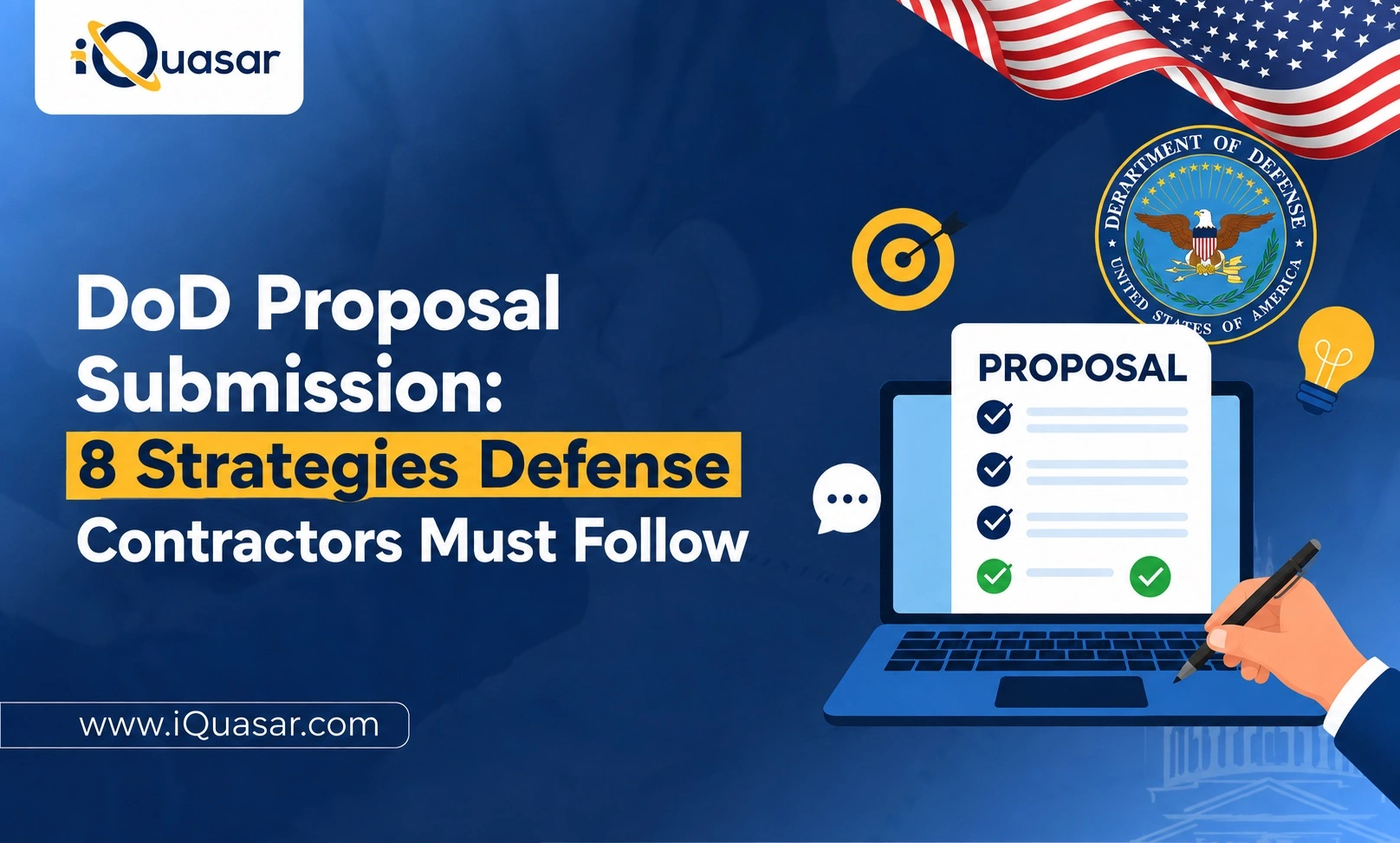
The Department of Defense obligated more than $400 billion in contract spending in fiscal year 2024, making it by far the largest single buyer in the federal government. Yet the majority of companies that attempt to compete for DoD work lose their first several proposals not because they lack the capability to perform, but because they do not understand the rules of the competition they have entered. Knowing how to win government contracts in the DoD space requires more than technical competence. It demands compliance discipline, strategic positioning, audience awareness, and a proposal process built for the specific demands of defense acquisition. In this blog, we explore eight practical, actionable tips that give contractors, whether first-timers or firms looking to improve their win rate, a structured path to more competitive DoD submissions in 2026.
Tip 1: Build Your Compliance Foundation Before You Bid
Every DoD proposal begins in the same place: SAM.gov, the System for Award Management. Registration is mandatory under FAR Part 4, and without an active, accurate registration, no DoD award is legally possible regardless of how strong your proposal is. Your SAM.gov profile must include a current Unique Entity Identifier, accurate NAICS codes that reflect your actual service capabilities, a valid CAGE code, and representations and certifications that are complete and current.
Beyond SAM.gov, contractors pursuing DoD work need to understand the two-layer regulatory environment that governs defense acquisitions. The Federal Acquisition Regulation establishes the baseline rules for all federal procurement. The Defense Federal Acquisition Regulation Supplement, commonly known as DFARS, adds DoD-specific requirements on top of that baseline, covering everything from cybersecurity obligations under DFARS 252.204-7012 to specialized sourcing restrictions under the Berry Amendment. Proposals that do not address applicable DFARS clauses, or that demonstrate unfamiliarity with the regulatory environment, signal compliance risk to evaluators before the technical evaluation even begins.
Tip 2: Activate the Federal Support Network Available to You
The federal government has built a substantial support infrastructure specifically designed to help small businesses compete for DoD and federal contracts, and the majority of contractors pursuing their first DoD award never use it. APEX Accelerators, formerly Procurement Technical Assistance Centers, provide no-cost expert guidance on registration, proposal development, and market research through a national network of local offices. Small Business Development Centers offer business planning and federal market entry support. SCORE connects small business owners with experienced mentors who have navigated the federal procurement environment firsthand.
Veteran-owned businesses can access specialized support through Veterans Business Outreach Centers, and women-owned small businesses pursuing DoD opportunities can leverage resources through programs like ChallengeHER. These networks exist precisely because the DoD acquisition environment is complex enough that first-time contractors benefit significantly from structured guidance, and the support is free.
Tip 3: Write Proposals That Think Like the DoD Evaluator
The single most common mistake contractors make in DoD proposal writing is writing about themselves rather than about the mission. DoD evaluators are not reading proposals to learn about your company. They are reading to determine whether your approach will deliver results that support national security objectives, protect classified and sensitive information, and provide tangible value to the operational units that depend on contract performance.
What does that mean in practice? Every section of your proposal should connect your capability to a specific mission outcome. Technical approaches should explain not just what you will do, but why your approach reduces operational risk and improves mission effectiveness. Past performance narratives should demonstrate not just that you performed similar work, but that your performance delivered measurable results in environments with comparable complexity and stakes. Security and compliance postures, including CMMC compliance status, data protection protocols, and ITAR handling procedures where applicable, should be addressed proactively rather than buried in appendices. Proposals that demonstrate genuine understanding of the DoD’s operational priorities consistently outperform those that recite technical specifications without connecting them to mission value.
Tip 4: Craft a Capability Statement That Opens Doors
A capability statement is the marketing document that introduces your firm to DoD contracting officers, small business offices, and potential teaming partners before a proposal is ever submitted. It is your first impression in the federal marketplace, and a generic one closes more doors than it opens. An effective DoD-focused capability statement is targeted, specific, and updated for the agencies and opportunities your firm is actively pursuing.
Every capability statement should include your core competencies described in mission-relevant language, your differentiators articulated in terms of what makes your approach uniquely suited to the customer’s requirements, past performance references with scope and outcome data, and all required identifiers: NAICS codes, CAGE code, SAM UEI, and any relevant socioeconomic certifications. One page is the standard. More than one page signals that you have not done the work of prioritizing what matters to the specific audience you are addressing.
Tip 5: Research Who Buys What You Sell Before You Bid
Submitting a proposal to the wrong agency, the wrong office, or against the wrong contract vehicle is one of the most common and costly mistakes in federal proposal development. It wastes internal resources that could have been invested in a pursuit where your firm has genuine competitive advantage, and it produces losses that discourage continued investment in federal market development.
Market research should precede every pursuit decision. USASpending.gov and FPDS-NG both publish detailed federal contract award data that allows contractors to identify which DoD offices are actively buying in their NAICS codes, what contract vehicles those offices use, who the incumbents are, and what typical award values look like. SAM.gov publishes active solicitations, sources sought notices, and presolicitation announcements that give contractors early visibility into upcoming requirements. Contractors that build a data-driven picture of their target market before they commit proposal resources consistently make better pursuit decisions than those that chase every opportunity that sounds relevant.
Tip 6: Know Whether to Prime or Subcontract and Choose Strategically
The decision to pursue a DoD contract as a prime contractor or as a subcontractor is one of the most consequential strategic choices a small business makes in the federal market, and it should be made deliberately rather than by default. Priming requires proposal investment, past performance at the prime level, and the operational infrastructure to manage contract delivery across the full scope. Subcontracting provides access to federal past performance, customer relationships, and operational experience without the full burden of prime proposal development and contract management.
Many of the most successful DoD small businesses built their federal track records through strategic subcontracting before transitioning to prime pursuits. SAM.gov’s SubNet platform, the Dynamic Small Business Search, and direct outreach to prime contractors identified through FPDS award data are all effective mechanisms for identifying subcontracting opportunities that build the experience base needed to compete as a prime. The goal is not to remain a subcontractor indefinitely. It is to build a performance record that supports prime-level competition on the vehicles and with the agencies where your firm has the strongest competitive position.
Also Read: Why Most First-Time Federal Contractors Lose Their First 10 Proposals
Tip 7: Build Relationships Before the Solicitation Drops
Federal contracting is a relationship-driven market, not in the sense that relationships substitute for compliance and capability, but in the sense that agencies award contracts to contractors they know, trust, and have confidence in. That confidence is not built during the proposal evaluation period. It is built through sustained, professional engagement before a requirement ever reaches the solicitation stage.
Attending agency industry days, responding to sources sought notices, connecting with small business offices at target agencies, and maintaining consistent visibility through capability statements and market outreach all contribute to a relationship foundation that influences how agencies structure requirements and which contractors they think of when a need emerges. The Dynamic Small Business Search makes your firm visible to contracting officers and prime contractors searching for capable small businesses. Keeping your profile current and accurate is a passive but effective market presence tool that costs nothing beyond the time required to maintain it.
Tip 8: Submit a Proposal Built to Win, Not Just to Comply
Compliance is the entry requirement for a DoD proposal, not the competitive differentiator. A proposal that meets every formatting requirement, addresses every evaluation criterion, and submits on time has done exactly what every other competitive proposal has also done. The proposals that win do all of that and then demonstrate something more: a specific, credible, and differentiated answer to the question of why this firm over the alternatives.
For contractors newer to DoD proposal submission, Simplified Acquisition Procedures, which govern contracts below $250,000 under FAR Part 13, provide a lower-complexity entry point into direct DoD contracting with streamlined documentation requirements and faster award timelines. These vehicles are an appropriate starting point for firms building their first DoD past performance record. For larger, full-and-open or set-aside competitions, the proposal must address the technical evaluation factors with specificity and depth, connect past performance references to the current requirement through explicit scope comparison, and present key personnel with credentials directly relevant to the work being proposed.
An internal compliance review against the solicitation’s Section L and Section M requirements, conducted before the final draft is submitted, is the minimum standard for a submission-ready proposal. Firms with the resources to engage external proposal review support gain an additional layer of quality assurance that consistently improves both compliance and technical quality. Every submission is also a data point: conducting a lessons-learned debrief after every award decision, win or loss, builds the institutional knowledge that compounds into improved win rates over time.
Key Takeaways
Winning DoD contracts in 2026 requires compliance discipline, mission-focused proposal writing, data-driven market research, and strategic positioning that begins well before a solicitation releases. SAM.gov registration and DFARS familiarity are non-negotiable prerequisites. The federal small business support network, including APEX Accelerators, SBDCs, and SCORE, provides substantial no-cost assistance that most contractors underutilize. Capability statements must be specific, targeted, and updated for each customer audience. Market research through USASpending.gov and FPDS-NG transforms pursuit decisions from guesswork into strategy. The prime-versus-sub decision should be made deliberately based on current competitive position and capability. Relationship building before solicitation release creates advantage that compliance alone cannot generate. Every proposal must go beyond compliance to deliver a specific, credible, differentiated answer to why your firm wins.
Conclusion
The DoD acquisition environment rewards contractors that approach it as a discipline, one that requires sustained investment in market intelligence, proposal infrastructure, compliance capability, and customer relationships. The eight strategies covered here do not guarantee a single award. Applied consistently over time, however, they produce the compounding competitive advantage that separates firms with strong DoD win rates from those that submit repeatedly without breaking through.
For contractors looking to strengthen their DoD proposal submissions, improve their compliance posture, or build the market intelligence and capture infrastructure that supports long-term federal contracting success, iQuasar’s proposal development and GovCon360 teams provide end-to-end support across every stage of the pursuit and submission process. Contact us today to build a DoD proposal strategy that wins.