If you’ve ever worked on a federal proposal, you know that not all requests for work are the same, even when they come from the exact contract vehicle.
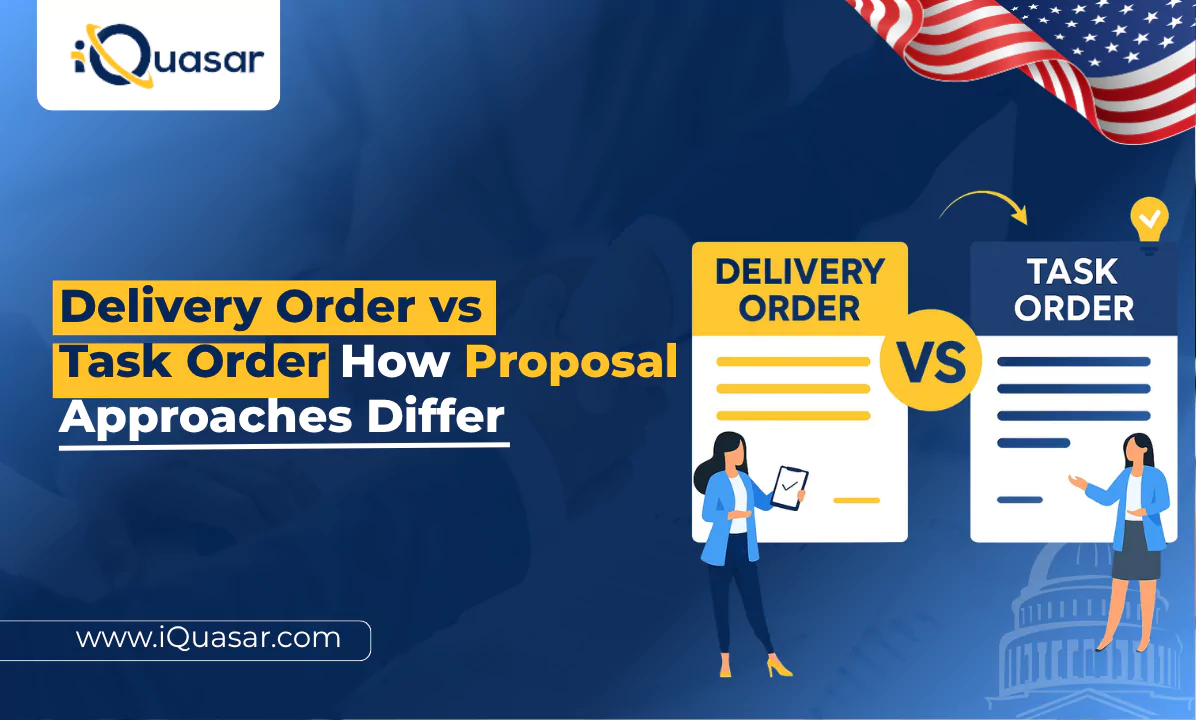
One of the most important distinctions to understand is the difference between a Delivery Order and a Task Order. On the surface, they might sound similar, but from a proposal standpoint, they require two very different approaches. While both are issued under Indefinite Delivery Vehicles (IDVs) like IDIQs or GWACs, each type demands a distinct proposal strategy.
By understanding the difference between these two order types, proposal teams can tailor their responses more effectively. You’ll be able to focus on what really matters to the evaluators and avoid wasting time on content that doesn’t move the needle.
This blog walks you through the key differences between the two, how to approach each, and what government evaluators are looking for.
What’s the Difference between Delivery Order vs Task Order?
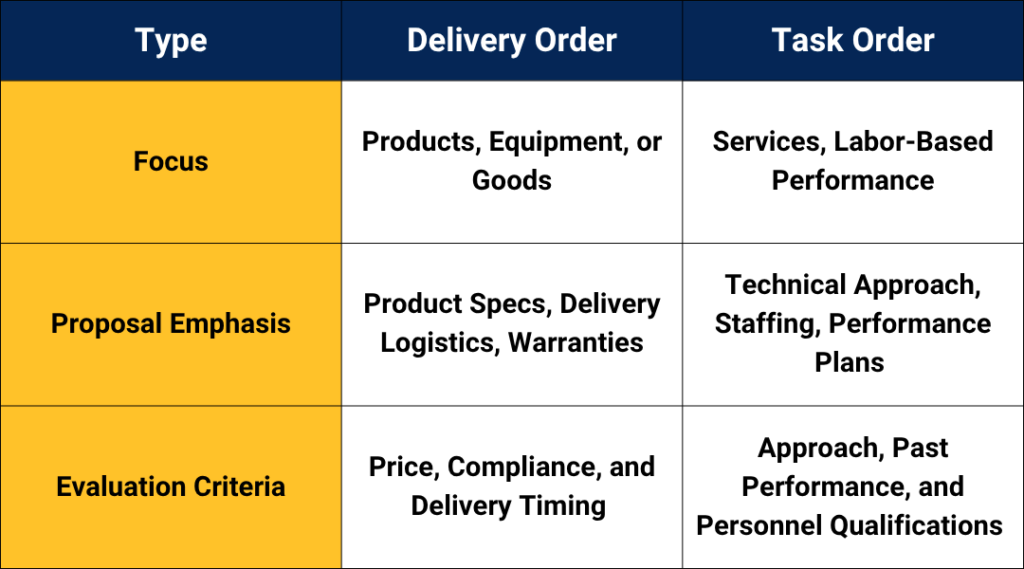
Understanding the Two Order Types
The Federal Acquisition Regulation (FAR) clarifies this distinction in FAR Subpart 16.5:
- FAR 16.501-1 – Defines Task Orders as contracts for services
- FAR 16.501-2 – Defines Delivery Orders as contracts for the supply of products
Understanding this difference isn’t optional; it’s a compliance requirement and critical to align your proposal with the solicitation’s intent.
What Is a Task Order?
A Task Order is issued when the government needs services performed. Task orders are all about services, such as IT support, program management, or consulting. To win these, you’ll need to tell a strong story about how you’ll do the work, who will do it, and why your team is the best fit. That means showcasing your team’s experience, laying out your technical approach, and making sure you’re ready to hit the ground running.
Key Elements to Include:
- Technical approach
- Staffing plan & resumes
- Transition-in/out strategy
- Past performance with similar services
What Is a Delivery Order?
A Delivery Order is issued when the government needs goods or tangible items delivered. On the other hand, Delivery Orders focus on tangible products, such as laptops, software licenses, lab equipment, and so on. Here, the story shifts. It’s less about personnel and more about products, timelines, sourcing, and logistics. Can you get the items on time? Do they meet the specs? Is your pricing solid and realistic?
Key Elements to Include:
- Product specifications and OEM details
- Compliance with TAA/BAA or agency-specific requirements
- Delivery schedule and logistics
- Warranty and post-delivery support
Why Proposal Approaches Must Differ
The approach for a Task Order requires storytelling your narrative around the methodology, team expertise, and performance management is central. For a Delivery Order, storytelling takes a back seat to accuracy, compliance, and logistics.

Also Read: Understanding the Federal Acquisition Regulation (FAR) for Proposal Success
Real-World Examples
Task Order Example:
A Department of Defense agency is issuing a Task Order for 24/7 cybersecurity operations support. Your proposal includes staffing plans, shift coverage, SLAs, and a quality assurance plan.
Delivery Order Example:
A federal agency needs 300 laptops delivered within 20 days. Your proposal includes item specifications, proof of TAA compliance, shipping timelines, and warranty support.
The line between a Delivery Order vs Task Order is more than terminology; it’s a strategic lens through which you shape your response. Understanding that difference allows you to focus your proposal on what the agency truly values.
Get it right, and you’ll position your company as responsive, capable, and well-aligned. Get it wrong, and you risk submitting a technically non-compliant bid.
Need Help Responding to Federal Orders?
Whether it’s a Delivery Order, Task Order, or something in between, iQuasar’s proposal team can help you:
- Interpret solicitation requirements.
- Develop tailored technical narratives or product compliance matrices.
- Align your past performance and pricing strategy.
- Submit compliant, compelling proposals that win.
Let’s collaborate and build your next federal win. Contact us today to learn more.