Somewhere in a federal acquisition office right now, a proposal is being pre-screened before a human evaluator reads a single page. Not because the agency is cutting corners because federal acquisition is increasingly incorporating AI, and proposal teams should prepare for more technology-assisted processes without losing sight of the human evaluation framework that governs source selection. The question most contractors are not asking yet is a simple one: is your proposal structured to survive that screen and score well on the other side of it? Government proposal writing built for human readers alone is no longer sufficient. In this blog, we explore what AI-assisted evaluation actually means for federal contractors, why it changes what “good” looks like in a proposal, and exactly what to check before your next submission goes out the door.
What AI-Assisted Proposal Evaluation Actually Means
Before building anxiety around a term, it helps to define it precisely. AI-assisted proposal evaluation does not mean a machine reads your proposal and makes an award decision. Federal source selection authority remains with warranted contracting officers under FAR Part 15, and that is not changing. What is changing is how agencies process, screen, and organize proposal content before substantive evaluation begins.
AI tools in the federal acquisition context are currently being used for two distinct purposes: compliance checking and content analysis. Compliance checking is straightforward automated systems scan submissions for required sections, page limit adherence, mandatory attachments, and formatting requirements. Content analysis is more substantive tools that identify how well a proposal’s responses map to specific evaluation criteria, flag vague or unsupported claims, and surface structural inconsistencies that might indicate a weaker technical approach.
The implication for contractors is significant. A proposal that is compliant but poorly organized, that buries key technical content in dense paragraphs, or that uses generalized language where specific responses are required will perform worse in an AI-assisted environment than a proposal written with precision, traceability, and clear section-to-criterion mapping. This is not about writing for machines. It is about writing with the kind of discipline that serves both human evaluators and automated screening equally well.
Why the Old Habits Are Becoming Liabilities
Two practices that have survived in government proposal writing longer than they should are keyword stuffing and narrative padding. Keyword stuffing loading proposals with evaluation criterion language in hopes that frequency signals relevance was never effective with experienced evaluators. In an AI-assisted environment, it becomes actively counterproductive. Pattern-detection tools can distinguish between criterion language that appears in context and criterion language that appears without substantive support. A proposal that says “our innovative approach” fourteen times without explaining what that approach is does not score better. It flags as a weak substantive response.
Narrative padding long introductory paragraphs, company history sections no one asked for, and generic capability statements that could apply to any contractor in the competitive range consumes space and evaluator attention without generating score. In a human evaluation, a skilled evaluator skims past padding and finds the substance. In an AI-assisted screen, padding creates noise between evaluation criteria and the responses that address them, making content harder to map accurately to the scoring framework.
The proposals that perform best in this environment are built the way the best proposals have always been built they just have to be built that way more rigorously and more consistently than before.
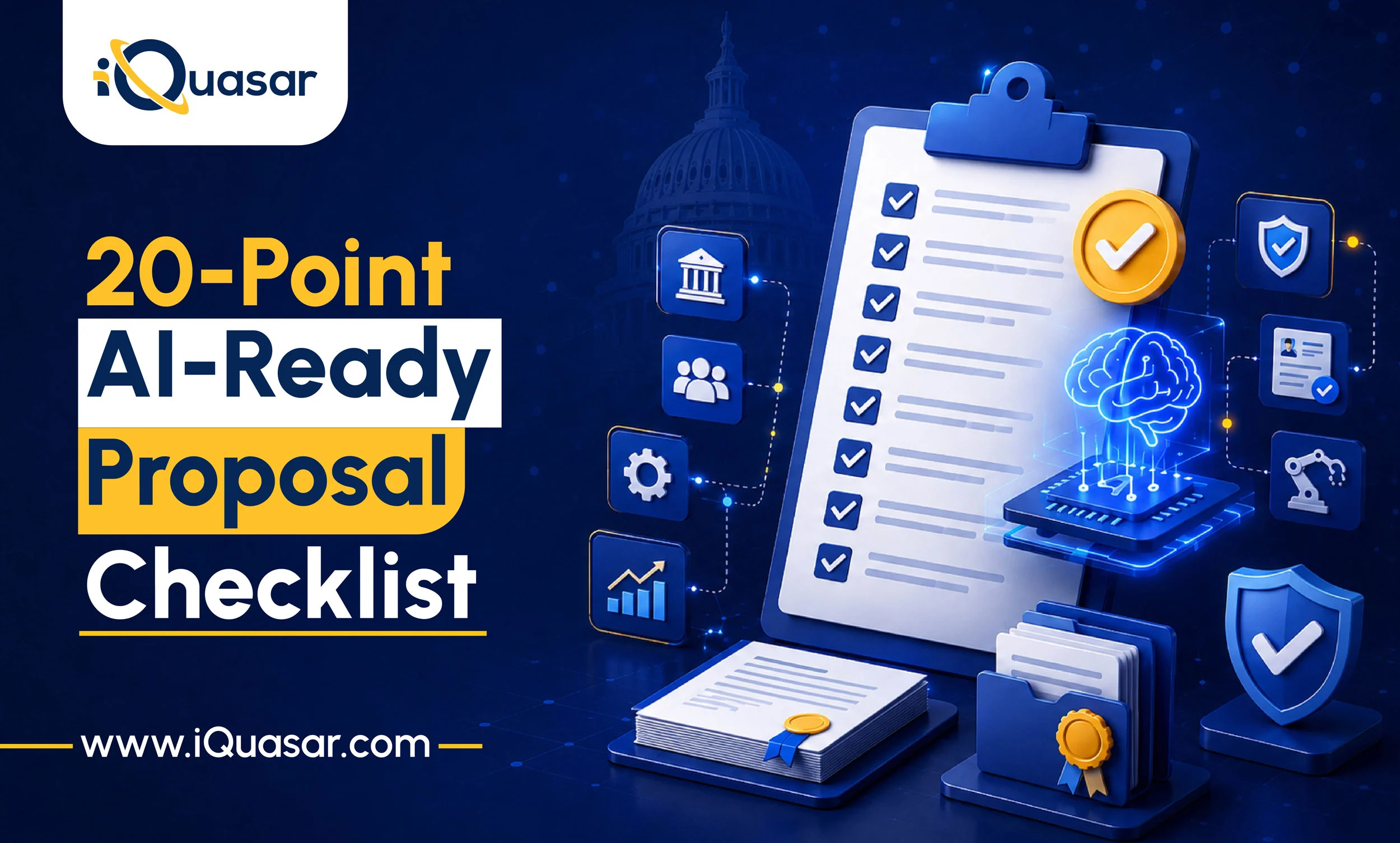
The 20-Point AI-Ready Proposal Checklist
Use this checklist in your final proposal review before submission. Each item reflects a specific structural or content quality that improves performance with both human evaluators and AI-assisted screening systems.
Compliance and Structure
1. Every Section L requirement has a dedicated, labeled section in the proposal. Do not combine or merge majorly distinct requirements. At instances where similar requirements are logically combined, the response should clearly identify how each requirement is addressed.
2. Page limits are respected with margin, not at the wire. Proposals submitted at exactly the page limit have no room for formatting errors introduced at the last step. Build in a buffer.
3. All required attachments are present, correctly named, and in the specified format. File naming conventions matter for automated intake systems. A misnamed attachment may not be processed.
4. The compliance matrix maps every Section L requirement to its exact proposal location. Use page numbers, section headings, and, where useful, paragraph or subsection references to make verification straightforward.
5. Font, margin, spacing, and graphic specifications match the solicitation exactly. Formatting deviations that seem minor are treated as non-compliance in automated compliance checks.
6. Past performance references match the number, format, and recency requirements in the solicitation. Three references when five are required is an evaluated weakness, not an oversight.
Technical Narrative Quality
7. Every evaluation criterion in Section M has a direct, traceable response. The response should appear where an evaluator human or AI would expect to find it, not embedded in a different section.
8. Technical claims are supported by specific evidence, not general assertions. “We have extensive experience” is unscored. “We delivered X outcome on Y contract with Z scope” is scoreable.
9. The executive summary restates the agency’s problem, not the contractor’s history. If the first three sentences are about your company’s founding, rewrite them.
10. Win themes appear in every major section and are tied to evaluation criteria. A win theme that exists only in the executive summary has not been integrated. It has been mentioned.
11. The technical approach answers the “how” with enough specificity to be verifiable. Vague methodology descriptions cannot be differentiated from a competitor’s vague methodology descriptions. Specificity is a scoring differentiator.
12. Acronyms are defined on first use and used consistently throughout. Inconsistent acronym use creates parsing errors in both automated and human review.
13. Graphics are labeled, referenced in the text, and add information that prose does not already convey. A graphic that restates a paragraph adds no score value and consumes page count.
14. The technical narrative flows in the same sequence as the evaluation criteria. Evaluators and content analysis tools should not need to reorder your response to match the scoring framework.
Risk, Management, and Staffing
15. Every risk identified in the technical approach has a corresponding mitigation. Risks mentioned without mitigations signal awareness without capability, which evaluators score as a weakness.
16. Key personnel resumes demonstrate directly relevant experience, not just credentials. An impressive resume that does not connect to the specific contract scope does not strengthen the staffing section.
17. The management plan describes actual organizational structures, not generic ones. Reporting relationships, escalation paths, and performance measurement mechanisms should be specific to this contract.
18. Subcontractor and teaming partner roles are defined with enough specificity to confirm meaningful contribution. A teaming partner listed without a defined scope creates compliance questions under the Commercially Useful Function standard.
Capture and Submission Readiness
19. The proposal has been reviewed against the solicitation’s Section M evaluation criteria by the reviewers and other executives. Writers cannot self-evaluate compliance and responsiveness effectively. The review function requires separation.
20. A submission test; if not final submission; is conducted in the required platform SAM.gov, PIEE, or the agency portal before the deadline. As a risk-control practice, proposal teams should complete the upload process well before the deadline; or atleast tested whenever the submission platform permits testing.
Also Read: Government Proposal Writing Mistakes That Cost You Federal Contracts!
What Capture Teams Should Start Doing Differently
The checklist above is a submission-stage tool. The discipline it reflects needs to begin much earlier in the capture cycle. Capture teams that wait until proposal kickoff to think about evaluation criterion traceability, past performance alignment, and win theme development consistently produce weaker proposals than teams that build those elements during the pre-RFP phase.
Specifically, three shifts matter most for AI-assisted evaluation environments. First, start building the compliance matrix from the draft RFP, not the final solicitation. The structure of your proposal should be established before the clock starts. Second, identify your specific, verifiable proof points for each anticipated evaluation criterion during capture not during proposal writing. Writing under deadline pressure is the wrong moment to discover that you cannot substantiate a key technical claim. Third, treat every past performance reference as a strategic asset that needs to be mapped to specific evaluation criteria before the RFP releases, not selected from a list after it does.
The role of human judgment in source selection is not diminishing. Contracting officers, technical evaluation panels, and source selection authorities remain the decision-makers in federal acquisition. What AI-assisted tools are doing is raising the cost of poor proposal structure making it harder for a well-intentioned but poorly organized submission to compete effectively against one that is built with precision. That shift rewards the discipline that the best proposal shops have always applied. It penalizes the shortcuts that too many have gotten away with for too long.
Key Takeaways
AI-assisted proposal evaluation is not replacing human source selection it is adding a structural filter that rewards traceable, specific, and well-organized proposals while surfacing weaknesses in vague, padded, or poorly mapped submissions. Compliance checking is already automated in many federal acquisition environments. Content analysis tools are expanding. Keyword stuffing and narrative padding are liabilities in this environment, not neutral habits. The 20-point checklist above gives proposal teams a concrete review framework that performs well for both human evaluators and AI-assisted screening. Capture teams that build evaluation-criterion traceability and substantive proof points during the pre-RFP phase produce better proposals under deadline than those that construct them from scratch after the solicitation drops.
Conclusion
Contractors that write with precision traceable responses, specific evidence, logical structure, and zero tolerance for padding are building the kind of submissions that perform well regardless of whether a human or an AI tool sees them first. Since FAR Part 15 still establishes a human source-selection framework based on the solicitation’s stated evaluation factors.The contractor’s job is therefore not to “write for AI”; it is to produce a proposal whose compliance, evidence, and response to every evaluation criterion are explicit, traceable, and easy to evaluate.
For contractors looking to strengthen their government proposal writing process, build AI-ready submission infrastructure, or develop the capture discipline that produces winning proposals before the RFP arrives, iQuasar’s proposal development team works with federal contractors across every stage of the pursuit and submission lifecycle. Contact us today to make your next proposal the one that wins.