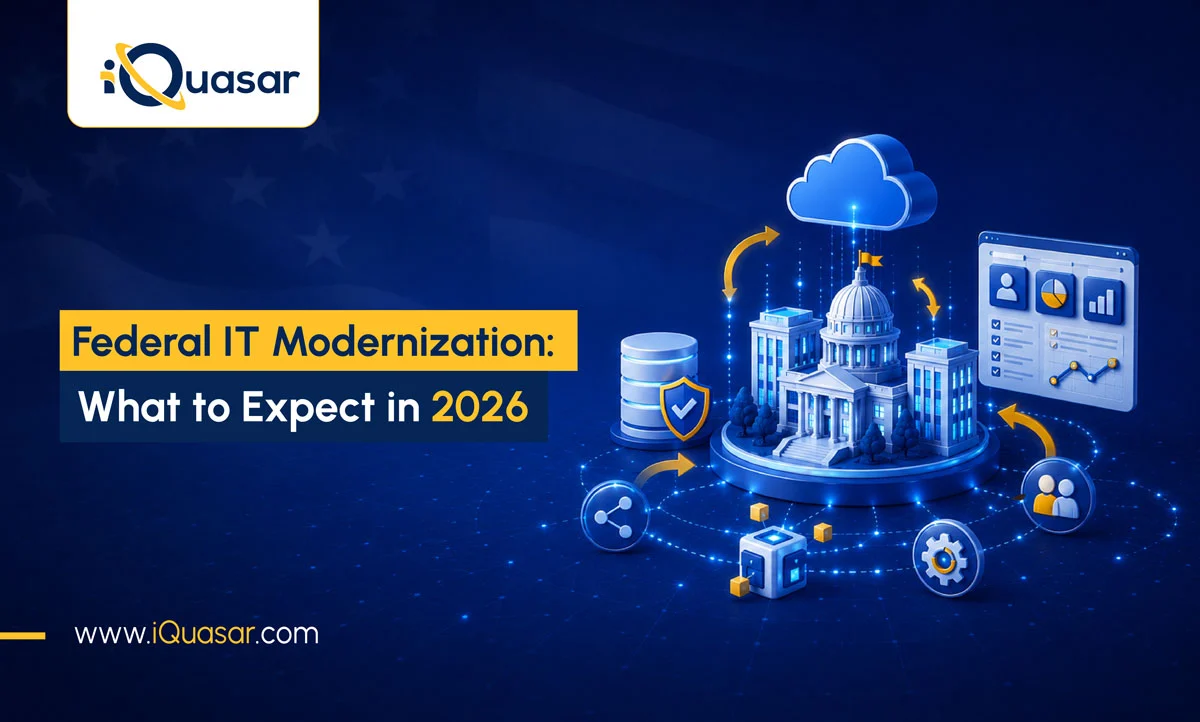
Federal IT modernization has moved beyond planning tables and isolated pilot programs. In FY 2026, agencies across the federal government are executing enterprise-scale technology initiatives. These efforts touch nearly every part of government operations, from how citizens access benefits to how warfighters share intelligence.
This matters now because two forces are converging: continued budget pressure to improve efficiency, and fast-maturing technologies especially artificial intelligence — that agencies can no longer afford to leave in testing mode.
So what technologies are agencies buying in FY 2026? And more importantly, how should contractors, especially small and mid-size businesses, position themselves to win these opportunities?
The answer centers on eight converging priorities: artificial intelligence, Zero Trust cybersecurity, cloud modernization, data modernization, digital service delivery, legacy system replacement, acquisition reform, and workforce transformation.
1. Artificial Intelligence Moves from Pilot to Production
Across civilian, defense, and healthcare agencies, generative AI is moving from testing toward full deployment. The driving goal is efficiency: agencies must do more with tight budgets, and AI can help improve document processing, contract analysis, customer service automation, cybersecurity triage, and knowledge management.
What agencies are actually buying:
- AI implementation and systems integration support
- Data engineering and pipeline development
- AI governance frameworks and responsible AI consulting
- Model validation, testing, and performance monitoring
- Change management and AI literacy training
The key differentiator for contractors in FY 2026 isn’t just building AI solutions. Instead, it’s building AI solutions that meet agency rules around security, privacy, explainability, and risk management. Contractors who can show responsible AI practices — such as model documentation, testing protocols, bias mitigation, and human-in-the-loop controls will be better positioned to win federal work.
2. Zero Trust Cybersecurity Becomes Operational
The federal Zero Trust mandate is no longer just about roadmaps. Agencies are now actively rolling out identity and access management, continuous monitoring, endpoint security, security automation, and cloud security.
As a result, agencies are increasingly judged on their progress against CISA’s Zero Trust Maturity Model, not just on stated intent.
DoD Zero Trust efforts, DHS cybersecurity programs, and civilian agency rollouts are all driving procurement activity at once. For defense contractors, Cybersecurity Maturity Model Certification (CMMC) readiness is becoming a key eligibility and risk factor as DoD phases in implementation. This, in turn, is fueling steady demand for advisory, assessment, remediation, and managed security services.
High-demand contractor capabilities in FY 2026:
- CMMC readiness assessments and gap remediation
- Identity and access management implementation
- Security operations center (SOC) managed services
- AI-enabled threat detection and response
- Zero Trust architecture design and integration
- Continuous monitoring and security automation
3. Cloud Modernization Enters a New Phase
Cloud migration alone is no longer the whole modernization strategy. In FY 2026, agencies that have finished migrating are now asking a harder question: are they actually getting the operational, security, and financial value they expected from the cloud?
Multi-cloud and hybrid cloud setups are now standard for many agencies. Meanwhile, Cloud Financial Operations (FinOps) the practice of managing cloud cost, usage, and performance has become a budget priority. Agencies are also investing in DevSecOps, cloud security, application modernization, and platform engineering, since many older applications were simply moved to the cloud without being redesigned.
So contractors who can show real experience in cloud architecture, secure adoption, optimization, managed services, DevSecOps, and application modernization, not just migration will be better positioned for FY 2026 opportunities.
4. Data Modernization and Digital Transformation
Federal agencies increasingly treat data as a strategic mission asset. As a result, data governance programs, API modernization, open data efforts, interoperability projects, and real-time analytics investments are underway across nearly every major agency.
In federal healthcare, for instance, FHIR-based interoperability standards, CMS Patient Access APIs, and cross-agency health data exchange keep driving strong demand for technical and program support. Across civilian agencies, modernization work is focused on improving information sharing, boosting data quality, and enabling faster mission decisions.
Services in demand:
- ETL modernization and data pipeline engineering
- Master data management and data quality programs
- Business intelligence and advanced analytics
- API development and systems integration
- Data governance framework implementation
- FHIR interoperability and healthcare data exchange support
5. Digital Service Delivery Becomes a Mission Priority
Agencies face growing pressure to improve how citizens, employees, and mission partners access government services. So digital service delivery now goes well beyond website redesign — it includes customer experience upgrades, self-service portals, digital forms, workflow automation, mobile access, and integrated case management.
Contractors with experience in human-centered design, agile delivery, user research, accessibility compliance, low-code automation, and customer experience work are increasingly relevant to these programs.
The strongest digital service partners pair technical delivery with real, measurable gains in accessibility, user satisfaction, processing time, and mission outcomes.
6. Legacy System Modernization Remains the Hardest Problem in Government IT
Decades of deferred maintenance have left many federal agencies stuck with systems that predate modern cloud, cybersecurity, and interoperability standards. Technical debt isn’t just a technology problem — it’s a mission risk. After all, systems that can’t integrate with modern platforms can’t fully support AI, Zero Trust, data-sharing, or digital service initiatives. That’s why the Technology Modernization Fund and other agency investments continue to back legacy system replacement, application rationalization, system consolidation, infrastructure upgrades, and agile modernization delivery.
Contractors with strong past performance in software development, systems integration, modernization roadmaps, application rationalization, and transition support are well-positioned for this ongoing wave of investment.
7. Acquisition Reform Creates Opportunities for Agile Contractors
Federal agencies want faster, more flexible ways to buy modernization capabilities. This includes greater use of modular contracting, agile delivery, challenge-based acquisitions, commercial solutions, governmentwide acquisition contracts, and small-business set-asides.
For small and mid-size firms, this opens the door to compete on specific capabilities rather than trying to offer every modernization service in-house. So the most successful contractors will show clearly defined capabilities, relevant past performance, compliant pricing, and teaming arrangements that fill technical or capacity gaps.
8. Federal Workforce Modernization Is Essential to Technology Adoption
Technology alone can’t modernize a government agency, workforce change must happen alongside it. Federal agencies still face digital skills shortages, AI literacy gaps, cybersecurity workforce challenges, and the added complexity of supporting hybrid work. That’s why contractors who pair technology delivery with training, knowledge transfer, change management, and workforce adoption support are increasingly winning bigger, longer-term contracts.
In short, agencies want modernization partners, not vendors who deploy technology and then leave, without helping the workforce sustain it.
What This Means for Government Contractors
FY 2026 is not a year to wait for the next major GWAC or IDIQ vehicle. Agencies are actively buying modernization capabilities right now, and small businesses with focused technical skills can compete effectively, especially through set-asides and strategic teaming.
Practical Guidance: Five Priorities for Contractors in FY 2026
- Invest in AI Delivery Capabilities: Focus on hands-on experience with generative AI tools, responsible AI governance, data readiness, security controls, and agency-specific use cases not just AI strategy slides.
- Strengthen Cybersecurity Offerings Around Zero Trust: Identity management, CMMC readiness, continuous monitoring, security automation, and managed cybersecurity remain high-demand areas.
- Build Cloud Optimization Past Performance: Agencies need FinOps skills, DevSecOps delivery, cloud security, managed cloud services, and multi-cloud support, not just migration experience.
- Develop Data Engineering and Interoperability Credentials: ETL modernization, API development, FHIR integration, data governance, analytics, and data quality skills matter more across healthcare, civilian, and defense programs.
- Pursue Teaming Relationships That Fill Capability Gaps: A small business with strong program management, customer knowledge, and delivery discipline can compete more effectively when paired with partners who bring specialized skills, IP, or relevant past performance.
Also Read: Access Intelligence: Can Federal Contractors Ignore This AI Edge?
FY 2027 Preview: Where Federal IT Modernization Is Heading
Looking ahead, FY 2027 will likely build on many of the priorities already underway in FY 2026. AI adoption may expand from productivity tools into more advanced decision-support uses. Meanwhile, cybersecurity standards including CMMC and Zero Trust maturity are expected to get more rigorous. And cloud optimization will keep evolving toward AI-enabled, cloud-native architectures.
Overall, the bar for measurable mission outcomes, secure delivery, workforce adoption, and steady performance will keep rising.
Contractors that build the right capabilities, certifications, partnerships, and past performance in FY 2026 will be better positioned to compete for the larger, longer-term modernization vehicles expected in FY 2027 and beyond.
FY 2026 Is a Modernization Execution Year — Is Your Firm Ready?
The shift from planning to execution means the window to build the right capabilities is now, not next fiscal year. Agencies are actively buying AI, cybersecurity, cloud, data, digital service delivery, and legacy modernization services at scale. At the same time, they’re becoming more selective about which contractors have the credentials, past performance, and delivery maturity to get the job done.
iQuasar helps small and mid-size businesses build technical capabilities, teaming strategies, capture plans, and proposal infrastructure to compete for federal IT modernization contracts.
Ready to pursue FY 2026 modernization opportunities or build a capture strategy for upcoming vehicles?
Schedule a Strategy Session with iQuasar