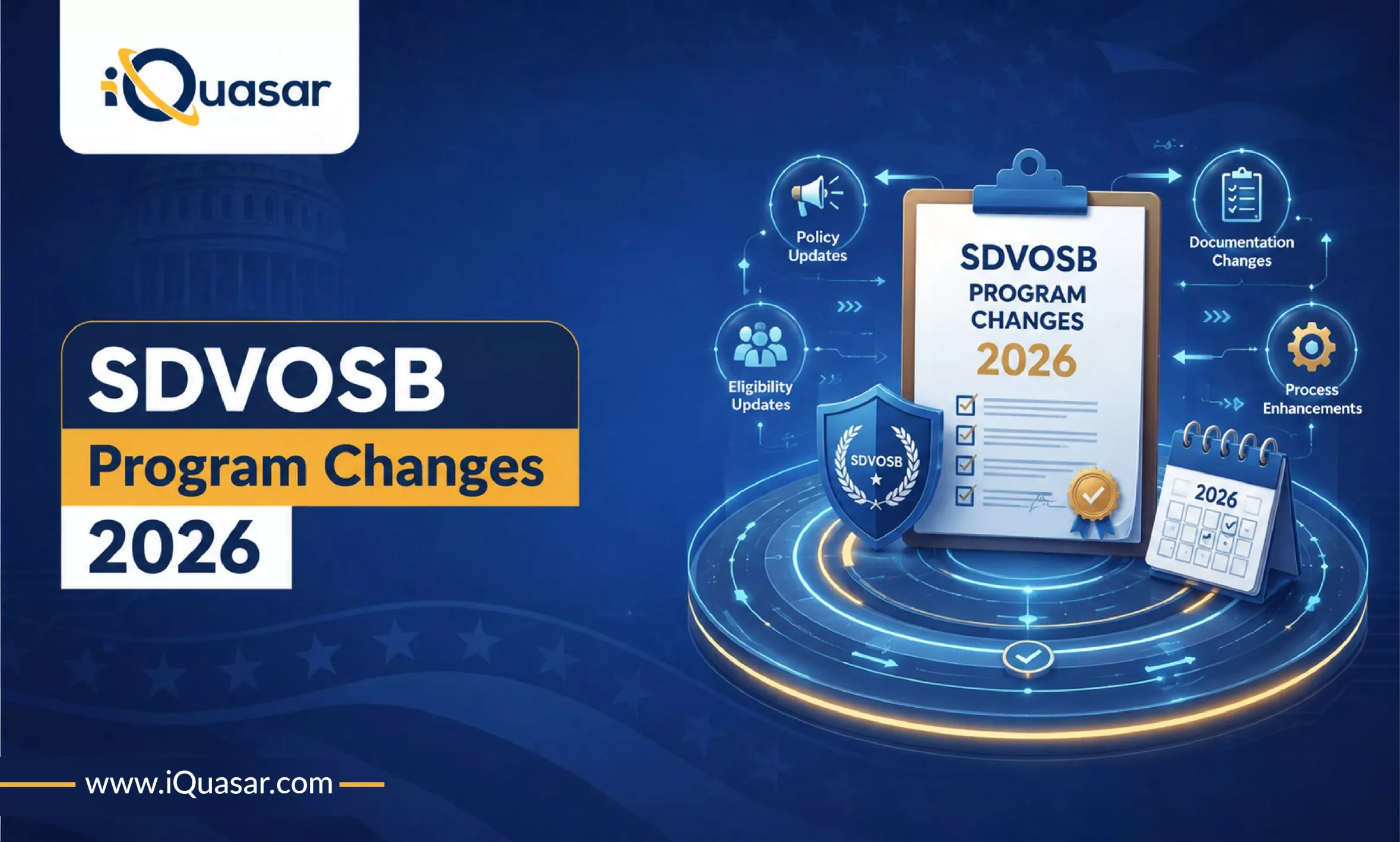
SDVOSB program changes over the past 18 months have fundamentally reshaped how veteran-owned firms enter and compete in federal contracting. Self-certification ended. VetCert became a capacity constraint just as certification became mandatory. Since then, periods of operational strain within the VetCert program have given way to a more predictable verification environment. The result is not only a certification story but a market-access and competitive-positioning shift. For service-disabled veteran-owned small businesses, the central question is how to position around a certification that is faster and more reliable, while navigating a broader pipeline of opportunities.
This blog examines the SDVOSB program changes, how VetCert dynamics are reshaping federal contracting, and practical steps veteran-owned firms can take today to position for growth.
Why the SDVOSB Market Changed so Quickly
Federal contracting rarely changes on one front alone. In the SDVOSB space, several major changes arrived almost at once, and each one amplified the effect of the others. That is why the current market feels less like a gradual evolution and more like a reset. At the center of that reset are three developments: the end of self-certification, VetCert capacity constraints during a period of mandatory verification, and a shift in how the market leverages VetCert within the broader federal procurement framework.
The End of Self-certification Changed Eligibility Immediately
The first major shift was the formal end of self-certification for SDVOSBs. As the SBA’s evolving policy framework took hold, firms must be recognized through the VetCert program to participate as an SDVOSB in the same manner as before. This change tightened eligibility and reduced the market visibility of firms operating solely on self-certified status. The shift reframed certification from a background registration issue into a front-end market-access issue, meaning strong past performance and agency relationships could still be at play, but practical eligibility depended on VetCert verification.
Why That Mattered Beyond Compliance
Beyond administrative precision, the move away from self-certification changed the competitive dynamics. Firms could no longer rely on self-reported status to unlock SDVOSB set-aside opportunities; verification became a prerequisite for eligibility and for counting toward SDVOSB participation metrics. This reorientation affected capture planning, strategic messaging, and the sequencing of certification as a core business development activity.
VetCert Program Dynamics and Operational Constraints
The VetCert program has experienced a period of transition-period disruptions as it shifted to a centralized verification model. This included delays and capacity constraints as the system restructured to handle certification at scale, with the operational reality affecting access to SDVOSB set-aside opportunities and the pace of market entry for newly certified firms. The effect was a temporary gap between policy goals and practical execution, where firms could have strong performance and relationships but faced delays in attaining or renewing VetCert verification. During 2024, these backlogs and processing delays reflected transition-period disruptions rather than systemic failure, and as VetCert processing matured into 2025, the verification environment became more predictable and usable for capture planning.
Processing delays and backlogs during 2024 generated a challenging environment for firms attempting to transition into the VetCert regime. This transition-period disruption highlighted the reality that policy changes do not automatically translate into immediate market access; firms needed to align certification status with their capture and BD plans to avoid missed opportunities. The consequence was a heightened emphasis on readiness, cadence in certification renewals, and proactive market mapping to ensure that SDVOSB opportunities remained within reach despite verification bottlenecks.
In this context, the market learned to adapt to a verification process that required careful sequencing of certification, project pursuit, and pipeline management. The result was a more deliberate but ultimately stronger alignment between eligibility status and opportunity pursuit, as firms recalibrated around VetCert timelines and demand signals.
The Post-Backlog Era: Market Recalibration and SDVOSB Opportunities
With the VetCert process now stabilized, the SDVOSB landscape has shifted from a phase of “survival and waiting” to one of market recalibration. New policy updates and higher participation goals are fundamentally widening the pipeline for veteran-owned firms.
The Opportunity Shift: From 3% to 5%
The policy context has evolved from discretionary targets to statutory mandates. Under the NDAA for FY2024, the federal SDVOSB participation goal increased from 3% to 5%.
- Statutory Mandate: This is no longer a “suggested” target; SBA scorecards and agency performance are now measured against this higher benchmark.
- Follow-on Flexibility: New reform frameworks grant contracting officers greater discretion to transition requirements (previously held in other small-business channels) into the SDVOSB pathway.
- The Rule of Two: While COs have more discretion, the “Rule of Two” remains the primary guardrail. Agencies must see a competitive pool of at least two certified SDVOSBs to justify a set-aside.
Targeted Market Mapping
Data from FY2024 and FY2025 show that SDVOSB activity remains concentrated in a core group of high-spend agencies. Success requires moving beyond a “generalist” approach to focus on where the money is moving:
| Top Agencies for SDVOSBs | Strategic Focus Areas |
| Dept. of Veterans Affairs (VA) | Healthcare IT, Medical Equipment, Construction. |
| Dept. of Defense (DoD) | Cybersecurity, Logistics, R&D, Maintenance. |
| Homeland Security (DHS) | Digital Infrastructure, Border Security Tech. |
| Dept. of Energy (DOE) | Professional Services, Clean Energy Solutions. |
What SDVOSB Firms Should Do Now
Certification is no longer the finish line; it’s the starting block. To capitalize on the rising opportunity curve, firms should execute the following “Readiness Plan”:
1. Audit Your Status
- Verify VetCert Timing: Confirm your renewal window. SBA has recently provided 6-month extensions for some firms; know your specific “exit date.”
- Data Integrity: Ensure your SAM.gov entity data matches your VetCert documentation exactly to avoid “data drift” flags.
2. Update Your Market Positioning
- Refresh Capability Statements: Align your narrative with the current “VetCert-certified” status.
- Map Expiring Work: Identify 8(a) or small business contracts expiring in the next 18–24 months that could be “re-competed” as SDVOSB set-asides.
- Engage Early: Use timely capability statements to influence market research before a solicitation is even drafted.
3. Build a “Dual-Path” Plan
If you are navigating a recent reorganization or waiting on a pending certification:
- Path A: Maintain strict compliance with current SBA requirements.
- Path B: Execute a proactive engagement cadence with Small Business Liaison Officers (SBLOs) at high-spend agencies to build your pipeline for when the certification is live.
Watch the LinkedIn Live Recording: SDVOSB Certification: How Veteran-Owned Businesses Can Win More Contracts
Frequently Asked Questions About SDVOSB Program Changes
What are the biggest SDVOSB program changes in 2025–2026?
The most important changes are the end of self-certification, the VetCert backlog and recovery, and the broader opportunity shift created by follow-on contracts moving into SDVOSB channels. Together, these changes have altered both eligibility and access to work.
Why was the end of self-certification so disruptive?
It made certification a hard gate instead of a self-represented status. Firms that were not processed through VetCert effectively lost immediate SDVOSB market visibility even if they had previously operated successfully in that space.
Is the VetCert backlog still a major problem?
SBA cleared the backlog and reduced average processing times significantly by November 2025. That suggests the main market challenge has shifted from system delay to strategic execution.
Why do expiring 8(a) contracts matter for SDVOSBs?
Because policy changes now make it easier for some follow-on work to move out of 8(a) and into other small-business channels, including SDVOSB. That creates a larger pool of potential recompete opportunities for certified firms.
What should an SDVOSB do first in this reset environment?
First, make sure certification status is current and active. Then move quickly into opportunity mapping, capability positioning, and capture planning so the firm can compete while the market is still recalibrating.
The “Veteran Workforce” Edge
Beyond just the 51% ownership requirement, the most successful firms are embedding a “veteran-centric” model into their delivery. Hiring veterans and demonstrating a veteran-led tasking capability strengthens your alignment with agency missions and provides a credible “value-add” in technical proposals.
Two rhetorical questions often surface in planning sessions.
- First: What does readiness look like for a firm transitioning to VetCert verification and broader SDVOSB opportunities? The answer is a structured, data-driven plan that ties VetCert status to a live BD calendar, with quarterly milestones for capability updates, targeted client outreach, and early engagement with contracting officers.
- Second: Can small SDVOSB firms compete in a market where policy is shifting? Yes, when they align with a clear, repeatable capture process, build strong relationships with the agencies most active in SDVOSB work, and maintain a competitive capability narrative that speaks to mission-critical outcomes.
The SDVOSB market is no longer operating under its old structure. The end of self-certification, the VetCert crisis, the system reset, and the expanding opportunity pipeline have combined to reshape how veteran-owned firms enter and compete in federal contracting. What once looked like a compliance transition has now become a competitive market reset.
For certified and actively positioning firms, this is a meaningful opportunity window. For firms that are not yet aligned, the market is already moving ahead. If your business needs support with SDVOSB Certification, strategic positioning, or federal readiness planning, Contact us. iQuasar can help you navigate the evolving certification landscape and build a practical roadmap for competing more effectively in the SDVOSB market.