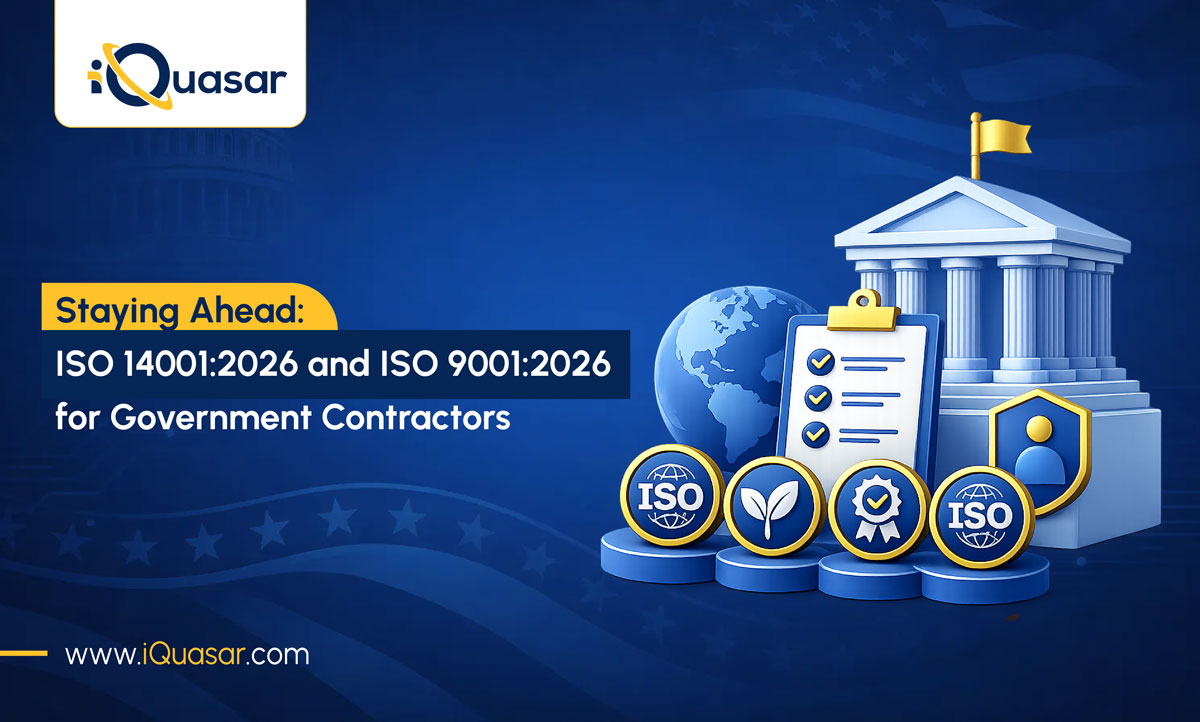
For small and medium-sized government contractors, navigating the evolving landscape of compliance and operational excellence is not just good practice it’s a prerequisite for securing and maintaining vital contracts. The International Organization for Standardization (ISO) is introducing significant updates to two cornerstone standards: ISO 14001 (Environmental Management) and ISO 9001 (Quality Management). These ISO 2026 revisions, while seemingly broad, carry direct implications for your competitive standing and contractual obligations within the federal marketplace. Understanding and proactively adapting to these changes is crucial for fostering organizational resilience, ensuring continued compliance and certification, and achieving a strategic upgrade that positions your firm for future success in government contracting.
Environmental Stewardship: ISO 14001:2026 and Government Contracts
With the official publication of ISO 14001:2026 this month, the three-year transition period has begun. For government contractors, this updated standard means a heightened focus on environmental performance, which can directly influence contract eligibility and evaluation. The revision moves beyond basic compliance, introducing mandatory requirements that align with increasing federal emphasis on sustainability.
A key change is the enhanced Life Cycle Perspective ISO 14001 (Clause 6.1.2). This requires contractors to consider the environmental impacts of their services and products across their entire lifecycle, from procurement to disposal. This is particularly relevant for supply chain management in government projects. Additionally, Biodiversity ISO 14001 is now explicitly integrated, urging organizations to assess and mitigate their impact on ecosystems, a factor that may become increasingly important in government solicitations.
Crucially, the new standard imposes a non-delegable accountability burden on top management for environmental performance. This means leadership within your contracting firm will be directly responsible for the effectiveness of your Environmental Management System (EMS). Given that the 2024 Climate Change ISO 14001 amendments are now fully woven into the core text, your next audit will undoubtedly scrutinize these areas. Proactive environmental risk management and a thorough ISO 14001 Gap Assessment are essential steps to ensure a smooth ISO 14001 transition and maintain your competitive edge.
Quality and Integrity: ISO 9001:2026 for Federal Projects
As the release of the ISO 9001:2026 Final Draft International Standard (FDIS) approaches this June, the shift in focus for the Quality Management System (QMS) is becoming clear. For government contractors, where quality is often a critical evaluation factor, this revision emphasizes a move from mere process documentation to a stronger focus on Quality Culture ISO 9001 and Ethics ISO 9001. This means demonstrating a deep-seated commitment to quality and ethical conduct throughout your organization, which can significantly bolster your reputation and trustworthiness with federal agencies.
The updated standard explicitly addresses the integration of AI in QMS and Digitalization QMS. As government contracts increasingly leverage advanced technologies, your ability to integrate these into your quality processes will be a distinct advantage. Furthermore, stricter requirements for planning change in ISO 9001 (Clause 6.3) are intended to prevent operational drift. This ensures that any changes in your processes or projects are carefully planned and executed, maintaining the high standards required for government work.
For leadership, this translates into audits that will focus less on paperwork and more on how quality and risk are ethically managed at the executive level, underscoring the importance of leadership accountability and quality. Meeting these enhanced expectations will be key to demonstrating your firm’s capability and reliability in delivering federal projects.
Navigating the Transition: A Strategic Approach for Contractors
Both the ISO 14001:2026 and ISO 9001:2026 revisions present a unique opportunity for small and medium-sized government contractors to not just comply, but to truly enhance their operations and strengthen their position in the federal marketplace.
Proactive engagement is paramount. Conducting immediate Gap Assessments for both your EMS and QMS will identify areas requiring attention and enable a structured, cost-effective implementation approach. This strategic foresight transforms potential last-minute administrative scrambles into well-planned upgrades, fostering greater organizational resilience and competitive advantage in the highly competitive government contracting arena.
To maintain your competitive edge, we recommend a phased Strategic Transition Plan:
Phase 1: The Integrity & Impact Audit (Months 1–6)
- Integrated Gap Assessment: Don’t view ISO 9001 and 14001 in silos. Conduct a dual assessment to identify where your Quality Culture (9001) intersects with your Life Cycle Perspective (14001).
- Climate & Biodiversity Mapping: Federal agencies are increasingly scoring “Sustainability” as a stand-alone technical factor. Document how climate risks impact your specific supply chains and identify your “Biodiversity Footprint” for projects involving physical infrastructure or land use.
Phase 2: Structural Integration (Months 6–12)
- Formalize Change Management (Clause 6.3): The 2026 revisions require structured change management. For contractors, this means your Project Management Office (PMO) must now formally document how staffing changes or scope creeps are assessed for quality and environmental impact.
- Ethical Quality Culture: Move beyond a signed Code of Conduct. Federal auditors will now look for evidence of “Quality Ethics”—how you handle “near-misses” in quality or environmental incidents without fear of reprisal.
Phase 3: Digital & AI Governance (Months 12–18)
- AI in the QMS: If your firm uses AI for data analysis, proposal drafting, or project monitoring, you must now validate these tools within your QMS. Ensure your AI-driven decisions are traceable and transparent to meet the new Digitalization requirements.
- Supply Chain Transparency: Update vendor agreements to include the “Life Cycle Perspective.” Your subcontractors’ environmental performance is now a direct reflection of your own compliance.
Phase 4: Leadership Accountability & Training (Ongoing)
- Executive Ownership: Under the 2026 standards, accountability is non-delegable. We provide “Leadership Awareness” briefings to ensure your C-suite can confidently discuss EMS and QMS effectiveness during high-level government audits.
- Workforce Reskilling: Empower your project leads with the tools to manage “Biodiversity Impact” and “Digital Quality” on-site, turning compliance from a back-office task into a field-level advantage.
Proactive Tip: The transition deadline for ISO 14001 is April 2029, and ISO 9001 is expected to follow in late 2029. However, certification bodies expect a massive surge in demand in 2027 and 2028. Scheduling your transition audit early ensures you won’t face a lapse in certification that could disqualify you from a key contract vehicle.
The ISO 2026 revisions for ISO 14001 and ISO 9001 mark a pivotal moment for government contractors. By embracing new mandates on a life-cycle perspective, biodiversity, quality culture, ethics, AI integration, and robust change management, your organization can not only achieve compliance but also drive genuine, sustainable improvement that aligns with federal procurement requirements. iQuasar is your trusted partner in this journey, providing the insights and support needed to turn these regulatory updates into a powerful catalyst for securing new contracts and achieving sustained excellence. Contact us today to discuss how these changes specifically impact your operational roadmap for 2026 and beyond.