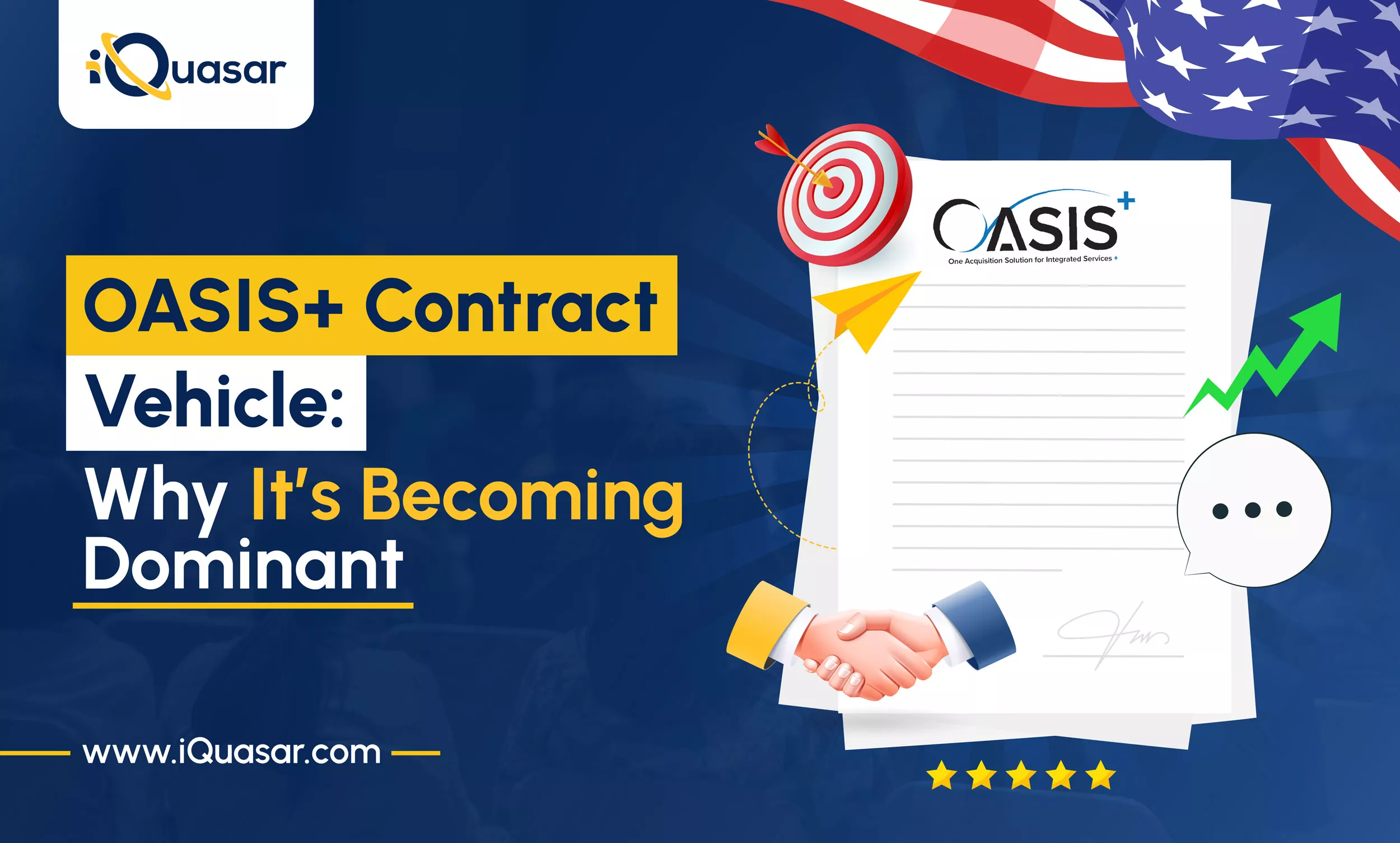
A significant and accelerating shift is transforming how the federal government procures complex professional services: governmentwide contracts are growing in centrality, while agency‑specific IDIQs are being consolidated or sunsetted. In this evolving landscape, the OASIS+ contract vehicle is moving from a supplemental option to a central spine for many agencies’ procurement strategies. This trend is visible in agency procurement guidance, and the way spend data is shifting toward governmentwide platforms, reinforced by policy and management imperatives described on the GSA OASIS+ page and related sources.
In this blog, we explain what the OASIS+ contract vehicle is, why agencies are increasingly favoring GWACs and BPAs, and how contractors can position themselves for task order opportunities in this evolving landscape.
What the OASIS+ Contract Vehicle Is
The OASIS+ contract vehicle is designed to streamline complex professional services acquisitions by providing a unified, governmentwide platform for task orders across multiple disciplines. It builds upon, significantly expands, and broadens the original OASIS framework, broadening its scope and structure to accommodate a broader set of professional services while preserving the performance-based, outcome-focused approach the program was founded to enable. Specifically, OASIS+ broadens the catalog of domains and sub‑domains, increases the flexibility for pricing and teaming, and strengthens the framework for both large primes and smaller firms to compete on a common, performance-driven footing.
The vehicle was designed to support sophisticated engagements, including program management, engineering services, IT and data analytics, and related professional services, through standardized processes that agencies can leverage across missions.
This is significant because OASIS+ represents a streamlined, scalable answer to the government’s demand for repeatable, high‑complexity work across agencies. The expanded domains, clearer small business tracks, and enhanced governance remove many of the frictions that historically slowed cross‑agency procurements while preserving the depth and rigor necessary for large, multi‑year professional services programs.
Why Federal Agencies Are Moving Toward GWACs and BPAs
The federal procurement environment is shifting toward consolidated purchasing and category-driven sourcing. Category management initiatives in the federal procurement ecosystem are accelerating the shift away from a fragmented landscape of agency-specific vehicles toward fewer, larger, more standardized platforms. This is reinforced by strategic sourcing policies that aim to reduce duplicative contracts and improve price and performance outcomes, as agencies pursue federal efficiency mandates and better leverage central purchasing power. The trend is reinforced by a growing commercial‑first mindset in federal acquisitions, where agencies increasingly value speed, market competitiveness, and consistent terms across programs.
The practical effect is a more predictable procurement landscape for professional services, with GWACs and BPAs serving as the preferred vehicles for high‑end, cross‑agency needs. Agencies are encouraged to plan, source, and execute through these platforms to realize scale, standardization, and better governance benefits that resonate with senior program executives and procurement leaders alike.
Policy Drivers Behind the Shift to GWACs
Centralized acquisition services (OCAS) play a pivotal role in accelerating government-wide procurement consolidation. By coordinating across agencies, OCAS reduces duplication, harmonizes contract terms, and helps agencies leverage a common set of vehicles for cross‑functional needs. This shift is largely driven by a policy ecosystem shaped by major guidance and revisions to the acquisition framework, including references to the FAR overhaul and related rulemaking. Executive actions and regulatory developments are part of the ongoing push toward greater reliance on GWACs and other governmentwide platforms.
What This Means for Existing Contract Vehicles
As consolidation advances, legacy agency‑specific IDIQs face intensified scrutiny and competition, including potential retirements or recompetition cycles. Contracting officers seek opportunities to move work onto GWACs and BPAs to realize efficiencies and standardize governance. Contractors with heavy exposure to agency vehicles face increased pipeline volatility and reduced opportunity visibility if those vehicles sunset or are overshadowed by GWACs like OASIS+. Spending trend data captured in FPDS illustrate the ongoing migration toward centralized platforms, underscoring the need for proactive portfolio management and contingency planning.
How Contractors Can Position for OASIS+ Opportunities
For contractors seeking to compete in an OASIS+-driven market, the focus should be on aligning their business development, capture strategy, and partnerships with how the vehicle operates. Because OASIS+ supports complex professional services across multiple domains and agencies, firms that approach the vehicle strategically rather than opportunistically will be better positioned to compete for task orders as they emerge.
- The first step is understanding how to gain access to the vehicle. Contractors should monitor eligibility requirements, domain structures, and any future on-ramp opportunities that allow new vendors to join the contract. Since OASIS+ is structured to support both large-business and small-business tracks, firms should evaluate where their capabilities best fit and determine whether pursuing prime access or participating as a subcontractor offers the most realistic entry path.
- Once positioned on or around the vehicle, the next priority is monitoring task-order opportunities. SAM.gov remains a primary source for federal procurement notices, and agencies using OASIS+ often release requests for information (RFIs), sources sought notices, and task-order solicitations through the platform. Contractors that actively track these signals can begin capture planning earlier, giving them more time to assemble teaming arrangements, refine technical approaches, and position their solutions with agency stakeholders.
Get the Latest OASIS+ Phase II Update: OASIS+ Phase II: Key Updates and Insights for Contractors
- Teaming strategies also play an important role in succeeding under OASIS+. Many task orders require multidisciplinary capabilities that span several domains, making partnerships between primes and specialized subcontractors essential. Contractors that cultivate credible teaming relationships combining complementary technical expertise, past performance, and scalable staffing models can create stronger proposals and compete for a wider range of opportunities across agencies.
- Finally, firms should ensure that their pipeline strategy reflects the broader shift toward GWAC-based procurement. As agencies continue to consolidate work onto vehicles like OASIS+, contractors may find that opportunities previously issued through agency-specific IDIQs now appear on centralized platforms. Aligning internal capture planning, capability messaging, and proposal readiness with this evolving procurement structure will help firms remain competitive as the federal services marketplace continues to consolidate around large governmentwide contracts.
Category Management and the Future of Federal Contract Vehicles
Category management is the engine behind the move toward fewer, larger contract vehicles. By aggregating demand and locking in standardized terms, agencies can achieve economies of scale, better supplier performance, and a more transparent marketplace. OASIS+ fits neatly into this strategy by offering a centralized, domain-based platform for complex services that cross agency lines. For contractors, this means designing pre‑positioned capabilities with an eye toward cross‑agency applicability, building multi‑discipline teams, and differentiating through proven outcomes and scalability. Understanding category management helps long‑term pipeline planning, identifying where OASIS+ and similar GWACs will dominate, and aligning proposal methodologies, capture playbooks, and partner ecosystems accordingly.
Conclusion: Preparing for an OASIS+ Driven Market
Federal procurement is steadily consolidating around governmentwide vehicles like OASIS+, and contractors that proactively recognize and adapt to this shift are better positioned to capture high-value, cross-agency work. As agencies increasingly rely on GWACs and BPAs to streamline acquisitions and enforce category management strategies, firms must reassess how their current contract vehicles, pipeline strategy, and capture planning align with this evolving landscape.
For many contractors, this means evaluating whether existing agency-specific IDIQs face consolidation risk and determining how OASIS+ eligibility, teaming arrangements, or upcoming on-ramps could expand long-term opportunity pipelines. Success in an OASIS+ environment will depend not only on contract access but also on the ability to compete effectively at the task-order level, where proposal quality, technical differentiation, and clear value articulation often determine outcomes.
If your organization is preparing to pursue OASIS+ task orders or similar GWAC opportunities, having a disciplined and structured proposal strategy is essential for success. iQuasar’s Proposal Writing Services help contractors develop compliant, compelling task-order proposals that clearly communicate technical capabilities, past performance, and pricing value in competitive GWAC environments. Learn more about how our team supports proposal development and capture strategy by visiting our Proposal Writing Services page or contact us to discuss how we can strengthen your competitive positioning and improve your task-order win rates for your next task-order submission.