Opening a federal solicitation has long meant navigating dense legal language and overlapping requirements, but that reality is beginning to change.
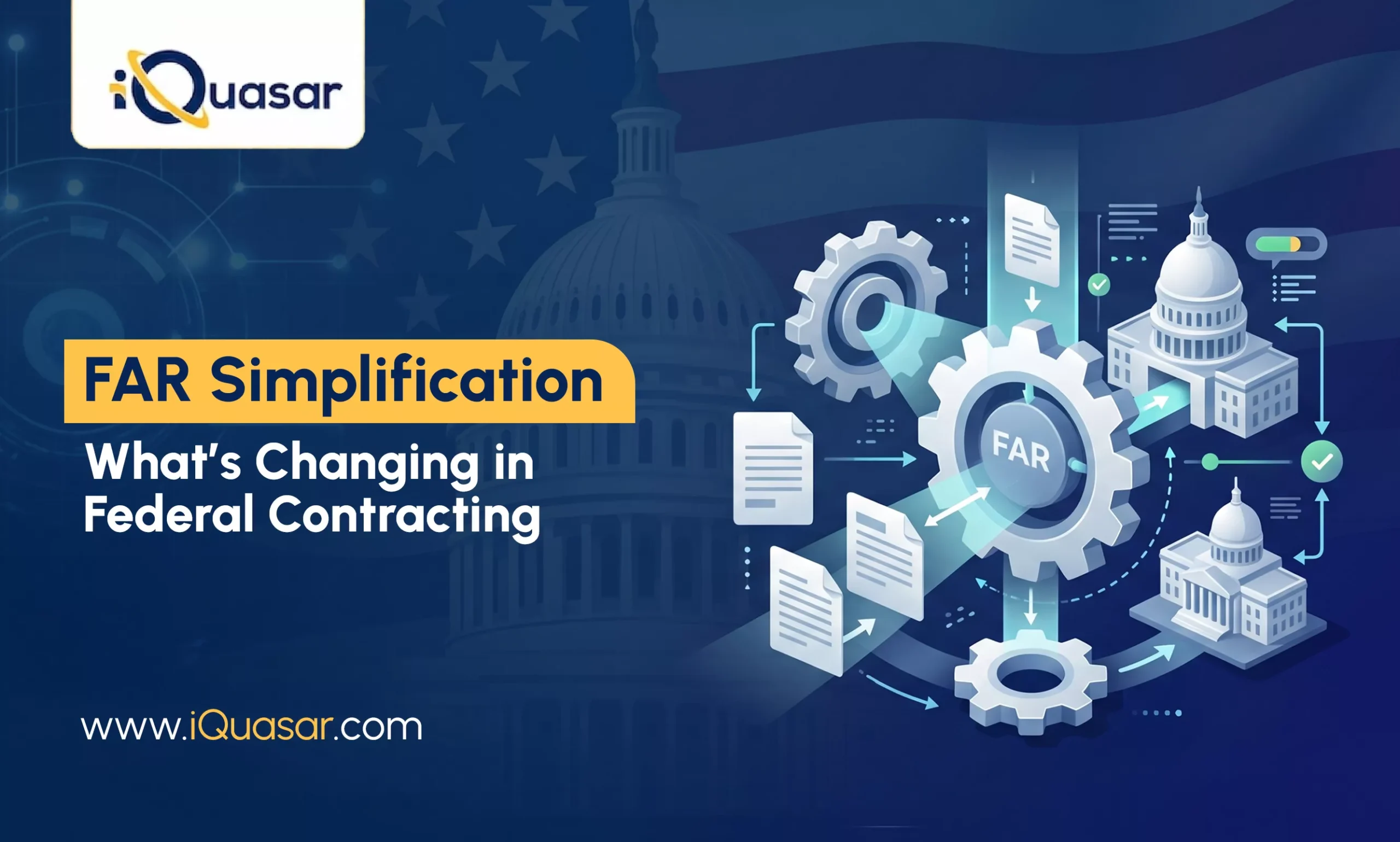
As part of a broader push to modernize federal procurement, the government has launched a FAR simplification initiative aimed at making acquisition rules clearer, more consistent, and easier to apply in practice.
In this blog, we break down why this initiative is happening, what it means in practice, and how contractors should adapt as federal contracting language evolves.
Why the FAR Simplification Initiative is Happening
The Federal Acquisition Regulation has grown steadily since its original publication in the 1980s. Over decades of policy updates, legislative changes, and agency-specific guidance, the FAR accumulated layers of clauses, cross-references, and duplicative requirements. While these updates addressed emerging needs, they also created a regulatory structure that many acquisition professionals and contractors find difficult to interpret consistently.
This complexity can slow procurement cycles and introduce uncertainty in how requirements are applied. Contracting officers, evaluators, and industry participants may interpret the same clause differently, leading to inconsistent proposal evaluations or disputes during contract performance.
The simplification initiative seeks to address these challenges by improving clarity and reducing unnecessary complexity. Rather than eliminating oversight or compliance expectations, the goal is to ensure that acquisition rules communicate expectations clearly and can be applied consistently across agencies and procurements.
What the FAR Simplification Initiative Means for Contractors
FAR simplification is not a single rule change but an ongoing modernization effort. At its core, the initiative focuses on reorganizing regulatory sections, rewriting dense language in clearer terms, and eliminating provisions that duplicate or conflict with other requirements.
This process involves examining existing FAR sections and determining whether certain clauses remain necessary, overlap with other provisions, or can be consolidated into more straightforward language. The aim is to make the regulation easier for acquisition professionals and contractors to navigate while preserving the safeguards that ensure accountability in federal procurement.
For contractors, the practical implication is that solicitations may begin to use clearer wording and more direct statements of expectation. Requirements that once spanned multiple clauses may be consolidated, making solicitation instructions easier to interpret.
Plain-Language Restructuring of Federal Acquisition Rules
One of the most visible aspects of FAR reform is the push toward plain-language drafting. Historically, regulatory language often relied on complex phrasing and legal terminology that could be difficult for non-specialists to interpret.
Plain-language restructuring aims to present requirements in simpler terms without altering the substance of the rules. When acquisition language becomes clearer, contractors can better understand what agencies expect in proposals and how performance will be evaluated once a contract is awarded.
This shift also improves consistency across agencies. When regulatory language is easier to interpret, the likelihood of conflicting interpretations between contracting offices, evaluators, and industry teams decreases. As a result, proposal commitments can align more directly with contractual obligations, reducing misunderstandings later in the contract lifecycle.
Reduction of Redundant and Outdated Clauses
Over time, similar requirements have appeared in multiple sections of the FAR as agencies addressed emerging policy priorities. While each update served a purpose when introduced, the cumulative effect has been a regulatory framework that sometimes repeats or overlaps requirements.
The simplification initiative aims to consolidate these provisions to reduce the number of duplicative clauses across solicitations. By removing outdated or redundant language, agencies can streamline procurement documentation and reduce the administrative burden associated with compliance.
For contractors, this change can simplify the process of interpreting solicitations and preparing proposals. When requirements are presented more coherently, proposal teams can focus on demonstrating capability and value rather than navigating overlapping regulatory references.
How FAR Simplification Aligns with Modern Federal Acquisition Practices
Federal procurement today operates in a very different environment from when the FAR was first developed. Technology procurement, agile development approaches, cybersecurity standards, and supply chain risk management have become central elements of modern government programs.
Regulatory modernization reflects these realities. The simplification effort seeks to ensure that acquisition rules align with contemporary procurement practices rather than relying solely on frameworks designed decades earlier. By updating language and removing unnecessary complexity, agencies can better support faster procurement cycles and more flexible acquisition strategies.
This alignment also benefits contractors by providing clearer expectations regarding performance outcomes, evaluation criteria, and compliance obligations in emerging areas such as cybersecurity and technology delivery.
What FAR Simplification means for Government Contractors
For contractors, the most immediate impact of FAR simplification will appear in how solicitations are written and interpreted. As language becomes clearer, requirements may become more explicit about performance expectations and evaluation criteria.
This shift reduces the effectiveness of generic compliance statements in proposals. Instead, proposal teams will need to demonstrate how their solutions deliver measurable outcomes that align with clearly stated requirements. When solicitations communicate expectations more directly, evaluators are better positioned to compare competing proposals based on evidence rather than interpretation.
Compliance teams will also benefit from clearer regulatory language. When obligations are easier to interpret, contractors can design internal processes and controls that better align with contractual expectations.
Strategic Considerations for Contractors
Adapting to regulatory modernization requires contractors to remain attentive to evolving acquisition guidance and solicitation language. Organizations should monitor updates to acquisition regulations and ensure that proposal teams, compliance specialists, and capture managers understand how these changes influence proposal development and contract performance.
Training proposal writers to interpret clearer regulatory language will become increasingly important. As solicitations rely less on ambiguous phrasing, proposals that demonstrate concrete execution plans and measurable outcomes will stand out more clearly during evaluation.
Many contractors are already reassessing their proposal and compliance strategies in response to these changes, particularly as FAR modernization continues to reshape how requirements are written and evaluated.
Contractors should also review internal compliance frameworks to ensure they align with the simplified regulatory structure. Aligning capture strategy, proposal development, and compliance processes with modernized acquisition language can help organizations remain competitive as federal procurement evolves.
Also Read: FAR Part 19 Overhaul – What It Means for Small Businesses
Frequently Asked Questions about the FAR Simplification Initiative:
What is the FAR simplification initiative?
The FAR simplification initiative is a federal effort to modernize acquisition regulations by simplifying language, removing redundancies, and improving clarity for agencies and contractors.
Why is the government simplifying the Federal Acquisition Regulation?
The government is simplifying the FAR to reduce complexity, eliminate duplicative clauses, and improve consistency in the application of procurement rules across agencies. Clearer regulations can accelerate procurement timelines and improve accountability for compliance.
Does FAR simplification reduce contractors’ compliance requirements?
No. The goal is not to reduce oversight but to make requirements easier to understand and implement. Contractors will still need to meet the same compliance obligations, but those obligations should be presented more clearly.
How will FAR reform affect proposal writing?
Clearer solicitation language will require proposal teams to align responses more closely with explicit requirements and measurable outcomes. Generic compliance statements will become less effective as agencies emphasize concrete execution strategies.
When will contractors start seeing these changes?
FAR modernization is occurring gradually through phased updates and regulatory revisions. Contractors may begin noticing clearer solicitation language and reorganized clauses as agencies incorporate these changes into new procurements.
As FAR modernization progresses through phased updates, contractors can expect continued refinements in solicitation structure, evaluation clarity, and compliance expectations across agencies.
The FAR simplification initiative marks a meaningful shift toward a more streamlined and transparent federal procurement environment. By improving clarity, reducing redundancy, and aligning regulatory language with modern acquisition practices, the government is making it easier for both agencies and contractors to operate within a consistent and predictable framework.
For contractors, success in this evolving landscape will depend on the ability to interpret clearer requirements, align proposals with measurable outcomes, and maintain compliance within a modernized regulatory structure. Those who proactively adapt their capture, proposal, and compliance strategies will be better positioned to compete as these reforms continue to take shape.
As these changes unfold, having the right guidance can make a measurable difference. iQuasar’s Government Contracting Consulting Services support organizations in navigating regulatory updates, strengthening compliance frameworks, and aligning acquisition strategies with evolving federal procurement expectations.
To learn how these changes may impact your organization, reach out to our team today.