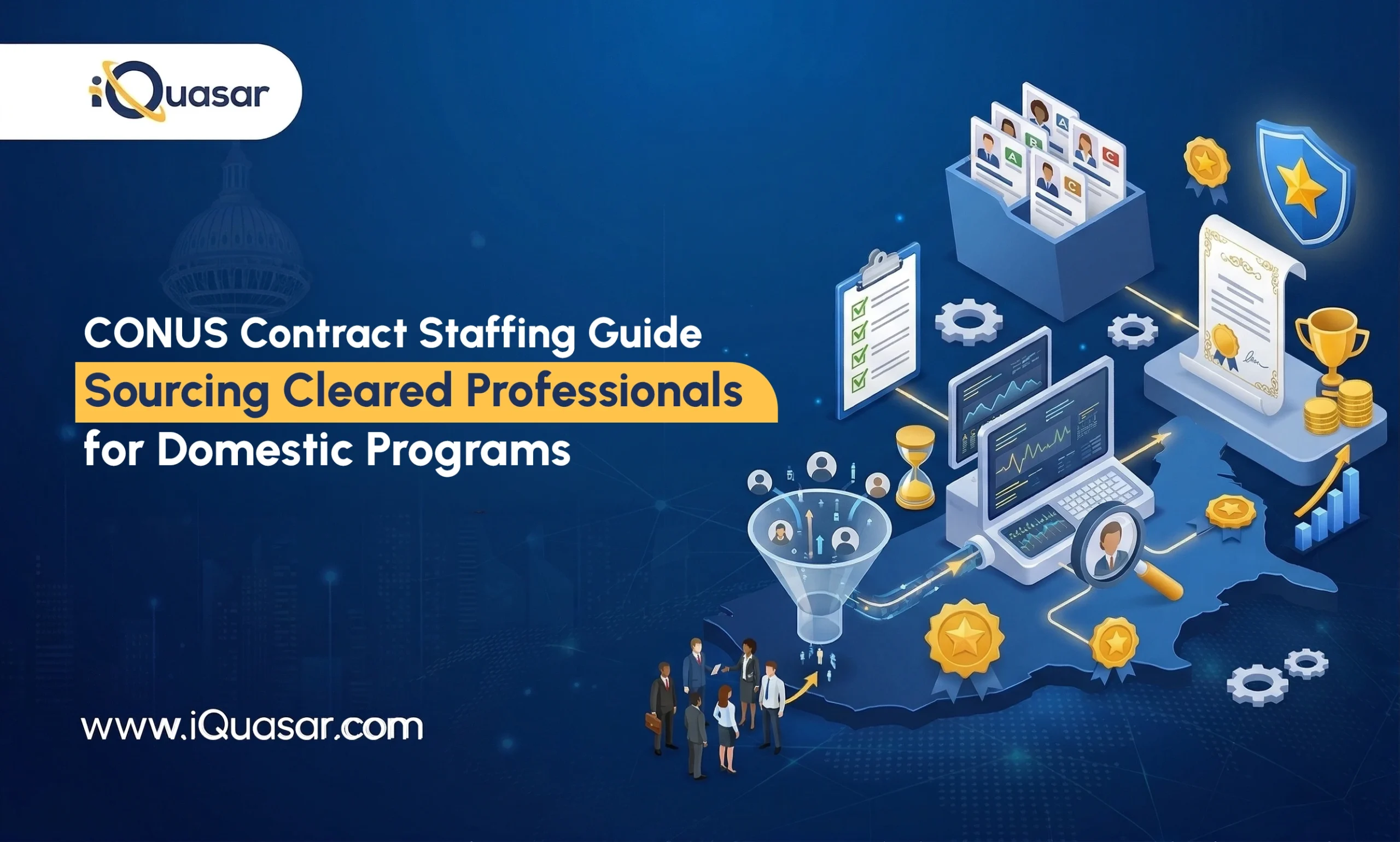
The vast majority of government contractor staffing happens right here, within the Continental United States (CONUS). But ‘domestic’ doesn’t mean ‘easy.’ CONUS cleared staffing carries its own set of structural challenges: geographic talent concentration, highly competitive local markets around major federal installations, and cleared candidate mobility constraints that make finding the right person at the right location a non-trivial challenge. This guide offers a strategic framework for sourcing and placing cleared professionals on CONUS federal programs. In this blog, we explore the geographic and logistical nuances of domestic cleared staffing to help government contractors secure elite talent across the most competitive federal hubs.
The Top 5 Strategic Pillars of CONUS Cleared Staffing
To maintain a competitive edge in the 2026 domestic market, contractors must treat each federal hub as a unique ecosystem with its own rules for engagement. To help your team optimize your domestic recruitment strategy, here are the five strategic pillars:
1. The Geography of Cleared Talent in the United States
Cleared talent in the United States is not evenly distributed. It is heavily concentrated in a small number of geographic markets built around federal government and military installation hubs. Understanding this geography is the foundation of effective CONUS cleared staffing:
- National Capital Region (DC, MD, VA): The largest single concentration of cleared professionals in the country; supports the Pentagon, intelligence community, and federal civilian agency contractors
- Colorado Springs / Denver Front Range: Significant Space Force, NORAD, NORTHCOM, and intelligence community contractor population
- Huntsville, AL: NASA, Army, and missile defense contractor hub; tight labor market with strong aerospace engineering focus
- San Diego, CA: Navy, SOCOM, and cybersecurity contractor community; significant TS/SCI population
- Hampton Roads, VA: SURFPAC, USSOCOM, and the major Navy contractor community; dense, cleared IT and engineering workforce
- San Antonio, TX: NSA Texas, AFCYBER, and intelligence community contractor presence
- Omaha, NE: USSTRATCOM contractor community; smaller but specialized cleared workforce
- Dayton, OH: Wright-Patterson AFB; significant AFRL and defense systems contractor population
For each of these markets, the local talent pool has specific characteristics, dominant cleared disciplines, typical clearance level distributions, active competitor employers, and local compensation norms. Effective CONUS cleared staffing requires market-specific knowledge, not generic national recruiting assumptions.
2. Candidate Mobility: The Understated CONUS Challenge
Unlike OCONUS assignments, where geographic mobility is an explicit job requirement, CONUS programs often appear to offer candidates geographic stability, which creates a different kind of mobility challenge. Cleared professionals are frequently unwilling to relocate even within the CONUS market:
- Candidates with school-age children are significantly less likely to relocate than the general workforce
- Dual-income households where one partner holds a government position (a common profile in cleared communities) face relocation constraints tied to the partner’s position
- Clearance community social networks are locally anchored, and cleared professionals often prefer employment within their existing community
- Contractor transitions within a geographic market are far more common than cross-market relocations
Practical Implication: For every CONUS cleared role, the realistic candidate pool is primarily local, within 30–50 miles of the place of performance in most markets. Sourcing strategies must reflect this geographic constraint, not assume national mobility.
3. CONUS Market-Specific Sourcing Strategies
Given the geographic concentration of cleared talent, effective CONUS sourcing looks different by market:
- NCR Programs: leverage the depth of the local cleared market with referral networks, cleared-specific community events, and relationships with the large incumbent contractor workforce
- Smaller Hub Markets (Huntsville, Colorado Springs, Dayton): sourcing is relationship-driven and insider-network-dependent; external recruiters with no existing community presence struggle significantly in these markets
- Naval/Military Installation Markets (San Diego, Hampton Roads): military transition pipeline is strong; recent O3-O6 and E7-E9 service members with active clearances represent a high-quality candidate source
- Growth Markets (San Antonio, Omaha): smaller established cleared communities mean contractors must invest more in relocation incentives or invest earlier in local talent development
4. The Role of Cleared Staffing Specialists in CONUS Programs
One of the less-discussed advantages of working with cleared staffing specialists on CONUS programs is their market-specific intelligence. Firms operating continuously in cleared talent markets accumulate knowledge that general HR teams rarely have access to:
- Real-time compensation benchmarks by location, clearance level, and discipline
- Active knowledge of which contractors are growing, contracting, or facing recompetes in each market
- Established relationships with passive candidates in each major market who aren’t actively applying
- Awareness of local events, base realignments, contract awards, and program cancellations that create talent availability windows
For current DoD program locations and acquisition activity, the USASpending.gov federal contract database provides valuable market intelligence for CONUS sourcing planning.
Also Read: iQuasar’s OCONUS Recruitment Success: 70+ Positions Filled
5. Remote Work and Hybrid Models in CONUS Cleared Programs
Post-2020, contractor expectations around remote and hybrid work have shifted substantially. For CONUS cleared programs, understanding what is and isn’t feasible is critical to candidate attraction:
- Unclassified work elements on cleared contracts may be performed remotely, expanding the effective geographic pool
- Classified work requiring SCIF access cannot be performed remotely; this is non-negotiable
- Many programs have mixed environments: candidates may be able to work 2–3 days remotely on unclassified tasks and require in-person work only for classified program activities
- Clearly communicating remote/hybrid eligibility in job postings significantly expands candidate response rates in CONUS markets
The Bottom Line: CONUS cleared staffing is not simply a function of posting to cleared job boards and waiting. It requires geographic market intelligence, local community relationships, candidate mobility awareness, and sourcing strategies calibrated to each specific federal hub. Contractors who bring this level of specificity to their domestic cleared hiring will consistently outperform those operating on generic assumptions.
Work With iQuasar Cleared Recruitment Services
iQuasar Cleared Recruitment Services operates across all major CONUS cleared talent markets, from the NCR to Huntsville, Colorado Springs, San Diego, and beyond. Our market-specific community relationships and real-time compensation intelligence give your CONUS programs a sourcing advantage that national job board strategies simply cannot match.
Whether you’re staffing a new contract award, managing a critical vacancy, or building a long-term pipeline strategy, iQuasar can compress your time-to-fill without sacrificing candidate quality or compliance rigor. Reach out to the iQuasar Cleared Recruitment team to discuss your next hire.